ProductNot yet confirmed elsewhere1 publisher2 min readPublished
Chinese researchers fuse small photon graphs into a 13-qubit entangled state without destroying the photons
Chinese researchers fused small groups of entangled microwave photons into a 13-qubit network using a measurement that leaves the photons intact. Building photonic quantum machines from prepared modules now looks more practical, though the demonstration is still small.
The Product Desk
What happened
- Conventional fusion in linear-optical systems often works probabilistically, so some joins fail and larger states need repeated attempts and extra hardware.
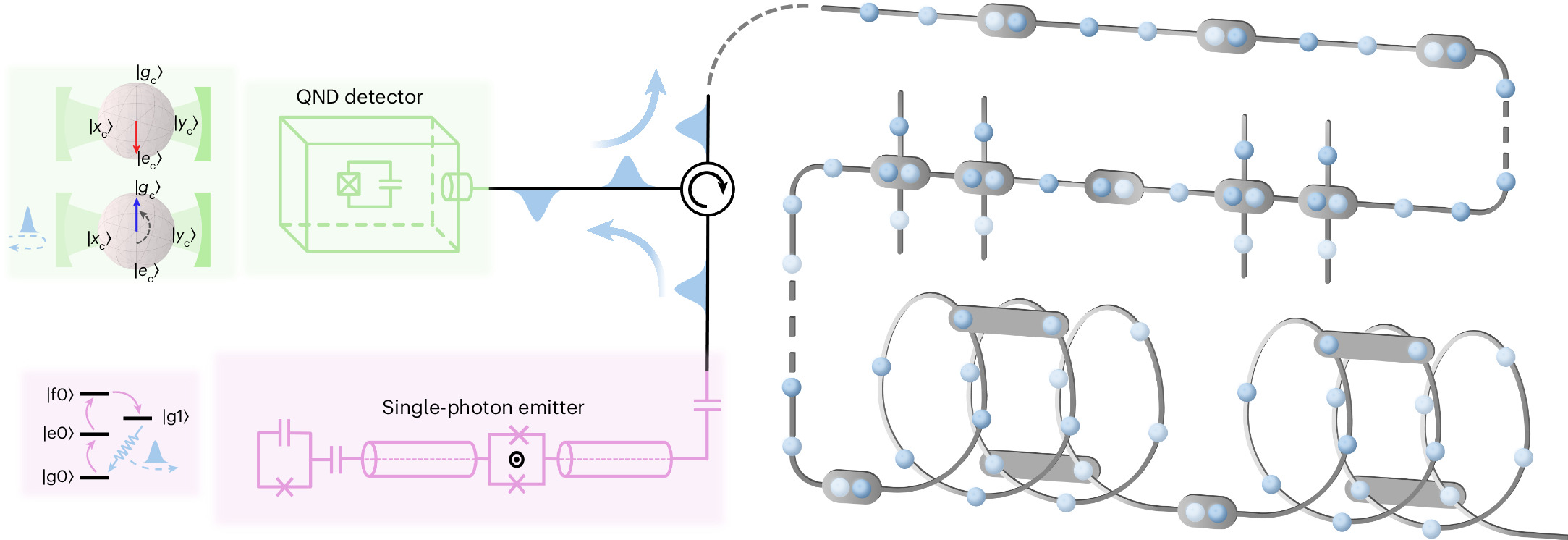
- The new setup uses a superconducting circuit with a nondemolition detector that projects selected photon pairs into a Bell state, joining small graph states while keeping the photons.
- Tuning the photons' frequencies decides which pairs go through the detector, so the researchers can program how the smaller graphs connect.
- The team actively reset and reused its superconducting qubits and applied built-in error mitigation to limit decoherence.
Why it matters
- capability A fusion step that works on demand lets a designer plan a large graph state as a fixed sequence of joins, without budgeting for failed attempts and spare hardware.
- constraint Any plan built on modular photonic assembly currently rests on a 13-qubit demonstration, so its assumptions about larger sizes are untested by this result.
- exposure Because the result relied on qubit reuse and error mitigation, claims built on it carry uncertainty about how the unassisted hardware performs.
The group started from a practical question. "We asked whether fusion could instead be made deterministic by using a quantum non-demolition measurement," Hongyi Zhang, the senior author and a quantum researcher at Tsinghua University, told Phys.org, according to Interesting Engineering [10][11].
Deterministic is the word a systems builder cares about. A join that can fail has to be retried, and in linear-optical systems those retries add up to extra hardware [3]. A join that works every time can go into a build plan as a fixed step.
There is a gap between what is being pitched and what was done. The pitch for this kind of work is large photonic graph states as a base for measurement-based quantum computing and quantum networks [13]. What was done is smaller: genuine multipartite entanglement across 13 photonic qubits, meaning the entanglement extends across the whole group [2][8]. The modular idea is part of the design. The circuit prepares small graph states first and connects them, instead of producing one large state in a single process [12]. "The work offers an architecture for scaling photonic graph states by connecting smaller, on-demand resource states," Zhang said [14].
Interesting Engineering's account does not report fidelities, the time each fusion takes, or how much of the 13-qubit result depends on the error mitigation the team applied [7].
In our view, the people who should act on this now are groups designing measurement-based photonic architectures. For them, a deterministic, programmable join changes what a build plan looks like. For an operator reading quantum vendor roadmaps, it is a research demonstration. It is useful mainly because it sharpens what to ask about how a system's pieces get joined.
We'd sort any modular quantum claim on a 2x2. One axis is how reliable the join is: deterministic or probabilistic. The other is what happens to the parts: preserved or consumed. Probabilistic joins sit in the corner where each larger state is harder to build than the last [3]. Measurements that absorb or destroy the photons sit on the consumed side [4]. Zhang places this work in the opposite corner. "Our main contribution is a fusion operation that is deterministic, programmable and nondestructive," he said [9]. The forcing function we'd apply is a cost test. A modular claim belongs in a plan once the group shows that each added fusion costs no more than the one before it.
What to watch
- A follow-up from the same group reporting a fused state larger than 13 qubits, with fidelity given both before and after error mitigation.
- Whether other groups reproduce deterministic, nondestructive fusion of microwave photon graph states on their own hardware.
Clarity's read
What the record supports and how the coverage leans. The claims behind it follow.
Reality
- Evidence50
- Adoption
- Insufficient
- Hype gap+10
- Incentives
- Insufficient
- Confidence45
Claim ledger
Ranked by verification strength, evidence, and original report placement.
- [1]
A team of Chinese researchers demonstrated a way to join smaller groups of entangled microwave photons into larger, programmable quantum networks without destroying the photons during the connection process.
- [2]
The researchers showed genuine entanglement across 13 photonic qubits.
- [3]
Conventional fusion methods used in linear-optical systems often work probabilistically, meaning some attempts fail; repeated attempts and additional hardware can make building larger states increasingly demanding.
- [4]
The approach uses a superconducting circuit and quantum nondemolition measurement, which, unlike a measurement that absorbs or destroys the photons, extracts information while preserving the photons; the measurement also transforms the pair's joint quantum state, allowing smaller graph states to be connected.
- [5]
The researchers used a quantum nondemolition detector in a superconducting circuit to measure selected photon pairs and project them into a Bell state, joining smaller graph states without destroying the photons.
- [6]
By adjusting the photons' frequencies, the researchers select which pairs undergo the measurement, controlling how smaller graph states connect, which makes the fusion process programmable.
- [7]
The team incorporated active resetting and reuse of superconducting qubits, along with built-in error mitigation, to help limit the effects of decoherence.
- [8]
Genuine multipartite entanglement means the entanglement extended across the entire group of 13 photonic qubits rather than being limited to isolated, smaller groups.
- [9]
"Our main contribution is a fusion operation that is deterministic, programmable and nondestructive," Zhang said.
ReportedSupportedSource: Hongyi Zhang, quoted by Interesting Engineering from Phys.orgView cited source - [10]
"We asked whether fusion could instead be made deterministic by using a quantum non-demolition measurement," Zhang said.
ReportedSupportedSource: Hongyi Zhang, quoted by Interesting Engineering from Phys.orgView cited source - [11]
Hongyi Zhang is the senior study author and a quantum researcher at Tsinghua University, and spoke to Phys.org.
- [12]
Rather than creating one enormous entangled state in a single process, the approach builds a larger network by connecting smaller, prepared states.
- [13]
Large photonic graph states could support measurement-based quantum computing, in which computations are performed through chosen measurements on an entangled state, and could help advance quantum networks and quantum error-correction schemes.
ReportedInsufficientSource: Interesting Engineering2 sources— create a free account to open themView cited source - [14]
"The work offers an architecture for scaling photonic graph states by connecting smaller, on-demand resource states," Zhang said.
ReportedInsufficientSource: Hongyi Zhang, quoted by Interesting Engineering from Phys.org2 sources— create a free account to open themView cited source
Sources
1 independent publisher whose own reporting we read for this story.
- interestingengineering.comScientists achieve 13-qubit genuine entanglement without destroying their photons
1 article · October 10, 2026
Topics and entities
Follow any of these and your For You feed starts watching them — no settings page required.