ScienceNot yet confirmed elsewhere1 publisher3 min readPublished
Oxford physicists reproduce the Aharonov-Bohm effect on a single loop of a simulated gauge theory
Oxford physicists reproduced the Aharonov-Bohm effect in a trapped-ion simulation of one gauge-theory loop built from two qubits and two oscillators. The simulated field was itself quantum and evolved with the matter, on a system far smaller than the lattices that strain classical computers.
The Scientist · Science desk
What happened
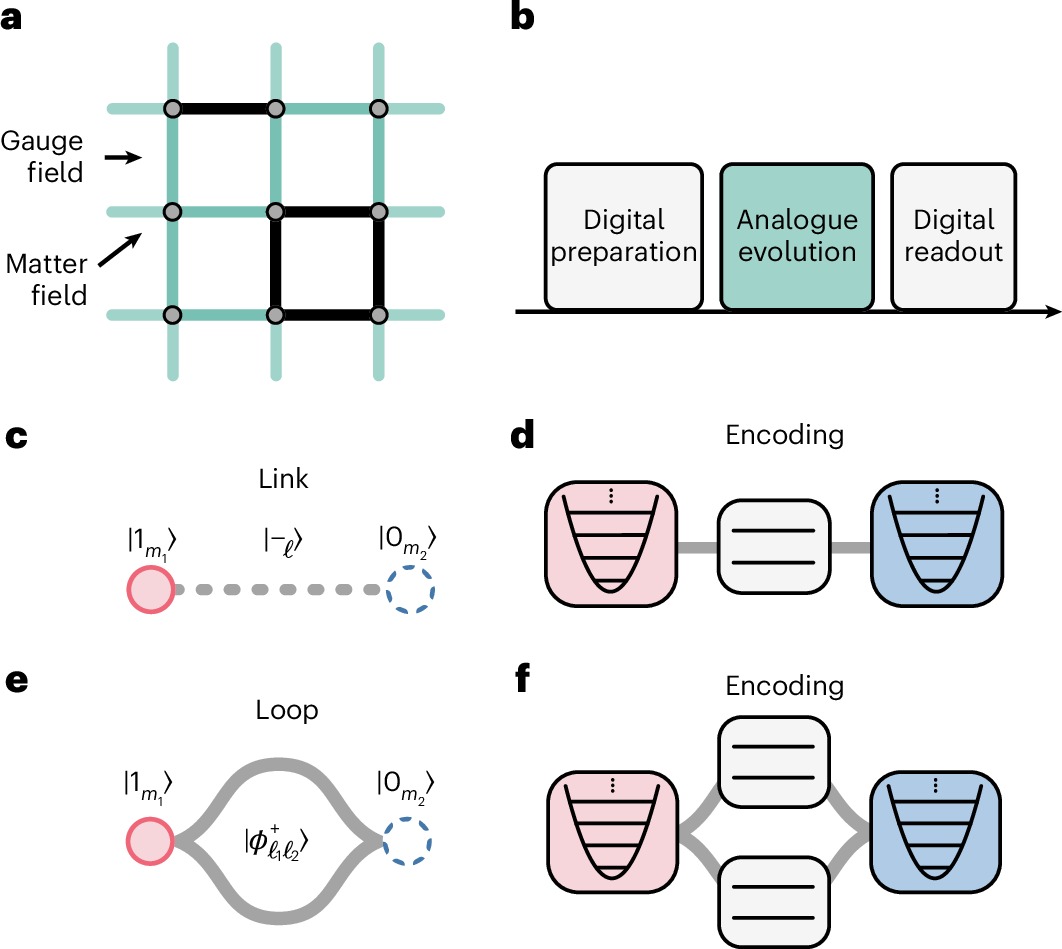
- Qubits held in the internal states of trapped ions stood for the gauge field, and the vibrations of those same ions stood for matter.
- With no flux a matter particle tunneled freely around the loop, but with flux the two paths interfered destructively and the system stayed frozen in its starting state.
- A University of Maryland group led by Norbert Linke, working independently, published a hybrid-system simulation of the Yukawa potential alongside the Oxford paper.
Why it matters
- capability Because the flux lives in qubits that are themselves quantum, the setup can study gauge theories in which field and matter change together, a case that fixed-background simulations leave out.
- constraint Classical calculation gets hard only as lattices grow, so a one-loop result shows the encoding works without yet testing any problem a classical computer cannot handle.
- precedent Two groups reaching Nature Physics independently with hybrid hardware makes that hardware a likelier choice for the next lattice gauge experiments.
In a lattice gauge theory, matter sits on the points of a grid and the fields sit on the links between them [6]. Oxford's design put both on the same trapped ions [9]. One loop of the grid, two matter sites joined by two links, is the theory's elementary building block [10], so the entire simulation ran on four encoded components [18]. The work dates to 2022, when lead author Sebastian Saner, Oana Bazavan and colleagues at Oxford began building it with Alejandro Bermudez of the Instituto de Fisica Teorica in Madrid [8].
The experiment has its own control. The same loop was run with and without the flux [15]. Without it, a matter particle tunneled freely around the loop. With it, the two paths interfered destructively and the system stayed frozen in its starting state, according to Phys.org [15]. That suppression is the Aharonov-Bohm signature: a phase picked up by going around a flux without ever entering a region of magnetic field [4]. Aharonov and Bohm predicted it in 1959, and experiments with real electrons later confirmed it [5].
The interesting physics came out of a hardware limit. Producing the flux as a fixed background would have needed an interaction the hardware could not provide, so the team prepared the two qubits in an entangled state that the theory reads as a flux piercing the loop [11][12]. "For us, the exciting step was to encode the magnetic flux in a gauge field that was itself dynamical," Saner said [13]. "Rather than having matter evolve in a fixed background, the matter and gauge field become part of the same quantum dynamics," he said [14].
Phys.org presents the Nature Physics result as showing how hybrid machines can simulate matter-field interactions that become increasingly hard to model on classical computers [3][1]. In the same account, that difficulty arrives as the systems grow [7]. This system is the smallest the theory has [10]. We think the paper establishes two things: the encoding works, and a dynamical field produces the predicted interference. Whether the method holds on lattices large enough to strain a classical computer is untested here [10][7]. The account does not report error bars, or how close the measured state came to the complete suppression it describes [15].
The Oxford paper runs alongside one from a University of Maryland group led by Norbert Linke. That group simulated the Yukawa potential, an interaction that bears on nuclear and particle physics, on a hybrid quantum system [16]. In our view the pairing is better evidence for hybrid hardware than either result alone. The two groups developed their approaches independently before coordinating their submissions to Nature Physics [17].
What to watch
- Whether the Oxford group extends the qubit-flux encoding from one loop to multi-loop lattices, the size at which classical calculation starts to struggle.
- Fidelity and error figures in the Nature Physics paper showing how complete the measured suppression of tunneling actually was.
- How large the Maryland Yukawa simulation can be made, and whether the two groups' hybrid approaches can be combined on one machine.
Clarity's read
What the record supports and how the coverage leans. The claims behind it follow.
Reality
- Evidence58
- Adoption
- Insufficient
- Hype gap+18
- Incentives
- Insufficient
- Confidence55
Claim ledger
Ranked by verification strength, evidence, and original report placement.
- [1]
The result demonstrates how hybrid quantum systems can be used to simulate interactions between matter and gauge fields that become increasingly difficult to model on classical computers.
ReportedSupportedSource: phys.org framing2 sources— create a free account to open themView cited source - [2]
Physicists in the Department of Physics at the University of Oxford used a hybrid quantum computer made of qubits and quantum oscillators to observe the Aharonov-Bohm effect in a quantum simulation.
- [3]
The Oxford paper has been published in Nature Physics.
- [4]
The Aharonov-Bohm effect is a quantum phenomenon in which a particle acquires a measurable phase by traveling around a magnetic flux, even though it never passes through a region where a magnetic field is present.
- [5]
Yakir Aharonov and David Bohm predicted the effect in 1959; it was later confirmed in experiments with real electrons.
- [6]
Lattice gauge theories describe interactions between matter and gauge fields; matter sits at the points of a grid and the fields live on the links connecting those points.
- [7]
As lattice gauge systems grow, their behavior becomes increasingly difficult to calculate on a classical computer.
- [8]
Beginning in 2022, lead author Sebastian Saner, Oana Bazavan and colleagues in Oxford, working with Alejandro Bermudez of the Instituto de Fisica Teorica in Madrid, developed the experiment.
- [9]
Qubits encoded in the internal states of trapped ions represented the gauge fields, while quantum oscillators, the vibrations of those same ions, represented the matter.
- [10]
The team built a loop, the elementary building block of the theory, from two oscillators representing matter at two points, connected by two qubits representing the fields between them.
- [11]
The team prepared the two qubits in an entangled state, which in the language of the lattice gauge theory corresponds to a magnetic flux piercing the loop.
- [12]
Producing the flux conventionally, as a fixed background, would have required an interaction the hardware could not provide, so encoding it in the qubits began as a practical workaround.
- [13]
"For us, the exciting step was to encode the magnetic flux in a gauge field that was itself dynamical,"
- [14]
"Rather than having matter evolve in a fixed background, the matter and gauge field become part of the same quantum dynamics."
- [15]
With no flux present, a matter particle tunneled freely around the loop; with the flux present, the two paths interfered destructively, suppressing the tunneling completely and leaving the system frozen in its starting state.
- [16]
The paper appears alongside related work from a University of Maryland group led by Norbert Linke, which used a hybrid quantum system to simulate the Yukawa potential, an interaction relevant to nuclear and particle physics.
- [17]
The Oxford and Maryland groups developed their approaches independently before coordinating their submissions to Nature Physics.
- [18]
The simulated loop used four encoded components in total: two oscillators for matter and two qubits for the field.
Sources
1 independent publisher whose own reporting we read for this story.
- phys.orgHybrid quantum computer observes foundational quantum effect in a new setting
1 article · October 10, 2026
Topics and entities
Follow any of these and your For You feed starts watching them — no settings page required.
Topics
- Quantum SimulationFollow
- Lattice gauge theoryFollow
- Trapped-ion quantum computingFollow
- Aharonov–Bohm effectFollow
Entities
- University of OxfordFollow
- Instituto de Física TeóricaFollow
- University of MarylandFollow
- Nature PhysicsFollow
- Sebastian SanerFollow
- Oana BazavanFollow
- Alejandro BermudezFollow
- Norbert LinkeFollow
- Yakir AharonovFollow
- David BohmFollow