ScienceNot yet confirmed elsewhere1 publisher2 min readPublished
Tsinghua and Hefei physicists fuse small microwave-photon clusters into a 13-qubit entangled graph state
Researchers at Tsinghua University and Hefei National Laboratory used a superconducting circuit to fuse small photon clusters into a 13-qubit entangled state. According to co-senior author Hongyi Zhang, the joining step is deterministic, where optical fusion schemes often fail and must be retried.
The Scientist · Science desk
What happened
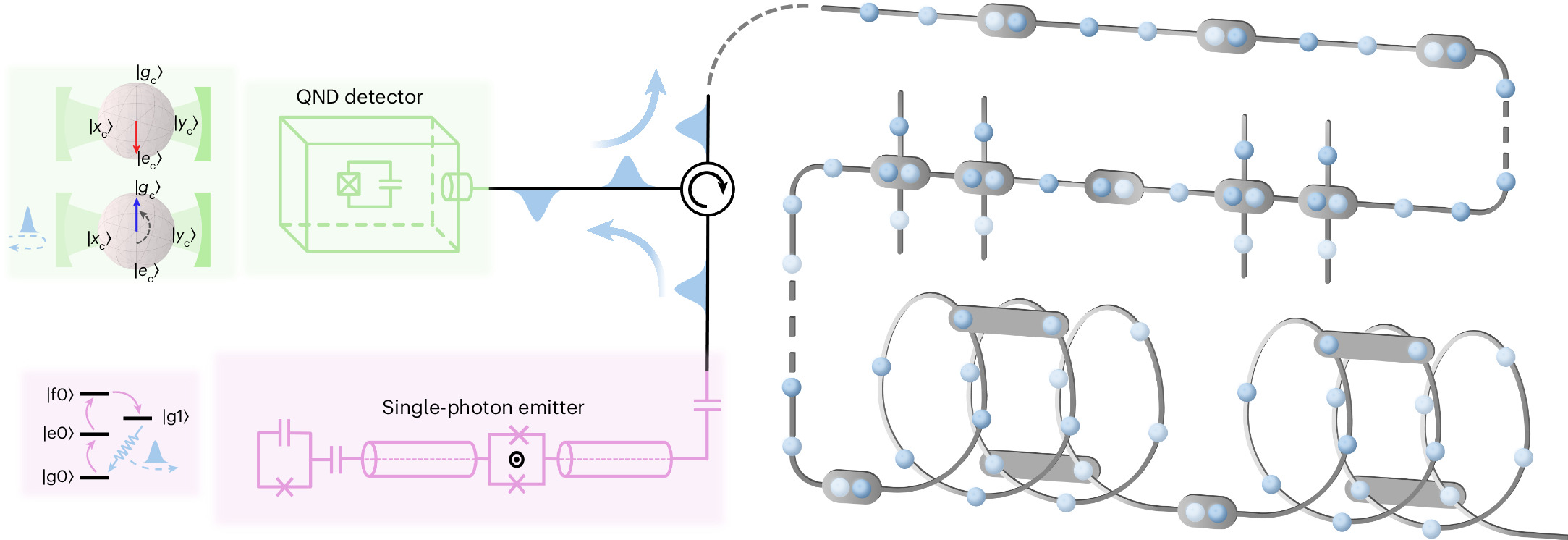
- A quantum non-demolition detector measures the parity of selected photon pairs, entangling them without destroying them and joining two small graph states into one.
- Tuning the photons' frequencies lets the team choose which ones get fused, so the links in the final graph can be rearranged.
- The entanglement is genuinely multipartite, meaning it extends across the whole group of photons and is not confined to separate subgroups.
- The work is described in a paper published in Nature Physics.
Compiled by The ScientistSomething wrong?How this is made
Why it matters
- capability A fusion step that succeeds on demand would let builders add modules to a graph state one at a time, avoiding the retries that drive up resource overhead in probabilistic schemes.
- constraint Without per-fusion error figures, the 13-qubit result cannot tell anyone how many fusions can be chained before accumulated noise outweighs the benefit of determinism.
- precedent Zhang's pointer to error-correction schemes, where graph size and connectivity both matter, makes larger, deliberately shaped graphs the expected next test of the method.
Zhang described the problem in terms of overhead. "A promising way to build them is 'fusion': rather than making one very large, entangled state in a single step, one connects smaller resource states together. The difficulty is that conventional fusion methods are probabilistic, so many attempts fail and the resource overhead grows rapidly," he told Phys.org [7].
The group changed the instrument that does the joining. "We asked whether fusion could instead be made deterministic by using a quantum non-demolition measurement," Zhang said [1]. Their superconducting circuits first produce microwave photons in small entangled states [10]. The parity measurement leaves the photons intact [5]. On that basis Zhang presents the result as something to build on: the work "offers an architecture for scaling photonic graph states by connecting smaller, on-demand resource states," he said [12].
The 13-qubit state demonstrates the step, and the step is what the authors are claiming [4]. "Our main contribution is a fusion operation that is deterministic, programmable and nondestructive," Zhang said [2]. The published account does not give the fidelity of the final state, the size of the starting clusters, or how many fusions went into the 13-qubit result [4].
I think those missing figures matter more than the qubit count. A fusion step that always fires can still add noise every time it fires. If it does, the noise per fusion, more than the success rate, would decide how many fusions can be chained before the graph degrades.
Connectivity is the other half of the case. "This is relevant to future measurement-based quantum computing, quantum networking and potentially quantum error-correction schemes, where both the size and the connectivity of graph states matter," Zhang said [13]. Frequency tuning is how the device addresses connectivity, because it picks which photons are joined [6]. Phys.org's own forecast goes further, to quantum processors and long-distance quantum communication networks [14]. A network would also have to move these photons between separate machines, and the experiment behind that forecast built a single 13-qubit state [4].
What to watch
- Published fidelity and per-fusion error figures for the 13-qubit state. Those numbers would show how far the fusion can be repeated.
- A follow-up that chains many more fusions, testing Zhang's claim that the approach avoids rapidly growing resource overhead.
- Any experiment that sends these microwave photons between separate devices, which the long-distance networking forecast depends on.
Clarity's read
What the record supports and how the coverage leans. The claims behind it follow.
Reality
- Evidence55
- Adoption
- Insufficient
- Hype gap+15
- Incentives
- Insufficient
- Confidence50
Claim ledger
Ranked by verification strength, evidence, and original report placement.
- [1]
"We asked whether fusion could instead be made deterministic by using a quantum non-demolition measurement,"
ReportedSupportedSource: Hongyi Zhang, told Phys.org2 sources— create a free account to open themView cited source - [2]
"Our main contribution is a fusion operation that is deterministic, programmable and nondestructive,"
ReportedSupportedSource: Hongyi Zhang, told Phys.org2 sources— create a free account to open themView cited source - [3]
Researchers at Tsinghua University and Hefei National Laboratory introduced a strategy to link smaller entangled groups of microwave photons into larger, adjustable graph states using a superconducting circuit.
- [4]
Using the approach, the team demonstrated genuine multipartite entanglement across 13 photonic qubits, meaning the entanglement spanned the entire group rather than being confined to smaller, separate groups of photons.
- [5]
A quantum non-demolition detector performs a parity measurement on selected photon pairs, entangling them without destroying them and thereby connecting two smaller graph states into a larger one.
- [6]
Frequency tuning lets the team choose which photons to fuse, so connections between qubits in the resulting graph states can be adjusted.
- [7]
"A promising way to build them is 'fusion': rather than making one very large, entangled state in a single step, one connects smaller resource states together. The difficulty is that conventional fusion methods are probabilistic, so many attempts fail and the resource overhead grows rapidly."
- [8]
Conventional fusion approaches that rely on optical components such as mirrors and beam splitters do not always enable fusion, often requiring repeated attempts or additional equipment.
- [9]
The team's approach is outlined in a paper published in Nature Physics.
- [10]
The team uses superconducting circuits to generate microwave photons in small, entangled states.
- [11]
Hongyi Zhang is a co-senior author of the paper.
- [12]
offers an architecture for scaling photonic graph states by connecting smaller, on-demand resource states
- [13]
"This is relevant to future measurement-based quantum computing, quantum networking and potentially quantum error-correction schemes, where both the size and the connectivity of graph states matter,"
- [14]
The methods could be used to realize larger and more complex entangled states and may eventually contribute to quantum processors and long-distance quantum communication networks.
Sources
1 independent publisher whose own reporting we read for this story.
- phys.orgSuperconducting circuit links smaller photon groups into larger entangled states
1 article · October 9, 2026
Topics and entities
Follow any of these and your For You feed starts watching them — no settings page required.
Topics
- Photonic graph statesFollow
- Measurement-based quantum computingFollow
- Quantum NetworkingFollow
- Superconducting quantum circuitsFollow
Entities
- Tsinghua UniversityFollow
- Hefei National LaboratoryFollow
- Hongyi ZhangFollow
- Nature PhysicsFollow