ProductNot yet confirmed elsewhere1 publisher2 min readPublished
Rutgers and IBM hold a 100-qubit chain in order with nearly 5,000 mid-run resets
Rutgers and IBM researchers reset qubits almost 5,000 times mid-calculation to push a 100-qubit chain from chaos into order. Present-day hardware can run the repeated loop that error correction depends on, though the demonstration stops short of a fault-tolerant machine.
The Product Desk
What happened
- The processor alternated two competing processes: one scrambled information across neighboring qubits, the other measured single qubits and reset them toward a set state.
- The sharpest change came near a 50-50 balance of the two processes, where a small shift in their relative frequency tipped the whole system, a pattern physicists call a phase transition.
- The transition between chaos and control became more clearly defined as the researchers examined larger systems.
- The team also ran systems larger than conventional computers can simulate, and the comparison strengthened confidence in the theoretical explanation.
Why it matters
- capability Teams can now test the repeated measure-and-reset loop that fault tolerance depends on using hardware that already exists, on chains as long as 100 qubits.
- constraint Because the work stops short of fault tolerance, plans that assume error-corrected machines still rest on vendor timelines, with this result backing only the control layer beneath them.
- precedent Checking behavior against theory on systems too big to simulate classically gives later claims at 100 qubits and beyond a way to be verified once simulation runs out.
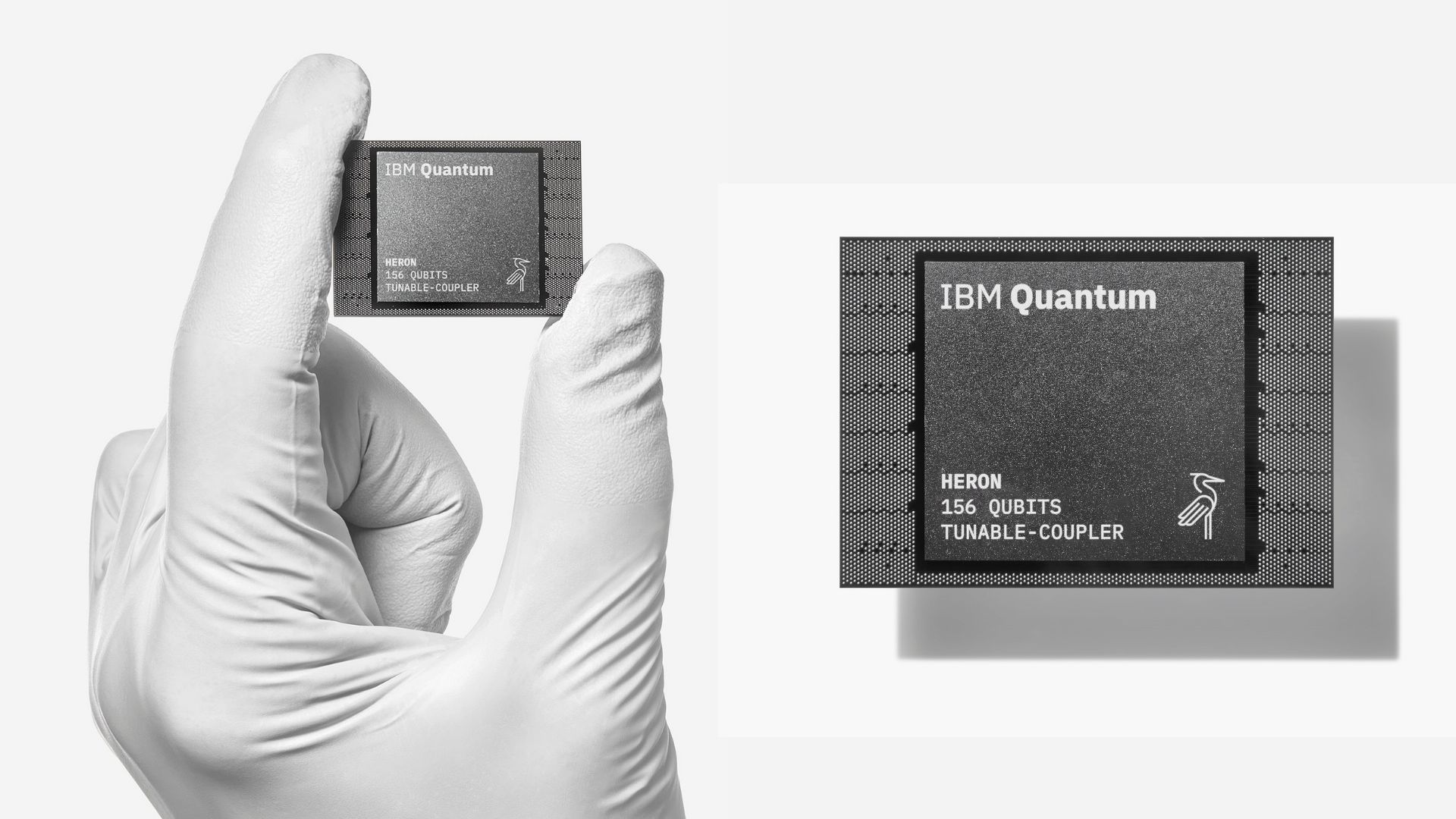
Interesting Engineering ran the result under a headline about a "100-qubit chip" that "advances self-correcting quantum computers" [14]. The chip is a 156-qubit IBM Quantum Heron. The team picked a connected chain of up to 100 of its qubits, about 64 percent of the processor [2][15]. Whoever forwards that headline to a CTO on Monday will be explaining it by Friday.
The paper, published in Nature Physics by researchers from Rutgers, IBM and collaborating institutions, reports a control experiment [1]. The team set how often the scrambling and the resets ran, then watched which one won [5]. More scrambling kept the chain chaotic. More measuring and resetting pushed it into an orderly, controllable state [5]. Justin Wilson, an associate professor of physics at Louisiana State University and a coauthor, explained that random interventions could suppress otherwise unpredictable behavior, the publication reported [11]. Whether the transition would survive in a quantum system at all had been uncertain, and it did [7].
For the person planning around quantum hardware, the useful part is the repetition. A fault-tolerant machine has to run its corrections many times over without destroying the information it is processing [13]. The resets here ran alongside nearly 5,000 two-qubit operations while the calculation kept going [4]. IBM researcher Maika Takita said the experiment kept operations, measurements and resets working together thousands of times on a large system, and called that an important step toward practical error correction, according to the report [10].
The loop runs at 100-qubit scale on existing hardware, and its threshold matched theoretical predictions [12][7]. On that evidence, I think the control side of error correction is now an engineering problem. The write-up does not report an error rate for any encoded qubit, and by its own account the demonstration does not establish a fully fault-tolerant computer [12].
Two tests sort announcements like this one. The first is whether the hardware repeated an intervention at scale while a computation kept running. The second is whether encoded information came out of that process with fewer errors than it went in with. This result passes the first and leaves the second unshown [4][12]. Passing both is what would justify moving budget toward error-corrected workloads. Passing only the first justifies having one person on the team learn how mid-circuit resets are programmed and read each follow-up paper, at the cost of that person's time and with no production payoff yet.
What to watch
- A follow-up that runs error correction through these mid-circuit resets on encoded qubits and reports logical error rates against physical ones.
- Whether the transition keeps sharpening on chains longer than 100 qubits, up to the full 156-qubit Heron processor.
Clarity's read
What the record supports and how the coverage leans. The claims behind it follow.
Reality
- Evidence45
- Adoption
- Insufficient
- Hype gap+30
- Incentives50
- Confidence45
Claim ledger
Ranked by verification strength, evidence, and original report placement.
- [1]
Researchers from Rutgers University, IBM and several collaborating institutions published findings in Nature Physics demonstrating that a quantum computer can repeatedly measure and reset its qubits while calculations continue, using up to 100 qubits.
ReportedSupportedSource: Interesting Engineering report on the Nature Physics paperView cited source - [2]
The team tested its approach on an IBM Quantum Heron processor with 156 qubits, selecting a connected chain containing up to 100 qubits for the experiment.
- [3]
The researchers alternated between two competing processes: one scrambled information across neighboring qubits, spreading disorder; the other repeatedly measured individual qubits and reset them toward a predetermined state.
- [4]
The experiment involved nearly 5,000 two-qubit operations alongside almost 5,000 measurement-and-reset cycles.
- [5]
Researchers adjusted how frequently each process occurred; when scrambling happened more frequently the system remained chaotic, while more frequent measurements and resets pushed it toward an orderly, controllable state.
- [6]
The most striking change occurred near a 50-50 balance between the two processes, where a small adjustment in their relative frequency could trigger a dramatic shift across the system, a phenomenon physicists call a phase transition.
- [7]
The transition persisted in a quantum system, where its survival had remained uncertain, and the findings matched theoretical predictions.
- [8]
The transition became more clearly defined as researchers examined larger systems, suggesting the effect extended beyond small experimental circuits.
- [9]
The team tested systems larger than those it could simulate using conventional computers, and that comparison strengthened confidence in the theoretical explanation.
- [10]
IBM researcher Maika Takita said the experiment coordinated quantum operations, measurements, and resets thousands of times across a large system, and described this capability as an important step toward practical error correction.
ReportedSupportedSource: Paraphrase of Maika Takita, IBM, as reported by Interesting EngineeringView cited source - [11]
Justin Wilson, an associate professor of physics at Louisiana State University and a study coauthor, explained that random interventions could suppress otherwise unpredictable behavior.
ReportedSupportedSource: Paraphrase of Justin Wilson, LSU, as reported by Interesting EngineeringView cited source - [12]
The demonstration does not establish a fully fault-tolerant quantum computer, but shows that present-day hardware can repeatedly intervene in a quantum system while operations continue.
- [13]
A fault-tolerant machine must repeat correction operations many times without destroying the information it processes.
- [14]
Interesting Engineering's headline: "IBM's 100-qubit chip advances self-correcting quantum computers with 5,000 operations".
- [15]
The 100-qubit chain used about 64 percent of the 156-qubit Heron processor.
Sources
1 independent publisher whose own reporting we read for this story.
Topics and entities
Follow any of these and your For You feed starts watching them — no settings page required.
Topics
- Quantum ComputingFollow
- Quantum Error CorrectionFollow
- Measurement-induced phase transitionsFollow
Entities
- IBMFollow
- IBM Quantum HeronFollow
- Rutgers UniversityFollow
- Nature PhysicsFollow
- Maika TakitaFollow
- Justin WilsonFollow
- Louisiana State UniversityFollow