Science3 publishersAlso reported elsewhere3 min readPublished
First nuclear clocks run on thorium-229 crystals in two independent labs
Teams at PTB-TU Wien and Tsinghua report the first working nuclear clocks, locking UV lasers to thorium-229 nuclei after more than 20 years of effort. With two labs running one crystal design, results can now be reproduced and checked against atomic clocks.
The Scientist · Science desk
Drafted by a language model from the sources cited here and checked against its claim ledger before publication. How we use AISend a correction
What happened
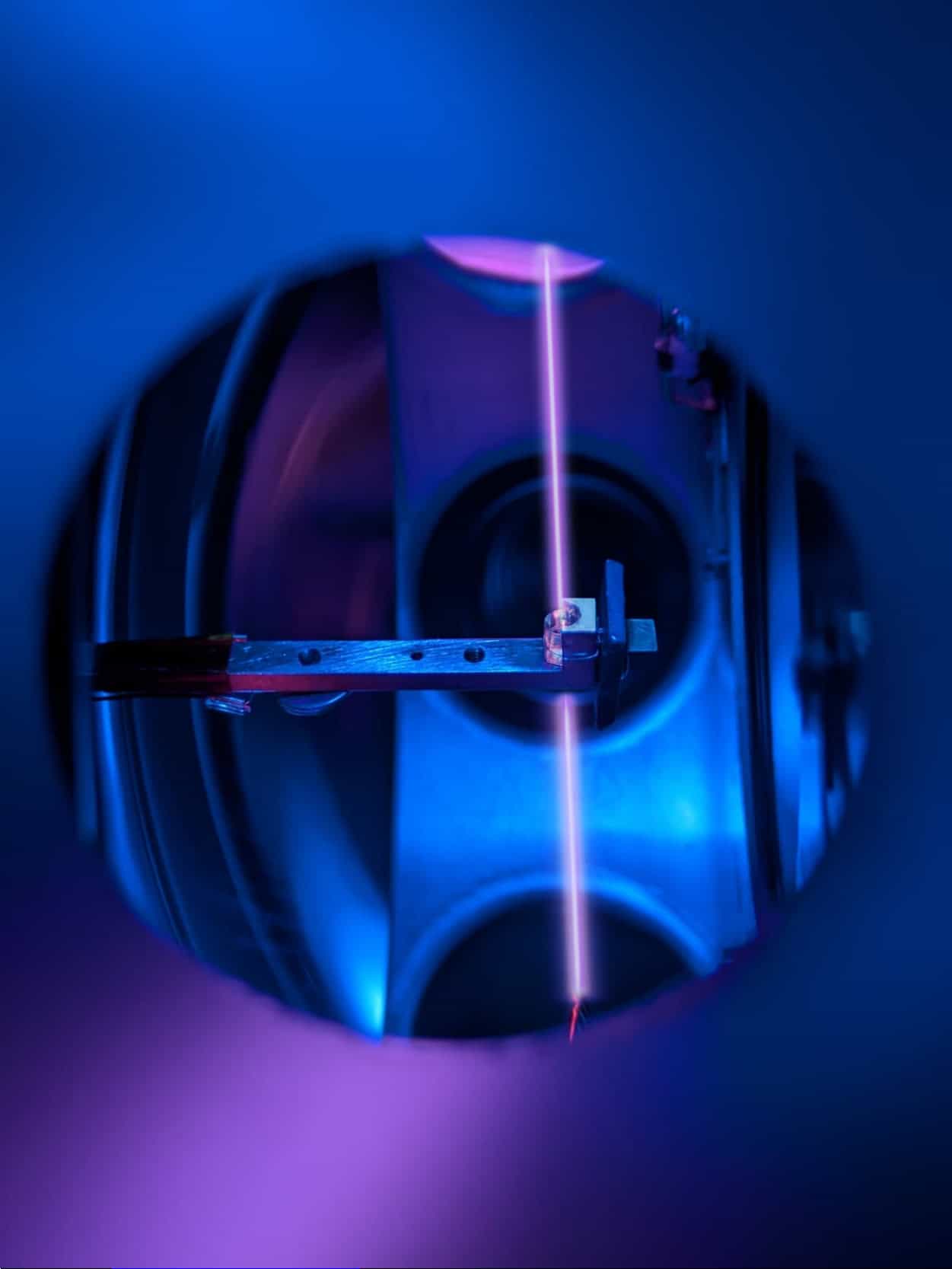
- Both clocks hold thorium-229 in millimetre-sized calcium fluoride crystals, read the nuclear resonance by direct absorption, and run continuously against atomic-clock frequency standards.
- PTB-TU Wien used its clock to search for ultralight scalar dark matter, setting limits on couplings to photons and the strong force comparable to the best atomic clocks.
- Tsinghua's crystal-growing method needs only 1.4 micrograms of thorium-229, developed because China has limited access to the isotope.
Compiled by The ScientistSomething wrong?How this is made
Why it matters
- cost The PTB-TU Wien clock pays for its higher noise in measurement time, needing 36 times longer averaging to match the Tsinghua device in any given search.
- constraint With dark matter limits only level with atomic clocks, the precision gain that motivated nuclear clocks is still unmeasured for these devices.
- capability Matching frequencies across independently grown crystals and JILA's comb data suggest a new thorium crystal could be used as a reference without its own calibration.
The two clocks share a design but put their effort in different places. The PTB-TU Wien team loaded more thorium-229 into its crystals, and the Tsinghua team drove its crystals with more laser power [9]. Either change tends to raise the signal-to-noise ratio [9]. On the reported numbers, the Tsinghua device comes out ahead. Its fractional frequency instability is 5 x 10^-13 at one second of averaging, against 3 x 10^-12 for PTB-TU Wien, and both fall with the square root of the averaging time [10]. Tsinghua's figure is six times lower [14]. Because noise averages down with the square root of time, the PTB-TU Wien clock needs 36 times as long to reach the same level [15].
The thing this doesn't tell you is how accurate either clock is. Instability describes how fast the noise averages away. Accuracy, meaning how far the reading sits from the true transition frequency, is a separate measurement, and the Physics World account does not report one for either device.
The idea behind the two Nature papers [1] dates to the late 1990s [2]. The case for it was that a clock based on a nucleus is less prone to disturbance from electromagnetic fields, and that its transition sits at ultraviolet frequencies, above those of optical clocks, which are themselves more precise than microwave clocks because they tick more often [3]. The obstacle was the light. The nuclear transition is so narrow that driving it takes highly stable lasers with extremely small bandwidths [4]. Ding's group had already built the first continuous-wave, narrow-linewidth UV laser at 148.4 nm [6]. The Peik and Schumm group had been first to excite the transition with a laser and first to embed thorium-229 in calcium fluoride, which made a solid-state device with no trapped atoms or ions [5].
Tsinghua's paper was mostly about the machine: high-power vacuum-ultraviolet interrogation, clock performance, reproducibility between crystals and metrological consistency [12]. The result I would weight most is the least showy one. Clock frequencies measured in two independently fabricated crystals agreed with each other and with earlier frequency-comb measurements at JILA [13]. Had the frequency moved from crystal to crystal, each new device would need its own calibration, and a crystal clock would be hard to use as a shared reference.
The PTB-TU Wien dark matter search put a nuclear clock to work on a physics question. It also constrained drifts in the nuclear transition energy, and its limits came out comparable to those from today's best atomic clocks [11]. I think that earns the thorium crystal the description of a working platform for fundamental-physics tests: two labs run the design, and one has already published a search with it [8][11]. The original argument for nuclear clocks was that they could be more precise than atomic ones [3]. On the figures reported so far, neither clock has shown that yet [10][11].
What to watch
- An accuracy evaluation of either thorium crystal clock, showing whether the reduced sensitivity to electromagnetic fields holds up in a solid-state host.
- A clock that pairs PTB-TU Wien's heavier thorium loading with Tsinghua's higher laser power, and whether its instability drops below 5 x 10^-13.
- A dark matter or transition-drift limit from a nuclear clock that improves on the best atomic clocks instead of matching them.