Two length estimates put Gujarat's Vasuki snake on either side of Titanoboa
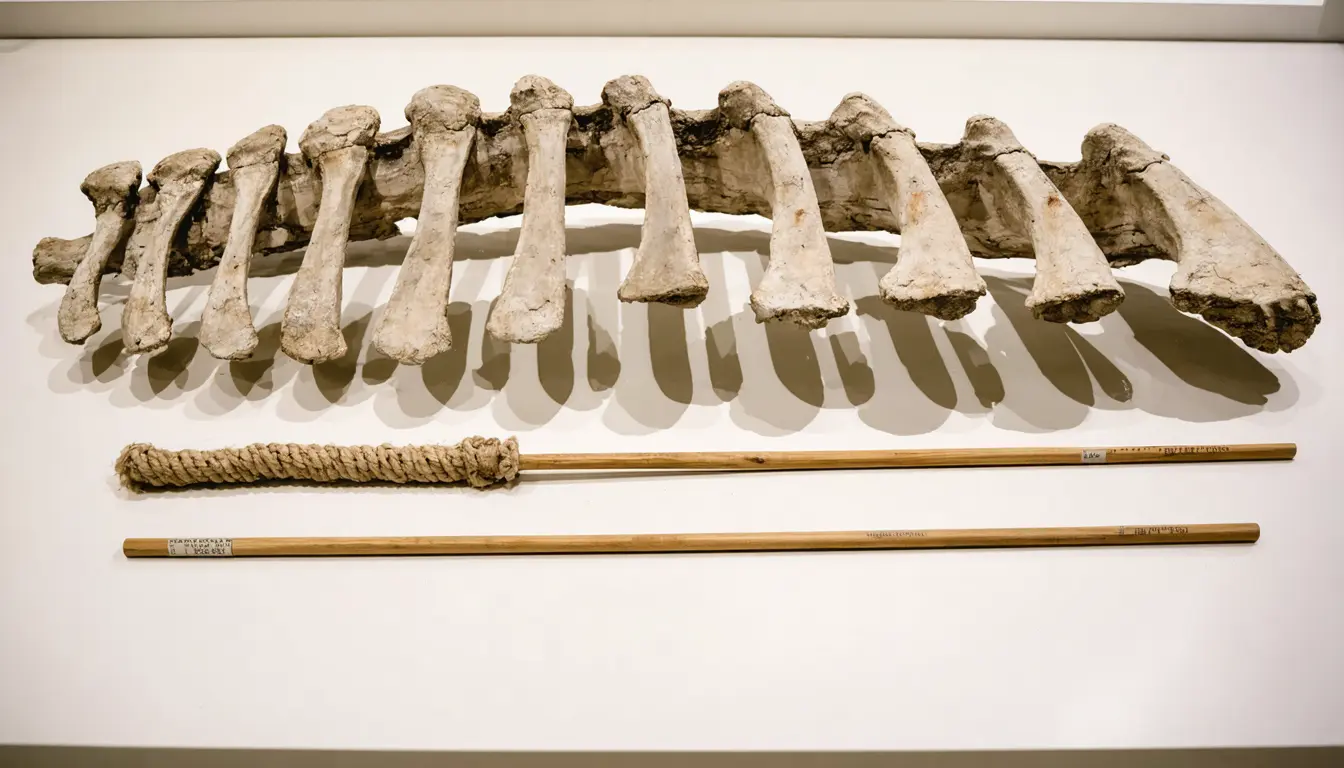
Paleontologists at IIT Roorkee estimate Vasuki indicus, a 47-million-year-old Gujarat snake, at 10.9 to 15.2 meters from 27 vertebrae. Titanoboa's roughly 13 meters falls between the two methods' ranges, so which snake was longer is open.
The Scientist · Science desk
Three distances in meters. The nearest edges of the researchers' two Vasuki indicus length methods are 2.3 meters apart. Titanoboa's roughly 13 meters is 0.8 meters above the top of the first method's range, and 1.5 meters below the bottom of the second method's range.
| Figure | Value | Note | Claim |
|---|---|---|---|
| Gap between the two methods' nearest edges | 2.3 meters | 16 | |
| Titanoboa above the first method's top | 0.8 meters | Titanoboa: roughly 13 meters | 17 |
| Titanoboa below the second method's bottom | 1.5 meters | Titanoboa: roughly 13 meters | 18 |
What happened
- Debajit Datta and Sunil Bajpai of IIT Roorkee identified the species from fossils recovered at the Panandhro Lignite Mine in Kutch.
- The vertebrae measure 37.5 to 62.7 millimeters long and 62.4 to 111.4 millimeters wide, and their broad shape suggests a thick, cylindrical body.
- To estimate length, the team compared the fossil vertebrae with those of living snakes of known body length, using two different methods.
- Many of the vertebrae were well preserved, some were still connected, and they appear to come from a fully grown animal.
Why it matters
- contradiction ScienceDaily's headline and summary lean on 'one of the largest ever' and 'up to 50 feet', while the researchers say it is unclear whether Vasuki exceeded Titanoboa.
- constraint With no complete skeleton, any record ranking rests on a backbone reconstruction, and two methods disagree by 2.3 meters at their nearest edges.
- constraint The slow ambush-predator lifestyle is inferred from vertebral shape and modern analogues, and the fossils cannot fix diet or hunting behavior.
The overall range of 10.9 to 15.2 meters [9] is made of two narrower ones. The first method gave 10.9 to 12.2 meters and the second gave 14.5 to 15.2 [8]. The nearest edges of those ranges are 2.3 meters apart [16].
Titanoboa, which lived in what is now Colombia about 60 million years ago, is thought to have reached around 13 meters [10]. That figure sits in the gap. It is 0.8 meters above the top of the first range [17] and 1.5 meters below the bottom of the second [18]. Measured against Titanoboa, the low end of Vasuki's estimate is about 84% of its length and the high end about 117% [19].
Which side of Titanoboa Vasuki lands on therefore depends on which method you trust. The researchers caution that their calculations involve considerable uncertainty, because different methods can produce substantially different estimates when an extinct animal is reconstructed from an incomplete backbone, and they say it remains unclear whether Vasuki exceeded Titanoboa [11]. No complete skeleton was recovered [6].
ScienceDaily's write-up, dated October 14, 2026, leads with "up to 50 feet" and calls Vasuki comparable to Titanoboa [14][15]. The paper it summarizes was published in Scientific Reports in 2024 [3]. The 50-foot figure is the top of the second method's range.
The ambush-predator picture is a separate inference. The researchers suggest that the body and distinctive vertebral structure would have favored relatively slow movement, and that Vasuki may have ambushed prey the way modern anacondas and large pythons do [12]. The thing this doesn't tell you is how the snake killed or what it ate: its precise diet and hunting behavior cannot be determined from the surviving fossils [13].
In our view, the defensible statement is that Vasuki was in Titanoboa's size class, somewhere between 10.9 and 15.2 meters [9]. A ranking has to wait until the two methods agree.
What to watch
- A follow-up analysis that reconciles the two length methods and places Vasuki wholly above or below Titanoboa's roughly 13 meters.
- Further Vasuki material from the Panandhro mine that adds vertebrae beyond the 27 examined so far.
Clarity's read
What the record supports and how the coverage leans. The claims behind it follow.
Reality
- Evidence58
- Adoption
- Insufficient
- Hype gap+30
- Incentives
- Insufficient
- Confidence55
Claim ledger
Ranked by verification strength, evidence, and original report placement.
- [1]
Vasuki indicus lived in India about 47 million years ago, in the Middle Eocene, when Earth's climate was considerably warmer than today.
- [2]
Paleontologists Debajit Datta and Sunil Bajpai of the Indian Institute of Technology Roorkee identified the species from fossils recovered at the Panandhro Lignite Mine in Kutch, Gujarat.
- [3]
The discovery was described in 2024 in the journal Scientific Reports.
- [4]
The researchers examined 27 fossilized vertebrae.
- [5]
Many of the vertebrae were remarkably well preserved, some remained connected in their original arrangement, and the bones appear to have belonged to a fully grown animal.
- [6]
The scientists did not recover a complete skeleton.
- [7]
Individual vertebrae measured between 37.5 and 62.7 millimeters long and between 62.4 and 111.4 millimeters wide; their unusually broad shape suggests a thick, cylindrical body.
- [8]
To estimate total length, the researchers compared the fossilized bones with vertebrae from living snakes of known body length; two different methods produced estimates of 10.9 to 12.2 meters and 14.5 to 15.2 meters.
- [9]
The researchers estimate Vasuki measured between 10.9 and 15.2 meters long, although its exact size remains uncertain.
- [10]
Titanoboa inhabited what is now Colombia approximately 60 million years ago and is thought to have reached around 13 meters.
- [11]
The researchers caution that their calculations involve considerable uncertainty; different methods can produce substantially different estimates, particularly when an extinct animal is reconstructed from an incomplete backbone, and it remains unclear whether Vasuki exceeded Titanoboa in length.
- [12]
The researchers suggest that Vasuki's enormous body and distinctive vertebral structure would have favored relatively slow movement and that it may have relied on ambush tactics, like modern anacondas and large pythons.
- [13]
Vasuki's precise diet and hunting behavior cannot be determined from the surviving fossils.
- [14]
ScienceDaily's summary says Vasuki could have reached up to 50 feet long, making it comparable to Titanoboa, and its headline says the snake may have been one of the largest ever.
- [15]
The ScienceDaily item is dated October 14, 2026.
- [16]
The nearest edges of the two method ranges are 2.3 meters apart.
- [17]
Titanoboa's roughly 13 meters is 0.8 meters above the top of the first method's range.
- [18]
Titanoboa's roughly 13 meters is 1.5 meters below the bottom of the second method's range.
- [19]
Vasuki's lowest estimate is about 84% of Titanoboa's roughly 13 meters and its highest about 117%.
Get this ledger inside ChatGPT. Ask about any of our stories and the answer brings its figure, each claim’s verdict and the sources. Free, no account.
Sources
1 independent publisher whose own reporting we read for this story.
- sciencedaily.comGigantic prehistoric snake discovered in India may have been one of the largest ever
1 article · October 13, 2026
Topics and entities
Follow any of these and your For You feed starts watching them — no settings page required.
Topics
- Fossil snakesFollow
- PaleontologyFollow
Entities
- Vasuki indicusFollow
- Indian Institute of Technology RoorkeeFollow
- ScienceDailyFollow
- Scientific ReportsFollow
- TitanoboaFollow