Flexible fibers in a Yale microfluidic chip remember past flows as zeros and ones
Yale researchers built a microfluidic chip whose flexible fibers switch between two stable states, so each one can hold a bit of flow history. The Physical Review X study points to all-fluid controllers for soft robots, though the account of it describes only a chip.
The Scientist · Science desk
What happened
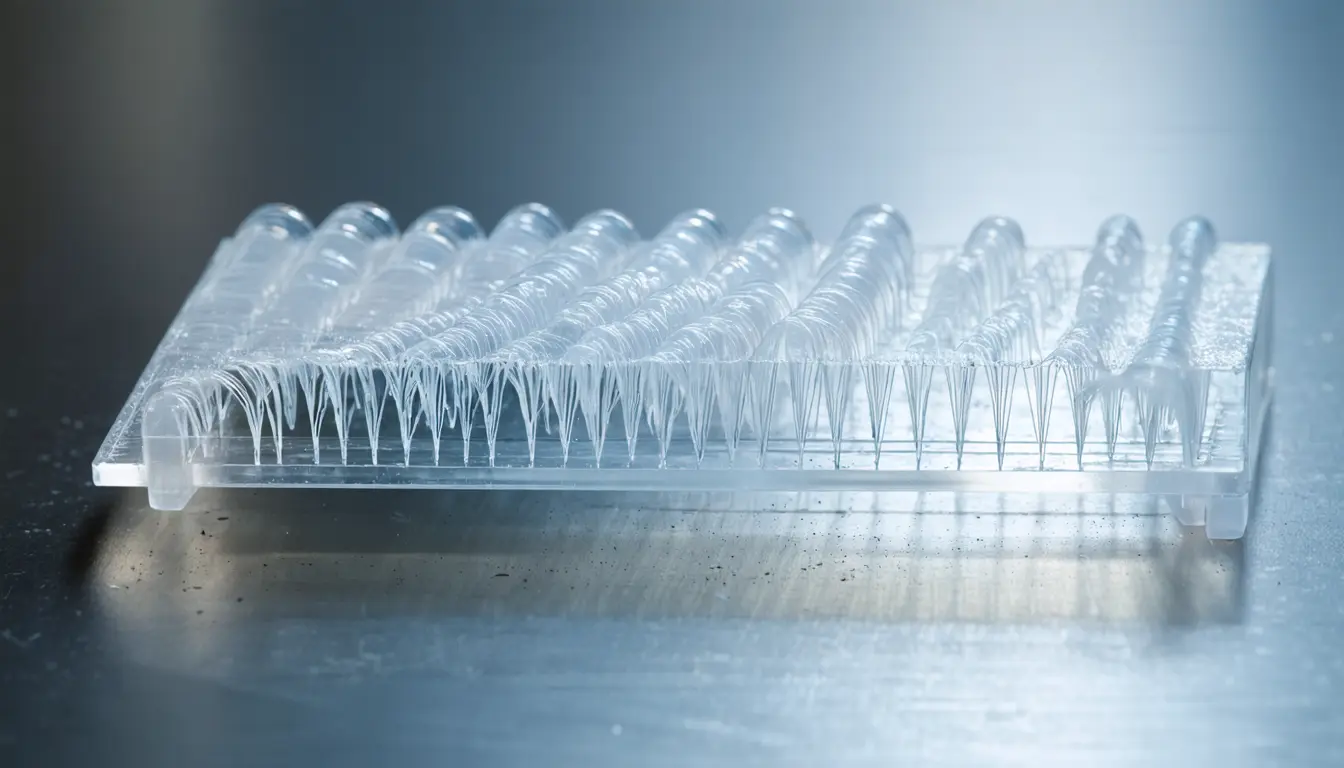
- The chip has several tiny channels, each about half as deep as a human hair is wide, with flexible microfibers standing in the path of the fluid.
- A fiber's state depends on its history and, when fibers are coupled, on the states of its neighbors; the two stable configurations can stand for a zero or a one.
- In a soft robot, flow rate and pressure would replace electrical current, with the fibers acting as valves and the channels as connections.
- The authors' longer-term question is whether such networks can be trained, which would extend retaining information into physical learning.
Why it matters
- capability A bit can be flipped by changing the imposed flow alone. Rajput contrasts this with conventional microfluidics, which relies on active elements.
- constraint The soft-robot controller is described as an idea. So far there is a chip, with no robot, no computation run on it and no switching figures a designer could use.
- precedent If the networks can be trained, the same hardware would bear on memory and learning in fungi, plant roots and slime mold. The reported work involves no organisms.
The design puts the memory in the geometry. Each microfiber stands in the path of the fluid, and pressure from the flow can push it from one configuration to the other [3]. Because both configurations are stable, a fiber's current state depends on its history [4]. The paper, by Abhineet Singh Rajput and colleagues, is titled "Fluidic Hysterons and Memory in Flow Networks" [8].
Coupling is the feature that turns a single switch into a network. According to the study, a coupled fiber's state also depends on the states of other fibers [4]. "These fibers can also be configured to interact, meaning they mutually influence one another's physical state, driving the emergence of complex, systemwide memory," said Rajput, the lead author and a graduate student in Pahlavan's lab [6][9].
Amir Pahlavan, an assistant professor of mechanical engineering, framed the target as places where electronics fail [9]. "And in many of these environments, electronics might not be able to operate due to electromagnetic interference or other issues," he said. "So the idea here is that we could design a fully fluidic controller that can be integrated into a soft robot and effectively act as its brain." [11]
We think the controller is a design proposal at this stage. Pahlavan's own phrase is "the idea here," and what the phys.org account describes is a chip with channels and fibers [11].
The account does not say whether the memory is good enough to build on. A controller would need to know how many fibers were coupled, what pressures flip them, how fast they switch, and how many cycles a fiber survives. It would also need a comparison against the same chip without fibers.
What to watch
- Whether the Physical Review X paper itself gives switching pressures, switching speed and cycle counts for the fibers, figures missing from the press account.
- A demonstration of a coupled fiber network driving an actuator or valve in a soft robot.
- Any experiment in which the network is trained to change its response, which would test the physical-learning claim.
Clarity's read
What the record supports and how the coverage leans. The claims behind it follow.
Reality
- Evidence50
- Adoption
- Insufficient
- Hype gap+15
- Incentives
- Insufficient
- Confidence55
Claim ledger
Ranked by verification strength, evidence, and original report placement.
- [1]
Yale researchers show that networks of flowing water and other fluids can store their own memories, in a study published in Physical Review X.
- [2]
The chip has multiple tiny channels, each with a depth about half the width of a human hair.
- [3]
Flexible microfibers placed in the channels stand in the way of the fluid; pressure from the flow can cause the fibers to switch between two states, affecting how the fluid passes.
- [4]
Each fiber's current state depends on its history and, when coupled, on the states of other fibers; its two stable configurations can represent a zero or a one, like a bit in computer memory.
- [5]
The fibers switch passively as the imposed flow changes.
- [6]
"These fibers can also be configured to interact, meaning they mutually influence one another's physical state, driving the emergence of complex, systemwide memory," said Abhineet Rajput.
- [7]
Rajput said that while conventional microfluidics rely on active elements, this system uses microfibers to passively store information.
- [8]
The paper is Abhineet Singh Rajput et al., Fluidic Hysterons and Memory in Flow Networks, Physical Review X (2026), DOI 10.1103/hh4n-pw7w.
- [9]
Abhineet Rajput is the lead author and a graduate student in Professor Amir Pahlavan's lab; Pahlavan is an assistant professor of mechanical engineering.
- [10]
In a soft robot, flow rates and pressure levels of the fluids could take the place of electrical current, the microfibers could act as valves and the channels as connections.
- [11]
"And in many of these environments, electronics might not be able to operate due to electromagnetic interference or other issues," said Pahlavan. "So the idea here is that we could design a fully fluidic controller that can be integrated into a soft robot and effectively act as its brain."
- [12]
A longer-term question is whether these fluidic networks could be trained to perform useful tasks, which would extend the work from retaining information to physical learning, in which training changes a system's response to achieve a desired outcome.
- [13]
The work could also give researchers insight into memory and learning in living organisms such as fungi, plant roots and the slime mold.
Get this ledger inside ChatGPT. Ask about any of our stories and the answer brings its figure, each claim’s verdict and the sources. Free, no account.
Sources
2 independent publishers whose own reporting we read for this story.
- interestingengineering.comTiny chip stores memories in flowing water without conventional electronics
1 article · October 13, 2026
- phys.orgStoring memory on a chip with flowing water
1 article · October 14, 2026
Topics and entities
Follow any of these and your For You feed starts watching them — no settings page required.
Topics
- Soft RoboticsFollow
- Physical memory and learningFollow
- MicrofluidicsFollow
Entities
- Amir PahlavanFollow
- Physical Review XFollow
- Abhineet RajputFollow
- Phys.orgFollow
- Yale UniversityFollow