Two seafloor sulfide rocks caught fire on their own after freeze-drying and crushing
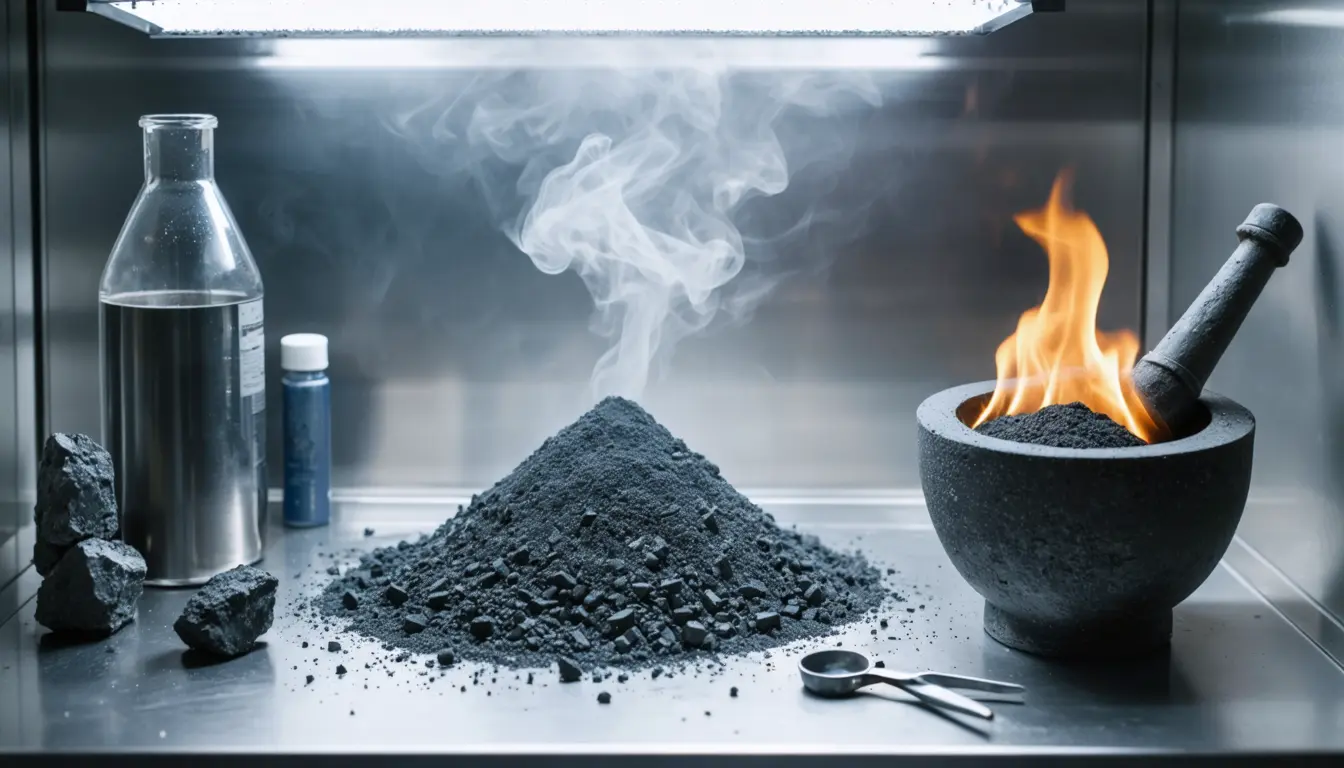
Two of 57 rocks collected from the Escanaba Trough combusted without an outside flame in a lab, according to a Scientific Reports study. The authors write that no engineering controls exist yet for mining modern seafloor sulfides.
The Scientist · Science desk
Two part-of-whole bars. 2 of 41 marcasite-rich samples combusted. 2 of 57 rocks collected combusted.
- Of marcasite-rich samples, claim 5 2 of 41 samples 4.9% computed
Of marcasite-rich samples The rest of the 41
- Of rocks collected, claim 16 2 of 57 rocks 3.5% computed
Of rocks collected The rest of the 57
| Share | Part | Whole | Percent | Claim |
|---|---|---|---|---|
| Of marcasite-rich samples | 2 samples | 41 samples | 4.9% (computed) | 5 |
| Of rocks collected | 2 rocks | 57 rocks | 3.5% (computed) | 16 |
What happened
- Both rocks that combusted were dominated by marcasite, an iron sulfide made of extremely small crystals.
- The two samples gave off heat and smoke before crushing began, reaching more than 100 degrees C, probably from exposure to oxygen.
- Calculations showed marcasite oxidation with oxygen generally releases more heat than the dissolved-iron reactions that apply to pyrrhotite.
- On that basis the team thinks modern seafloor sulfides could be more prone to self-heating than the older deposits mined on land.
Why it matters
- constraint Fire practice from land sulfide mines cannot simply be carried over, because seafloor rock is more porous and likely needs different safety measures.
- exposure The hazard appears at the surface and during processing, so the risk sits with the vessels and plants that handle the ore.
- decision Sampling programs face a choice: the team says seafloor material, likely much of a future mine's output, is poorly sampled and needs wider study before the risk can be set.
As phys.org describes the study [1], the team collected 57 rocks in 2022 from the Escanaba Trough, part of the Gorda Ridge in the northeast Pacific [2]. In the lab they freeze-dried the rocks and then crushed them, and the extra heat from crushing set two off [3]. Two of 57 is 3.5% [16]. Among the 41 marcasite-rich samples it is 4.9% [5][15]. Both figures belong to one site and one lab protocol.
The design was a comparison. The team set combusting and non-combusting rocks side by side using mineral identification, microscopy, chemical analysis and laboratory heating tests [13]. The small marcasite crystals in the burners had replaced an earlier mineral and kept its blade-like shape. The replacement left cracks and empty spaces, and that raised the surface area available for reactions with oxygen [7]. The earlier mineral appears to have been pyrrhotite, which previous research often identified as a self-heating hazard [8].
A comparison like this shows what the two burners had in common. It cannot show that texture alone causes ignition, because 39 of the 41 marcasite-rich samples did not burn [17]. The team says pH and exposure to light, among other factors, are involved, so how often combustion might occur is unclear [19].
Sulfide mining around vents already draws criticism for its destructive nature [14]. This study concerns the ore after it is raised. The authors write: "The production of heat through exothermic reactions has not been investigated in SMS deposits but has the potential to cause rapid-onset fires on ships." [20]
The thing this doesn't tell you is how often a ship's hold would burn. Ignition here happened in a lab after freeze-drying and crushing. The authors also write that "there are currently no established engineering controls for mining sulfide deposits from the modern seafloor" [11]. In our view, that makes the next dataset worth more than this one: ignition tests on more seafloor samples would give an operator a rate, and two events in one trough do not.
What to watch
- Ignition tests on seafloor sulfides from other vent fields, to see whether the 2-in-41 rate in marcasite-rich rock holds outside the Escanaba Trough.
- Experiments that vary pH and light exposure on marcasite-rich samples, since the team names both as factors without yet pinning down their effect.
- Any published engineering controls or combustion risk assessment for seafloor massive sulfide mining.
Clarity's read
What the record supports and how the coverage leans. The claims behind it follow.
Reality
- Evidence55
- Adoption
- Insufficient
- Hype gap+10
- Incentives
- Insufficient
- Confidence50
Claim ledger
Ranked by verification strength, evidence, and original report placement.
- [1]
A study published in Scientific Reports describes how certain samples of rock brought up from seafloor massive sulfide (SMS) deposits have unexpectedly caught fire.
- [2]
In 2022 the team collected 57 rocks from the hydrothermally active Escanaba Trough, a part of the Gorda Ridge in the northeast Pacific Ocean.
- [3]
During lab processing the rocks were freeze-dried and then crushed, which created additional heat and caused two of the samples to spontaneously combust.
- [4]
The combusting samples generated heat and smoke even before crushing began, reaching temperatures above 100 degrees C, likely due to oxygen exposure.
- [5]
Only two out of 41 marcasite-rich samples combusted.
- [6]
Both combusting rocks were dominated by marcasite, an iron sulfide made of extremely small crystals.
- [7]
The small crystals had replaced an earlier mineral while retaining a blade-like shape; the replacement created cracks and empty spaces, producing a higher surface area and allowing more reactions with oxygen, which made the rocks less stable.
- [8]
Marcasite appears to have replaced the iron sulfide mineral pyrrhotite, which previous research often identified as a self-heating hazard.
- [9]
Calculations showed that marcasite oxidation, which involves oxygen, generally releases more heat than reactions involving dissolved iron as the oxidizing agent, as with pyrrhotite.
- [10]
Spontaneous combustion has occasionally been documented in land-based volcanogenic massive sulfide mines, and some safety practices have been developed for them, but seafloor rocks are more porous and likely require different safety practices.
- [11]
The study authors write that, given SMS mining has yet to occur, "there are currently no established engineering controls for mining sulfide deposits from the modern seafloor".
- [12]
The study indicates that conditions at the surface, combined with processing activities, may turn some of these rocks into a hazard.
- [13]
To find what caused the rocks to catch fire, the team compared combusting and noncombusting samples using mineral identification, microscopy, chemical analysis and laboratory heating tests.
- [14]
Projects mining seafloor massive sulfide deposits around hydrothermal vents already face criticism over their destructive nature.
- [15]
Two combusting samples out of 41 marcasite-rich samples is about 4.9%.
- [16]
Two combusting rocks out of 57 collected is about 3.5%.
- [17]
39 of the 41 marcasite-rich samples did not combust.
- [18]
Based on the results, the team thinks modern seafloor sulfides could be more prone to self-heating than the more ancient deposits mined on land.
- [19]
Many factors appear to be involved in marcasite combustion, such as pH and exposure to light, making it unclear how often combustion might occur.
- [20]
The study authors write: "The production of heat through exothermic reactions has not been investigated in SMS deposits but has the potential to cause rapid-onset fires on ships."
- [21]
The team notes that material from the seafloor, likely to make up much of a future mine's output, remains poorly sampled and should be studied more extensively to determine risks for mining operations.
Get this ledger inside ChatGPT. Ask about any of our stories and the answer brings its figure, each claim’s verdict and the sources. Free, no account.
Sources
1 independent publisher whose own reporting we read for this story.
Topics and entities
Follow any of these and your For You feed starts watching them — no settings page required.
Topics
- Deep-sea miningFollow
- Mining safetyFollow
- Seafloor massive sulfidesFollow