Zimbabwe's new Triassic dinosaur Musango points to a fauna distinct from South Africa's
Researchers have named Musango matusadonaensis, a 210-million-year-old Zimbabwean dinosaur, and say Zimbabwe's dinosaurs include species unique to the region. The authors suspect ancient climate explains the split and say they are still working out why.
The Scientist · Science desk
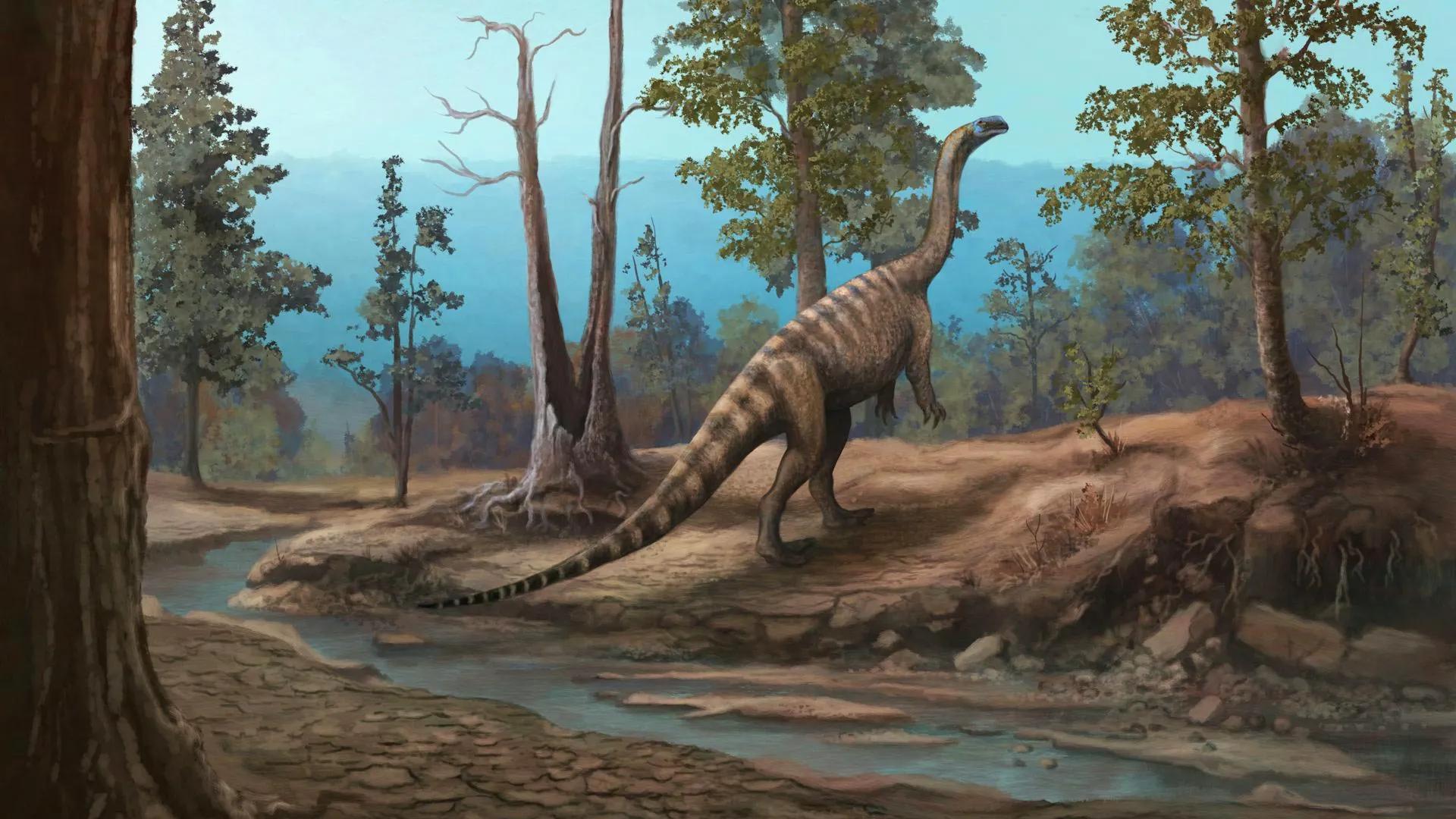
Three figures for Musango matusadonaensis, a newly identified sauropodomorph dinosaur from Zimbabwe. Its anatomy shows a body length of about 4.5 meters and a weight of 220kg, and that the animal was bipedal. Its age is about 210 million years.
| Figure | Value | Note | Claim |
|---|---|---|---|
| Musango's body length, about | 4.5 meters | 4 | |
| Weight, from anatomy | 220 kg | 4 | |
| Musango's age, about | 210 million years | 1 |
What happened
- The incomplete skeleton came from the bank of the Nyamasango River near Musango Island, a location the scientific name records.
- Musango walked on its hind legs, reached about 4.5 meters in length and weighed 220kg, according to its anatomy.
- Two expeditions, in 2017 and 2018, prospected the Lake Kariba shoreline deep inside Matusadona National Park from a houseboat that served as hotel and laboratory.
- The bones came from brick-red mudstones and sandstones that ancient rivers laid down during the Late Triassic.
Why it matters
- decision Most 1970s finds near Bulawayo and the lower Zambezi Valley were assigned to known South African species. If Zimbabwe's fauna is distinct, those identifications are the first thing to recheck.
- constraint The climate explanation is a suspicion the team is still testing, so it cannot yet be cited as a result.
- cost Each added specimen comes from a remote shoreline that needed a houseboat base and two expeditions, so the sample is likely to grow slowly.
The claim has a descriptive layer and a causal one, and the account argues them with different confidence. The descriptive layer is firm. Its author wrote, "They're not simply an extension of better-known South African faunas but include an array of species unique to the region." [13] The causal layer is hedged in the author's own words: "We suspect that environmental conditions might be the key." [14] The team is still working out why the differences exist [15]. ScienceDaily's summary of the piece is a notch more assertive. It says the discovery suggests ancient climate differences may have separated dinosaur populations across southern Africa [16].
Kariba is described as dry, on the evidence of geology and plant fossils [10]. That is one half of a climate comparison. A causal story also needs the climate at the South African sites, and the account does not describe it.
The thing this doesn't tell you is how many species make up the "array", or whether the South African animals used for comparison lived at the same time as Musango. The second point matters. The Late Triassic runs 36 million years [11], and an age of around 210 million years puts Musango about 9 million years before the period's end [12]. Animals separated by several million years can differ with no climatic barrier between them.
Musango is a thin data point on its own: a subadult [5] whose skull was not preserved, so its diet is unknown [6]. It belongs to the sauropodomorphs, the subgroup that eventually gave rise to four-legged, long-necked giants like Diplodocus [2]. In our view the regional argument rests on the pattern across species, not on this one animal. The distinct-fauna half of the claim is the safer half. The climate half needs age-matched comparisons before it counts as a finding.
What to watch
- Published climate evidence from the South African comparison sites, set against the dry conditions described at Kariba.
- Age-matched comparisons showing whether the South African species used as references lived at the same time as Musango.
- Re-examination of the 1970s Bulawayo and Zambezi Valley specimens that were assigned to known South African species.
Clarity's read
What the record supports and how the coverage leans. The claims behind it follow.
Reality
- Evidence55
- Adoption
- Insufficient
- Hype gap+20
- Incentives
- Insufficient
- Confidence40
Claim ledger
Ranked by verification strength, evidence, and original report placement.
- [1]
Musango matusadonaensis is a newly identified sauropodomorph dinosaur from Zimbabwe, about 210 million years old.
- [2]
Sauropodomorphs are the dinosaur subgroup that eventually gave rise to four-legged, long-necked giants like Diplodocus.
- [3]
Musango's incomplete skeleton was found in the bank of the Nyamasango River close to Musango Island, as captured in the animal's scientific name.
- [4]
Musango's anatomy shows it was bipedal, reached about 4.5 meters in length, and weighed 220kg.
- [5]
Growth marks in Musango's bones reveal it was a subadult when it died.
- [6]
The skull was not preserved, so Musango's diet is unknown, though its close relatives were largely herbivorous.
- [7]
In the 1970s, Zimbabwean paleontologists Geoffrey Bond and Michael Raath discovered abundant material in the hinterlands of Bulawayo and the lower Zambezi Valley, and most of these finds were identified as belonging to known species named from neighboring South Africa.
- [8]
The Lake Kariba shoreline sites are deep inside Matusadona National Park, so the team used a Kariba houseboat as a mobile hotel and laboratory and mounted two expeditions, in 2017 and 2018.
- [9]
The material was collected from brick-red mudstones and sandstones laid down by ancient rivers around 210 million years ago, during the Late Triassic period (237-201 million years ago).
- [10]
Geological evidence and plant fossils show that the Triassic landscape of Kariba was dry.
- [11]
The Late Triassic spans 36 million years.
- [12]
An age of around 210 million years places Musango about 9 million years before the end of the Late Triassic.
- [13]
The author wrote: "They're not simply an extension of better-known South African faunas but include an array of species unique to the region."
- [14]
The author wrote: "We suspect that environmental conditions might be the key."
- [15]
The research team is now trying to work out why the differences between Zimbabwean and South African dinosaur faunas exist.
- [16]
ScienceDaily's summary says the discovery suggests that ancient climate differences may have separated dinosaur populations across southern Africa.
Get this ledger inside ChatGPT. Ask about any of our stories and the answer brings its figure, each claim’s verdict and the sources. Free, no account.
Sources
1 independent publisher whose own reporting we read for this story.
- sciencedaily.com210-million-year-old dinosaur discovery reveals a lost world in Africa
1 article · October 13, 2026
Topics and entities
Follow any of these and your For You feed starts watching them — no settings page required.
Topics
- African fossilsFollow
- PaleontologyFollow
- Dinosaur evolutionFollow
Entities
- Musango matusadonaensisFollow
- The ConversationFollow
- ScienceDailyFollow
- Jonah ChoiniereFollow
- University of the WitwatersrandFollow