Machine learning finds thousands of missing reactions in a copper CO2 hydrogenation model
IISc researchers used machine learning to expand a copper-catalyst CO2 network from 152 reactions to 9,389. The larger network predicted about 40 times more conversion and matched experiments on methanol and carbon monoxide as major products.
The Scientist · Science desk
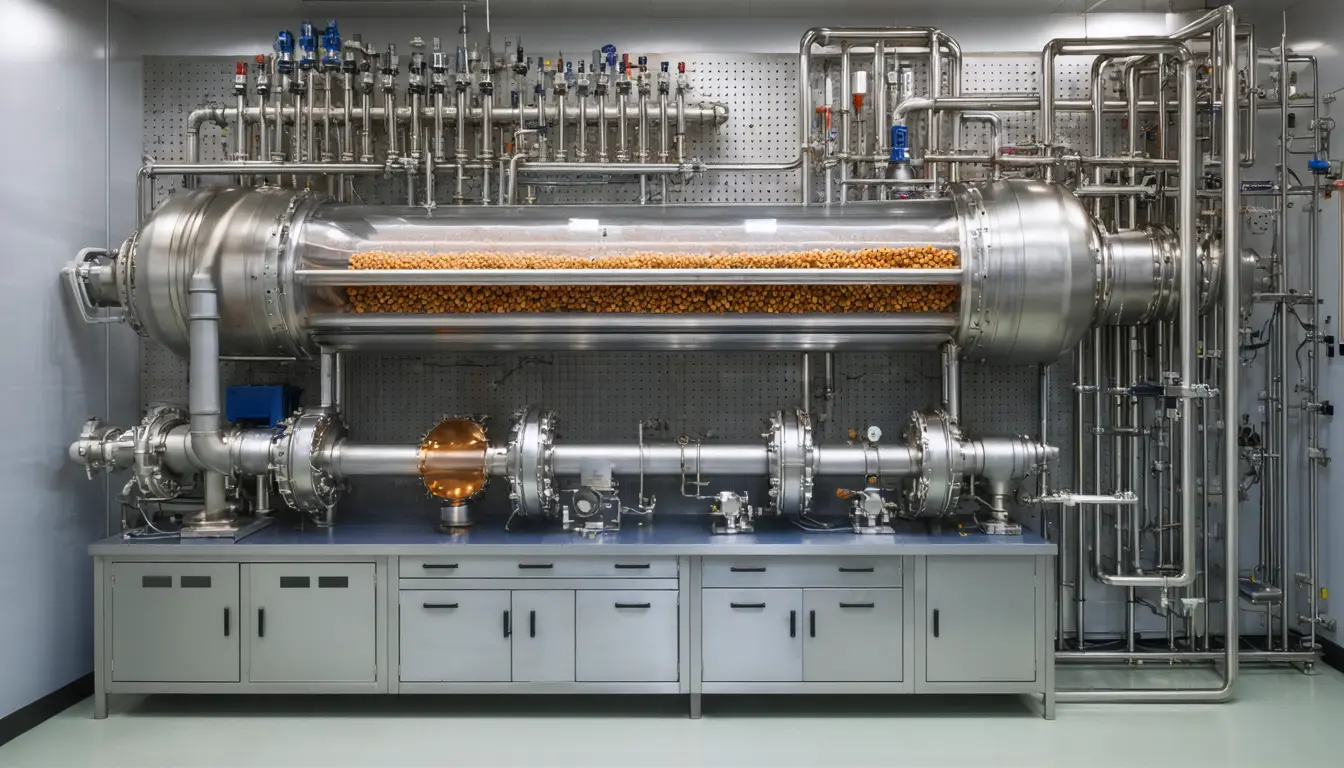
Three key figures: 9,389 reactions identified on a copper catalyst by combining machine learning with simulations; 152 reactions at the start of the network; predicted CO2 conversion up approximately 40 times compared with the original model.
| Figure | Value | Note | Claim |
|---|---|---|---|
| Reactions identified on copper catalyst | 9,389 reactions | 1 | |
| Reactions at the start | 152 reactions | 5 | |
| Predicted CO2 conversion increase, approximately | 40 times | vs the original model | 7 |
What happened
- Automated tools enumerated reactions among 105 surface species and kept those that could occur in a single step.
- With only the 152 reactions, the model named formic acid as the main product instead of methanol and predicted substantially less CO2 conversion than experiments showed.
- The work also reports a surprising way hydrogen can take part in these reactions. The finding challenges established assumptions about the process.
Why it matters
- constraint Omitted steps changed the predicted main product from methanol to formic acid, so a curated reaction network needs a completeness check before its output guides catalyst choices.
- capability Machine-learned barrier estimates let a team screen thousands of surface steps that full quantum calculations would make very costly. Network completeness becomes a testable question.
- decision Groups working on copper catalysts for methanol have a reported hydrogen pathway to check against their current assumptions about how the process runs.
Quantum mechanics is the accurate way to get a reaction's energy barrier. It is also the expensive one. Running it on every step of CO2 hydrogenation over a copper surface would demand immense computing power, so modelers usually pick a limited set of reactions they believe matter most [3]. The IISc team ran quantum calculations on 152 reactions to build a database, then trained machine learning models to estimate barriers for additional reactions [4]. Automated tools enumerated the possible reactions among 105 surface species and kept those that could happen in a single step [5]. That added 9,237 reactions [12]. The final network is about 62 times the size of the starting one [13].
The motive, said first author Anand Mohan Verma, was a completeness check. "We began with a worry familiar to anyone who does mechanistic modeling: How do you know that your reaction network has not omitted the one step that matters?" [10]
The paper's central comparison is the small network against the large one. Moving to the larger network raised predicted CO2 conversion by approximately 40 times [7], and the expanded model identified methanol and carbon monoxide as major products, in agreement with experiment [8]. "Only when we expanded the network to include thousands of additional, previously overlooked reactions did the predictions fall in line with what we and others see experimentally," said corresponding author Ananth Govind Rajan [11]. The experiments came from G Valavarasu and Santhosh Kotni at Hindustan Petroleum's Green Research and Development Centre and from Amol Amrute and colleagues at the Agency for Science, Technology and Research in Singapore [9].
That comparison does not say how much of the 40-fold change any single added reaction explains. It sets the new model against the old one, a model-to-model ratio [7]. The IISc summary describes the hydrogen step only as surprising and at odds with established assumptions [14], and it does not report the experimental conversion values or conditions.
Agreement on two outputs, product identity and overall conversion, fits a more complete network. It cannot by itself show that each of the 9,237 added reactions matters [12].
In our view the durable result is the diagnosis: on this copper system, a curated network got the main product wrong, and a machine-learned expansion fixed it. That holds for the one catalyst studied [1]. According to IISc, the findings, published in Nature Communications, could help scientists develop more effective catalysts for turning CO2 into methanol [2].
What to watch
- The Nature Communications paper's data: which of the added reactions carry most of the flux, and how the hydrogen step is described.
- Whether the experimental groups or others build and test a copper catalyst around the new hydrogen pathway.
- Whether the same barrier-estimation expansion changes predicted products on catalysts other than copper.
Clarity's read
What the record supports and how the coverage leans. The claims behind it follow.
Reality
- Evidence58
- Adoption
- Insufficient
- Hype gap+20
- Incentives
- Insufficient
- Confidence60
Claim ledger
Ranked by verification strength, evidence, and original report placement.
- [1]
By combining machine learning with advanced computer simulations, IISc researchers identified 9,389 individual reactions occurring on a copper catalyst, revealing chemical pathways that conventional models had missed.
- [2]
The findings, published in Nature Communications, could help scientists develop more effective catalysts for transforming CO2 into useful products such as methanol.
- [3]
Simulating every possible step with quantum mechanics would require immense computing power, so researchers typically focus on a limited selection of reactions believed to be the most important; this simplification can leave hundreds of potentially critical reactions out.
- [4]
The team used quantum mechanics simulations to build a database of 152 chemical reactions, then trained machine learning models to quickly estimate the energy barriers that additional reactions would need to overcome.
- [5]
Automated computational tools examined possible reactions involving 105 chemical species on the catalyst surface and determined which transformations could occur in a single reaction step, expanding the network from 152 reactions to 9,389.
- [6]
With the smaller 152-reaction network, the model incorrectly identified formic acid as the main product rather than methanol, and predicted substantially less CO2 conversion than experiments indicated.
- [7]
When the larger reaction network was incorporated into a model of how quickly the chemical processes occur, predicted CO2 conversion increased by approximately 40 times compared with the original model.
- [8]
The expanded model correctly identified methanol and carbon monoxide as major products, bringing its predictions into agreement with experimental findings.
- [9]
Experimental validation was carried out by G Valavarasu and Santhosh Kotni at Hindustan Petroleum Corporation Limited's Green Research and Development Centre, along with Amol Amrute and colleagues at the Agency for Science, Technology, and Research in Singapore.
- [10]
"We began with a worry familiar to anyone who does mechanistic modeling: How do you know that your reaction network has not omitted the one step that matters?"
- [11]
"Only when we expanded the network to include thousands of additional, previously overlooked reactions did the predictions fall in line with what we and others see experimentally,"
- [12]
The expansion added 9,237 reactions to the original network.
- [13]
The final network is about 62 times the size of the 152-reaction starting network.
- [14]
The research also uncovered a surprising way hydrogen can participate in these reactions, challenging established assumptions about how the process works.
Get this ledger inside ChatGPT. Ask about any of our stories and the answer brings its figure, each claim’s verdict and the sources. Free, no account.
Sources
1 independent publisher whose own reporting we read for this story.
- sciencedaily.comAI reveals a hidden chemical shortcut that could turn CO2 into fuel
1 article · October 13, 2026
Topics and entities
Follow any of these and your For You feed starts watching them — no settings page required.
Topics
- Heterogeneous catalysisFollow
- Machine learning in chemistryFollow
- CO2 hydrogenationFollow
Entities
- Agency for Science, Technology and ResearchFollow
- Indian Institute of ScienceFollow
- ScienceDailyFollow
- Hindustan Petroleum Corporation LimitedFollow
- Nature CommunicationsFollow