Chang'e-6 far-side rocks point to Earth-driven magma flows behind the Moon's two faces
Nanjing University researchers found that Chang'e-6 far-side rocks point to a similar mantle under both hemispheres and a different crust. They infer heat-driven magma-ocean circulation after tidal locking as the cause.
The Scientist · Science desk
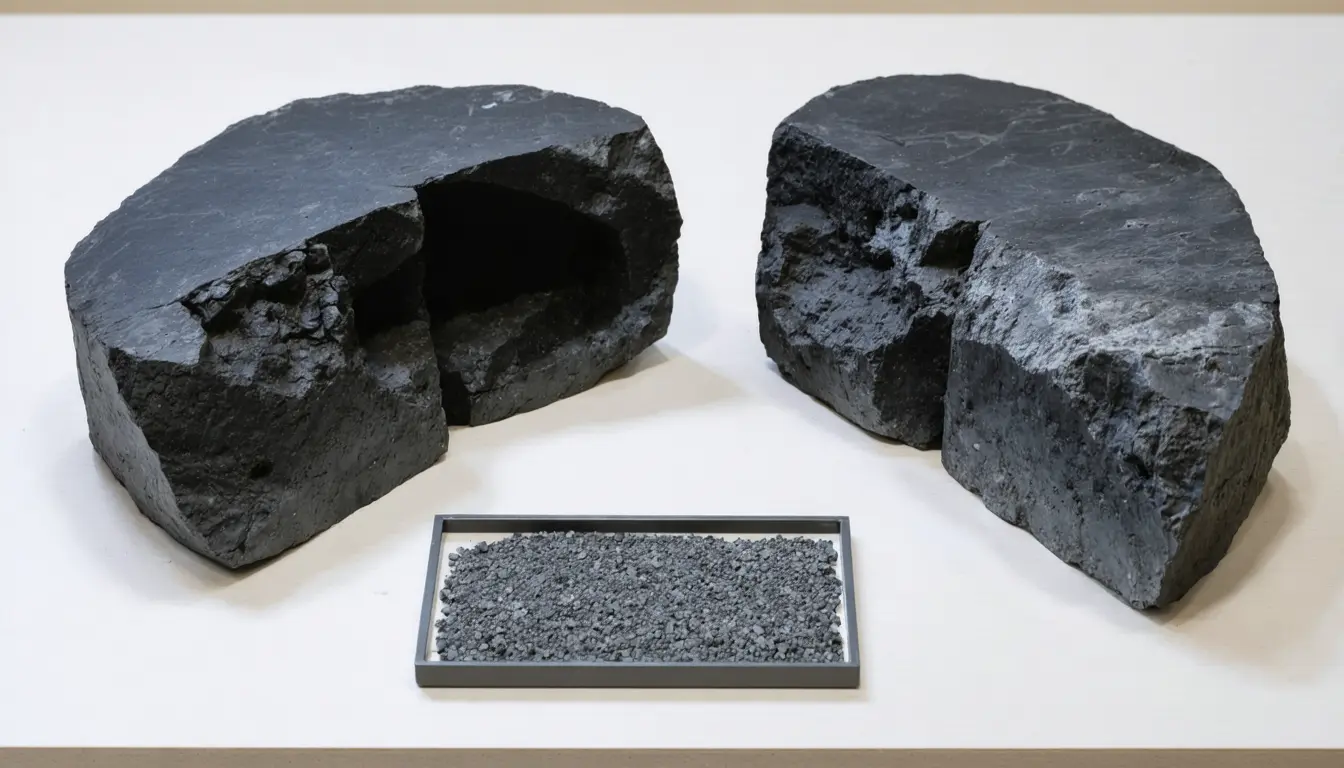
Three Chang'e-6 far-side rock types against Apollo samples. Basalts: depleted mantle, like Apollo low-Ti basalts. Mg-suite: Mg# similar to Apollo, so researchers conclude mantle cumulates are broadly alike. Anorthosites: higher peak Mg#, so far-side crust contains more magnesium-rich material.
- precedent Chang'e-6 basalts Signatures point to depleted mantle material, much like Apollo low-Ti basalts, claim 4
- precedent Chang'e-6 Mg-suite rocks Mg# similar to Apollo samples; researchers conclude mantle cumulates under both sides are broadly alike, claim 7
- contradiction Chang'e-6 anorthosites Higher peak Mg# than comparable Apollo samples: far-side crust contains more magnesium-rich material, claim 8
| Who | How | Kind | Claim |
|---|---|---|---|
| Chang'e-6 basalts | Signatures point to depleted mantle material, much like Apollo low-Ti basalts | precedent | 4 |
| Chang'e-6 Mg-suite rocks | Mg# similar to Apollo samples; researchers conclude mantle cumulates under both sides are broadly alike | precedent | 7 |
| Chang'e-6 anorthosites | Higher peak Mg# than comparable Apollo samples: far-side crust contains more magnesium-rich material | contradiction | 8 |
What happened
- Chang'e-6 returned the first far-side samples in 2024, so rocks from both lunar hemispheres could be compared directly for the first time.
- The team compared three rock types, anorthosites, Mg-suite rocks and mare basalts, against near-side material from the Apollo and Chang'e-5 missions.
- Far-side Mg-suite rocks contain extremely low rare earth concentrations and have lower Th/Sm ratios than their near-side counterparts.
Why it matters
- constraint Any model of the Moon's asymmetry now has to keep the mantle cumulates broadly alike on both sides while still making the far-side crust different.
- capability With far-side rock in hand, each of the four earlier explanations can be checked against chemistry from both hemispheres instead of near-side samples alone.
- exposure The link from rock chemistry to Earth's gravity is the team's inference, so the cause is less settled than the finding that the mantle is similar and the crust is not.
Different rocks report on different layers, and the study uses that. The Chang'e-6 basalts carry chemical signatures of depleted mantle material, much like the low-Ti basalts Apollo astronauts returned [4]. Mg-suite rocks form when parts of the accumulated mantle partially melt and interact with crust, so their magnesium number (Mg#) indicates the mantle they came from [6]. Anorthosites speak to the crust [8].
In the mantle, the Mg# values of Chang'e-6 and Apollo Mg-suite samples are similar, and the researchers concluded that the cumulates under both sides share broadly similar chemistry [7]. In the crust, far-side anorthosites have higher peak Mg# than comparable Apollo samples [8]. That agrees with earlier remote observations [8]. Far-side Mg-suite rocks also contain extremely low concentrations of rare earth elements and have lower Th/Sm ratios [9]. The source text breaks off before the authors say what they read into that last ratio.
The mantle was the open question. Scientists had been uncertain whether the hemispheric contrasts seen at the surface and in the crust extend deep into the mantle [12]. If the cumulates are alike, the asymmetry lives in crust-level rocks, and a model has to produce a uniform interior under a lopsided shell [5].
The cause is a separate step. The team says its findings suggest that large-scale heat-driven circulation in the ancient magma ocean, after the Moon became tidally locked to Earth, produced the differences [14]. The Science China Press summary puts it as uneven heating from Earth's gravitational pull driving enormous flows of ancient magma [15]. Earlier proposals numbered four [13]: magma ocean circulation, a massive collision, tidal heating and uneven crust development, and none has won universal acceptance [11]. In our view the Nanjing account is closer to a combination of the circulation and tidal-heating ideas than a fifth entrant. The chemistry as described locates where the asymmetry sits more directly than it shows what drove it.
Two limits on the evidence. The comparison runs across missions, so hemisphere is entangled with where each spacecraft landed [2]. The release does not report sample counts, landing sites or a journal. The thing this doesn't tell you is whether the same data rule out the collision explanation, and the source does not say.
What to watch
- The peer-reviewed paper's sample counts and Th/Sm data, which would show how much rock supports the far-side crust and Mg-suite contrasts.
- Whether independent groups working on Chang'e-6 material reproduce the similar-mantle Mg# result.
- Whether any analysis of the same samples separates the magma-ocean circulation account from the massive-collision explanation.
Clarity's read
What the record supports and how the coverage leans. The claims behind it follow.
Reality
- Evidence50
- Adoption
- Insufficient
- Hype gap+35
- Incentives
- Insufficient
- Confidence45
Claim ledger
Ranked by verification strength, evidence, and original report placement.
- [1]
A research team led by Professor Hejiu Hui of Nanjing University analyzed lunar rocks collected by China's Chang'e-6 mission.
- [2]
The researchers examined the chemical compositions of three types of lunar rock (anorthosites, Mg-suite rocks and mare basalts) and compared the far-side samples with near-side material collected during the Apollo and Chang'e-5 missions.
- [3]
In 2024 Chang'e-6 became the first mission to return samples from the Moon's far side, so scientists could directly compare rocks from both lunar hemispheres for the first time.
- [4]
Basalts collected by Chang'e-6 show chemical signatures indicating that they originated from depleted mantle material, much like the low-Ti basalts brought back by Apollo astronauts.
- [5]
The basalt result suggests that the mantle cumulates, minerals that accumulated as the Moon's magma ocean crystallized, do not differ substantially in composition between the two hemispheres.
- [6]
Mg-suite rocks form through interactions between the crust and mantle when portions of the accumulated mantle material partially melt, and their magnesium number (Mg#) is an indicator of the composition of the mantle material from which they originated.
- [7]
Because Mg-suite samples from Chang'e-6 and Apollo have similar Mg# values, the researchers concluded that the mantle cumulates beneath both sides of the Moon share broadly similar chemical characteristics.
- [8]
Anorthosite samples returned by Chang'e-6 have higher peak Mg# values than comparable Apollo samples, indicating that the far side's crust contains more magnesium-rich material, which agrees with earlier remote observations.
- [9]
Mg-suite samples from Chang'e-6 contain extremely low concentrations of rare earth elements and have lower thorium-to-samarium (Th/Sm) ratios.
- [10]
The near side features vast plains of dark volcanic basalt and relatively high concentrations of KREEP, while the far side is dominated by ancient, heavily cratered highlands with a much thicker crust and relatively few volcanic plains.
- [11]
Proposed explanations for the Moon's uneven structure have included differences in how the original magma ocean circulated, a massive collision, heating caused by gravitational tides, and uneven development of the lunar crust, but none has gained universal acceptance.
- [12]
Although the contrasts between the hemispheres are clearly visible at the surface and within the crust, scientists have been uncertain whether similar differences extend deep into the lunar mantle.
- [13]
The source lists four earlier proposed explanations for the Moon's lopsidedness.
- [14]
The researchers' findings suggest that the Moon's striking differences emerged through large-scale heat-driven circulation within its ancient lunar magma ocean, after the Moon became tidally locked to Earth.
- [15]
The release summary states that uneven heating from Earth's gravitational pull drove enormous flows of ancient magma, creating the different lunar landscapes.
Get this ledger inside ChatGPT. Ask about any of our stories and the answer brings its figure, each claim’s verdict and the sources. Free, no account.
Sources
1 independent publisher whose own reporting we read for this story.
- sciencedaily.comScientists may have finally solved the mystery of the Moon’s two faces
1 article · October 14, 2026
Topics and entities
Follow any of these and your For You feed starts watching them — no settings page required.
Topics
- Space explorationFollow
- Lunar scienceFollow
- Planetary geochemistryFollow
Entities
- Science China PressFollow
- ScienceDailyFollow
- Chang'e-5Follow
- Nanjing UniversityFollow
- Chang'e-6Follow
- Apollo programFollow
- Hejiu HuiFollow