Invest2 publishers3 min readPublished
Recovering Gulf exports pull Brent under $100 despite more tanker attacks near Hormuz
Brent fell to $99.49 as Gulf crude flows outside Iran climbed past 81% of pre-war levels and the G7 agreed to release 100 million barrels. Rising tanker attacks near Hormuz keep the cost of shipping and insuring those barrels high.
The Investor · Invest desk
Drafted by a language model from the sources cited here and checked against its claim ledger before publication. How we use AISend a correction
What happened
- ING analysts said Saudi Arabia cut its Arab Light selling price into Asia for November loadings, calling it a sign of improving supply.
- Iran's exports fell to zero under a US blockade, with talks between Washington and Tehran at a stalemate.
- Yemen's Houthis said they attacked an Aramco refinery at Rabigh and airports in Riyadh and Abha; Saudi Arabia did not immediately confirm.
Compiled by The InvestorSomething wrong?How this is made
Why it matters
- cost Whoever charters and insures Gulf cargoes still carries the elevated cost, insurance and routing risk Sachdeva describes, so a lower Brent overstates the relief in the delivered price.
- decision Asian refiners setting November purchases can take a cheaper Saudi barrel while G7 reserve crude and diesel reaches the market in the same weeks.
- constraint Waterer ties any further fall in Brent to a US-Iran breakthrough or better export efficiency, which limits what stockpile releases alone can do to prices.
- exposure The September recovery leans on Saudi exports, the same producer the Houthis now say they are striking, so the 81% figure rests heavily on one country's infrastructure.
Almost all of Tuesday's move came during Asian hours. Brent stood at $100.28 at 0003 GMT [3] and $99.49 by 0650 GMT [1]. That puts 79 of the 83 cents it lost between the two readings [16], counted from an implied prior settlement of $100.32 [17]. US crude fell harder, 1.1% to $88.43 against Brent's 0.8% [2][1], and Brent's premium over WTI widened from $10.95 to $11.06 [18]. Tim Waterer, chief analyst at KCM Trade, said the Saudi export pickup and the G7 release "are helping keep a lid on prices for now, even while Brent remains anchored around the $100 level" [14].
The supply figures come from two different series. Gulf flows excluding Iran reached over 81% of pre-war levels in September, led by Saudi exports [4]. A wider count of Middle East crude exports ran above pre-war levels on four days in the month's last week [5]. If the two series move together, late September ran well ahead of the monthly number. Kuwait is behind the regional figure: it said it is producing at 75% of pre-war levels, according to ING [12], about six points under the Gulf reading [19].
Saudi Arabia sent its own price signal. ING said the Saudis cut the official selling price of Arab Light into Asia for November loadings, and called it "a sign of an improving supply picture" [12]. The cut lands alongside the 100 million barrels of diesel and crude that G7 countries agreed on Friday to release from emergency reserves [6]. Buyers are getting a lower Saudi price and extra government stock in the same weeks. The G7 also pledged to refrain from energy export restrictions after pressure from President Donald Trump [6]. The reports do not include the size of the Saudi cut, or any freight or insurance rate.
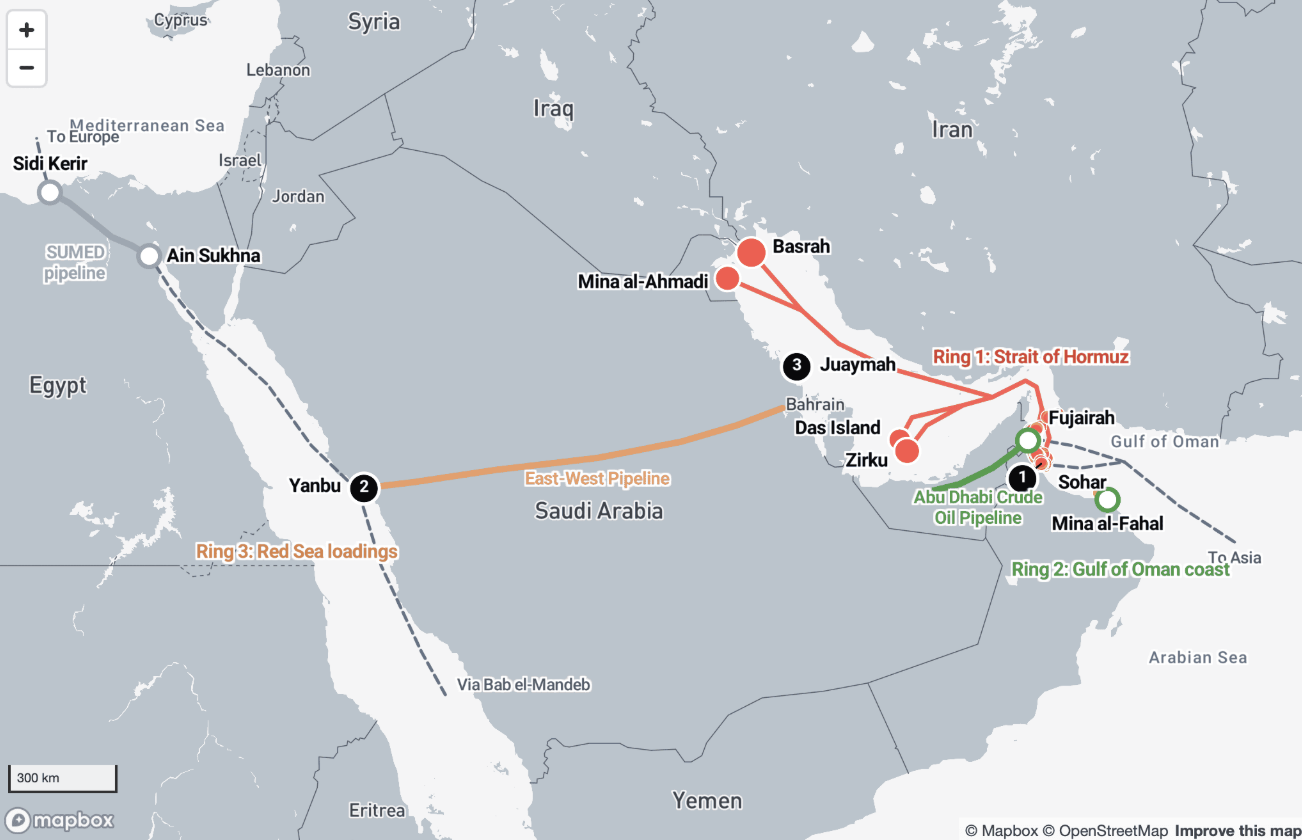
"Alternative routes and logistical adjustments have somehow allowed producers to keep barrels moving despite the disruption around Hormuz," said Priyanka Sachdeva, head of market insights at Phillip Nova [7]. She added: "There have been renewed attacks on tankers around the Strait of Hormuz, and the number of incidents has increased in recent days. This means that while barrels are still moving, the cost, insurance, routing, and security risks of moving them remain elevated." [13] In my view the relief has reached the benchmark before it reaches the delivered cargo, because those costs are paid on top of the crude price. The counter-case is that a Brent near $100 already includes them. Waterer said that without a clear diplomatic breakthrough or a further material improvement in export efficiency, the floor under prices looks reasonably firm [15].
Three outcomes would change that view. The first is the Houthi campaign turning from a cost problem into a volume problem. The group said it hit an Aramco refinery at Rabigh and airports in Riyadh and Abha [9] after Saudi-backed Yemeni forces retook the coast around the Bab el-Mandeb Strait up to Mocha [8]. The claims could not be immediately verified, and there was no immediate Saudi confirmation [8][9]. Saudi exports led the September recovery [4]. The second is diplomacy: US-Iran talks are at a stalemate [10], and a deal could add Iranian barrels that now count for zero [11]. The third would prove the cost thesis wrong. If export efficiency keeps improving and Brent falls well below $100 while tanker incidents keep rising, the shipping risk Sachdeva describes is a smaller charge than her warning implies.
What to watch
- Saudi Arabia's December official selling price for Arab Light into Asia; a second cut would extend what ING called an improving supply picture.
- The October reading for Gulf oil flows excluding Iran, set against September's figure of over 81% of pre-war levels.
- Whether Saudi Arabia confirms or denies damage at the Rabigh refinery the Houthis say they hit.