Invest2 publishers3 min readPublished
Samsung Biologics union asks Samsung Electronics to bargain as its employer under Korea's new labor law
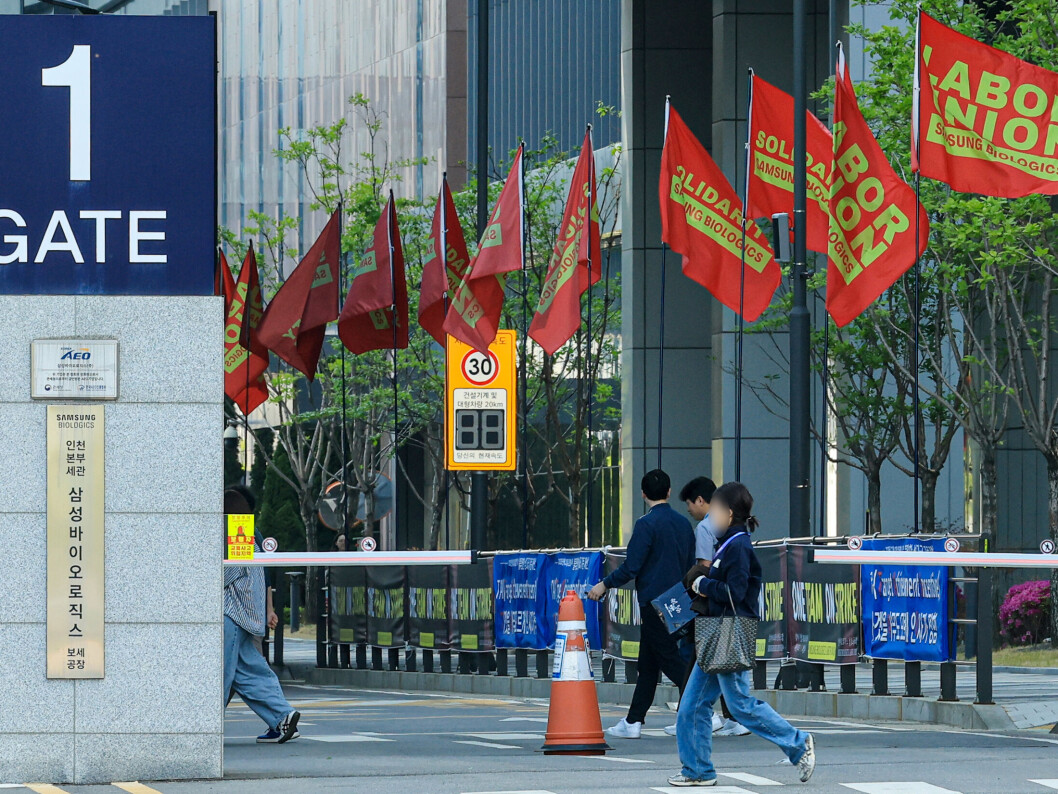
Samsung Biologics' union asked Samsung Electronics, its roughly 31% shareholder, to bargain over pay and promotions as its employer. The claim tests how far Korea's Yellow Envelope law reaches into a corporate group, while a three-week strike from Oct. 26 could cost, at May's loss rate, about a quarter's operating profit.
The Investor · Invest desk
Drafted by a language model from the sources cited here and checked against its claim ledger before publication. How we use AISend a correction
What happened
- The union gave Samsung Electronics until Monday to hand over HR documents and name negotiators, and proposed a first meeting at Samsung Biologics on Oct. 14.
- Korea's revised labor law, in force since March, lets a firm count as an employer without a contract if it has substantial and specific control over working conditions.
- Wage and personnel talks at Samsung Biologics have been deadlocked for more than six months, and three rounds of post-mediation talks failed.
Compiled by The InvestorSomething wrong?How this is made
Why it matters
- cost At the company's own May loss rate of 30 billion won a day, the 21-day strike would cost Samsung Biologics about 630 billion won, slightly more than a quarter's operating profit.
- decision Samsung Electronics has to choose by Monday: attending on Oct. 14 concedes part of the employer question, while silence sends the dispute to the labor commission.
- precedent A commission finding against a roughly 31% shareholder would be an early ruling under a law in force only since March, one that unions at other affiliates with parent-designed pay systems could cite.
The union's first collective bargaining demand to Samsung Electronics, sent on Tuesday [1], went to a company that is only the drugmaker's second-largest shareholder [19]. The union argues that the chipmaker's influence over personnel and pay policies makes it an employer under Korean labor law [9]. The Yellow Envelope act turns on control over working conditions [10], so the case rests on who writes the evaluation and pay rules, and the size of the stake matters less. The two newspapers covering the request do not even agree on it: 30.92% in the Korea Herald, 31.22% in the JoongAng Daily [19][20].
The union drew its list to fit that test. It said it confined its demands to matters where it believes Samsung Electronics holds actual employer authority [3], and the Korea Herald lists them as evaluations, performance-linked compensation, promotions and the rules governing personnel and reward systems [2]. The union has bargained alone since its members left the Samsung Group United Union, the group's cross-affiliate union, in June [13].
The strike cost falls on Samsung Biologics. The company estimated that the May 1-5 walkout cost about 150 billion won, roughly a quarter of its second-quarter operating profit [12]. That works out to 30 billion won a day [15], and it implies quarterly operating profit of around 600 billion won [16]. At the same daily rate, the three-week strike planned from Oct. 26 [7] would cost about 630 billion won [17], slightly more than one quarter's operating profit [18]. The estimate assumes the May rate holds for 21 days. It also leaves out the work-to-rule campaign of refused overtime and holiday work that has run since the May walkout [8]. This month the company is marketing its contract manufacturing capacity at CPHI Milan, Bio Japan and World ADC San Diego, the last running Oct. 12 to 15 [14].
"We are reviewing the matter and have no official position at this point," Samsung Electronics said [11]. If it names negotiators and attends the proposed Oct. 14 meeting [4], it concedes part of the employer question just by sitting down. Letting Monday's deadline pass sends the union to the National Labor Relations Commission, where a finding of employer status could bring a corrective order [5]. The third outcome is a wage deal at Samsung Biologics before Oct. 26 that makes the parent claim less pressing, though three rounds of post-mediation talks have already failed [6].
I think the request changes little about the October strike, which grew out of the subsidiary's own wage talks [6][7]. The longer exposure is the ruling. A commission finding that a roughly 31% shareholder is the employer for personnel rules it sets would be an early reading of a law in force only since March [10]. Unions at other affiliates whose pay systems are designed by a parent would then have a ruling to cite. This view is wrong if Samsung Electronics turns up on Oct. 14 and the strike is called off, because the parent claim would then have moved the subsidiary's wage talks.
What to watch
- Whether Samsung Electronics names bargaining representatives by the Monday deadline, or the union files for an employer-status ruling at the National Labor Relations Commission.
- Whether anyone from Samsung Electronics attends the proposed Oct. 14 meeting at Samsung Biologics.
- Whether a wage deal before Oct. 26 averts the three-week strike, and what loss estimate Samsung Biologics gives if it goes ahead.