Meijo University team finds the lipoxygenase that opens saclipin synthesis in a freshwater cyanobacterium
Meijo University researchers identified AsLOX2, a lipoxygenase that converts over 80% of its starting fatty acid to a saclipin precursor in minutes. It covers only the gateway step of the pathway, and the overall yield of saclipins was modest.
The Scientist · Science desk
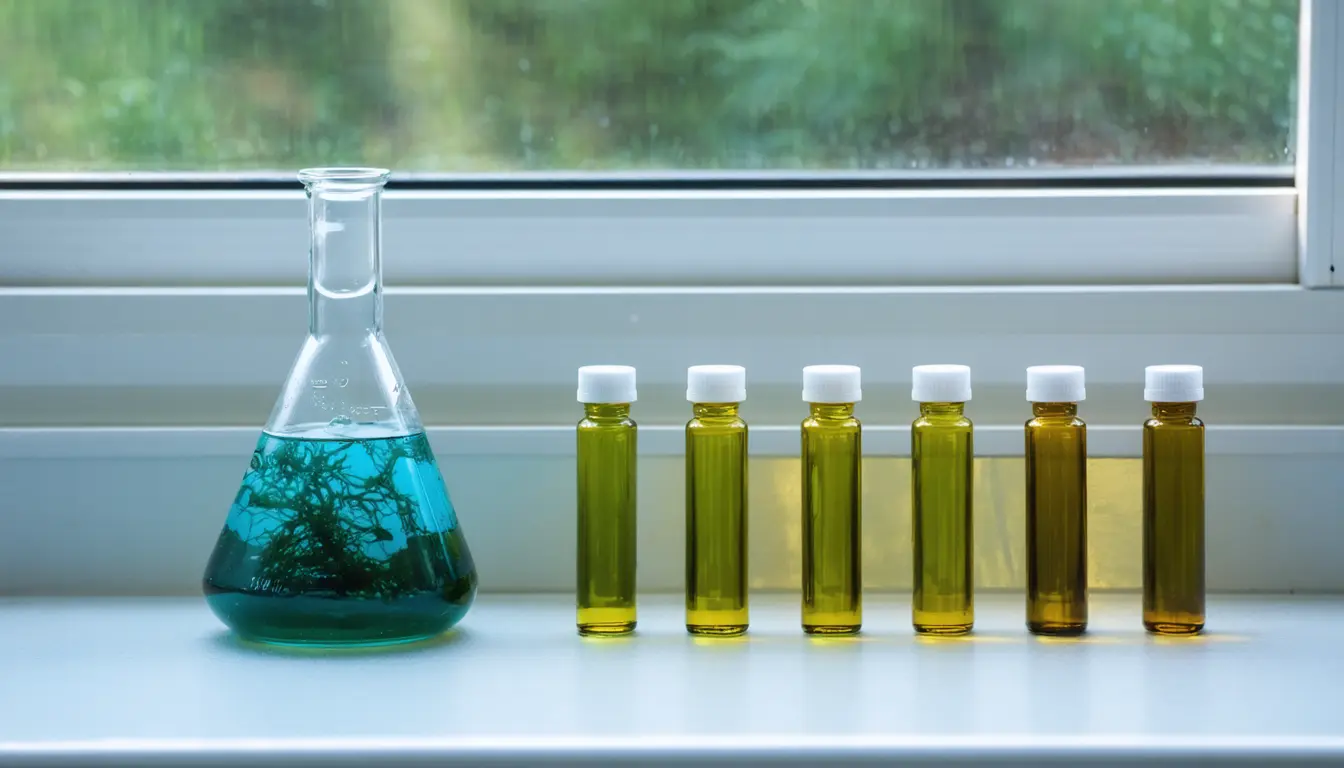
Key figures: under optimized conditions AsLOX2 converted more than 80% of the starting fatty acid into 9,16-diHPOTE within a few minutes. Separately, saclipin A and saclipin B were produced in a ratio of approximately 9 to 1.
| Figure | Value | Note | Claim |
|---|---|---|---|
| Fatty acid AsLOX2 converted to 9,16-diHPOTE, more than | 80% | within a few minutes, optimized conditions | 8 |
| Saclipin A, approximately | 9 parts | 10 | |
| Saclipin B | 1 parts | 10 |
What happened
- Only one of the two candidate lipoxygenases worked: AsLOX2 acted on all three fatty acids tested, most strongly on alpha-linolenic acid, while AsLOX1 showed no detectable activity.
- AsLOX2 adds oxygen at two positions on alpha-linolenic acid to give 9,16-diHPOTE, an intermediate the team confirmed by chromatography and mass spectrometry.
- The team reduced that intermediate and then oxidized it chemically, producing compounds that matched authentic saclipins A and B.
- Saclipin A formed in greater amounts than saclipin B, at roughly nine parts to one.
Why it matters
- capability A characterized enzyme gives other groups a defined starting point for building enzymatic or microbial production of saclipins, which low natural abundance has so far blocked.
- constraint The natural downstream enzymes are still unidentified, so a fully biological route cannot yet be designed and the chemical steps stay in the process.
- decision Anyone weighing this route against extraction from the cyanobacterium has nothing to compare yet: the authors list productivity, safety and stability as unassessed.
The 80% figure has a narrow denominator. It is the share of the starting fatty acid that AsLOX2 converted into 9,16-diHPOTE within a few minutes, under optimized conditions [8]. Two further chemical reactions, a reduction and then an oxidation, were needed to reach saclipins [9]. The report on the work did not state a yield for the finished compounds [11].
The design answers one question well. Hakuto Kageyama and Yoshie Uchida of Meijo University led a team that searched the A. sacrum genome, found two lipoxygenase candidates and tested recombinant versions of each against three fatty acids [4][5]. That shows what each protein can do when handed a substrate. It does not show what AsLOX2 does inside the cyanobacterium, where saclipin accumulation is strongly stimulated by desiccation stress [3]. In our view, the next check is whether AsLOX2 activity follows that stress response.
Kageyama does call AsLOX2 the entry point. He said: "Identifying AsLOX2 as the gateway enzyme gives us an important biochemical entry point for understanding how this unusual UV-absorbing compound is produced." [15]
He was equally direct about the unfinished part. Kageyama said: "The combination of an enzymatic gateway step and chemical conversion demonstrates a practical route toward saclipin production, while also highlighting the downstream reactions that remain to be discovered in the natural pathway." [16]
The interest in saclipins is commercial. Natural UV absorbers are attracting attention as cosmetic ingredients [18]. Saclipins have also been reported to be antioxidative and antiglycative and to be stable under light and heat [17]. Their low natural abundance and poorly understood biosynthesis have limited how widely they can be used [2].
What to watch
- Identification of the natural enzymes downstream of AsLOX2 in A. sacrum, which would let a fully biological route be designed.
- A reported overall yield for the enzyme-plus-chemistry route, or a first attempt at a microbial production host.
- Measurements of AsLOX2 activity in the cyanobacterium under desiccation stress, to test its role inside the cell.
Clarity's read
What the record supports and how the coverage leans. The claims behind it follow.
Reality
- Evidence68
- Adoption
- Insufficient
- Hype gap+20
- Incentives
- Insufficient
- Confidence62
Claim ledger
Ranked by verification strength, evidence, and original report placement.
- [1]
Saclipins A and B are unusual UV-absorbing oxylipins produced by the edible freshwater cyanobacterium Aphanothece sacrum, known in Japan as Suizenji-nori.
- [2]
The low natural abundance and poorly understood biosynthesis of saclipins have limited efforts to use them more broadly.
- [3]
Saclipin accumulation is strongly stimulated by desiccation stress.
- [4]
Professor Hakuto Kageyama and graduate student Yoshie Uchida of the Graduate School of Environmental and Human Sciences, Meijo University, Japan, led the research team, whose findings were published online in the Journal of Natural Products.
- [5]
The researchers searched the A. sacrum genome, identified two candidate lipoxygenase enzymes, AsLOX1 and AsLOX2, produced recombinant versions of both, and tested them on alpha-linolenic acid (ALA), linoleic acid and arachidonic acid.
- [6]
AsLOX2 showed clear activity toward all three substrates, with the highest activity toward ALA, whereas AsLOX1 showed no detectable activity under the tested conditions.
- [7]
AsLOX2 acts on ALA by introducing oxygen at two positions to produce 9,16-diHPOTE, a key intermediate linked to saclipin formation; the researchers confirmed its identity using chromatographic and mass spectrometric analyses.
- [8]
Under optimized conditions, AsLOX2 converted more than 80% of the starting fatty acid into 9,16-diHPOTE within a few minutes.
- [9]
The intermediate was reduced to form 9,16-diHOTE, and a chemical oxidation step then generated compounds corresponding to saclipins A and B, whose identities were confirmed by comparison with authentic compounds.
- [10]
Saclipin A was produced in greater amounts than saclipin B, with the two occurring in a ratio of approximately 9:1.
- [11]
The overall yield of the combined enzymatic and chemical route was modest, though the results showed the steps could be combined to produce the UV-absorbing compounds.
- [12]
The authors note that further work is needed to identify the natural downstream enzymes in the saclipin pathway.
- [13]
The authors note that productivity, safety, stability and other properties must be assessed before practical cosmetic or functional material applications can be considered.
- [14]
The findings provide a foundation for investigating enzymatic, microbial or other alternative production systems that could reduce reliance on extraction from A. sacrum.
- [15]
"Identifying AsLOX2 as the gateway enzyme gives us an important biochemical entry point for understanding how this unusual UV-absorbing compound is produced."
- [16]
"The combination of an enzymatic gateway step and chemical conversion demonstrates a practical route toward saclipin production, while also highlighting the downstream reactions that remain to be discovered in the natural pathway."
- [17]
Saclipins have been reported to show antioxidative and antiglycative activities as well as photo- and thermochemical stability.
- [18]
UV-absorbing compounds from natural sources are attracting interest as potential ingredients for cosmetics and other protective materials.
Get this ledger inside ChatGPT. Ask about any of our stories and the answer brings its figure, each claim’s verdict and the sources. Free, no account.
Sources
1 independent publisher whose own reporting we read for this story.
- phys.orgEnzyme discovery opens a new route to natural UV-absorbing saclipins
1 article · October 14, 2026
Topics and entities
Follow any of these and your For You feed starts watching them — no settings page required.