Antibody changes come earlier in pregnancies that end before 37 weeks, a UCSF analysis finds
UCSF researchers found antibody levels higher and earlier in women who delivered before 37 weeks, in samples from more than 2,000 pregnant women. The team says its profiling tool could lead to new ways to screen for preterm risk and to prevent it.
The Scientist · Science desk
What happened
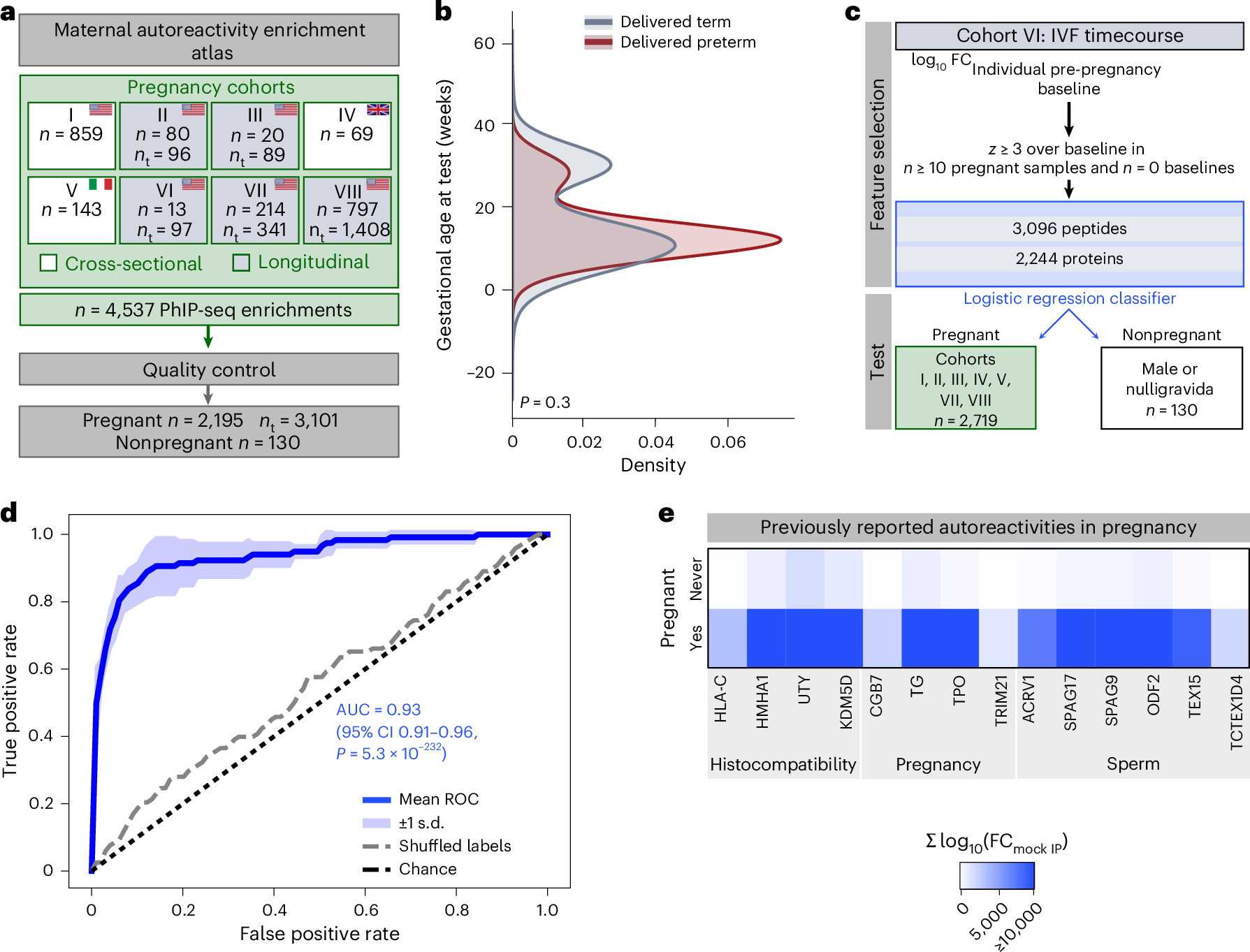
- The team recruited UCSF fertility-clinic patients, took blood before pregnancy, and then followed women who conceived through frozen embryo transfer.
- Using phage immunoprecipitation sequencing, the team identified a set of antibodies that appeared consistently once pregnancy began.
- That baseline was compared against eight cohorts, among them California prenatal screening samples collected at 15 weeks of gestation.
- Women who delivered early showed broader antibody changes sooner, and an antibody against the inflammation-controlling protein IL1RA stood out.
- IL1RA blocks IL1 beta, an inflammatory molecule linked to uterine contractions, and an antibody that neutralizes IL1RA removes that brake.
Why it matters
- capability A named inflammatory pathway gives preterm-birth research something specific to test, in a field where doctors have struggled to explain why labor starts early.
- decision Trialists weighing an existing anti-inflammatory drug for preterm prevention now have an antibody-based rationale, though the support so far is a hint.
- constraint The pre-pregnancy baseline rests on a handful of fertility-clinic patients, so it describes pregnancy-associated antibodies in that narrow group and leaves the broader claim to the larger cohorts.
The design matters as much as the result. Elze Rackaityte, the first author, said: "We wanted to capture the immune system before pregnancy, and then measure what changed." [6] She said the clinic population fit that aim: "This patient population was particularly well suited to answering that question, because the timing of pregnancy following a frozen embryo transfer could be closely tracked." [7]
That pre-pregnancy baseline let the team list antibodies that come with pregnancy itself [8]. The large cohorts could then show whether any antibodies were specifically associated with preterm birth [9]. In our view the small baseline group is adequate for that narrow job, because the preterm result rests on the larger comparison.
Two kinds of evidence are in play. The blood samples show an association: higher levels, appearing earlier [2]. The causal claim comes from the live-mouse and human placental tissue work, and the UCSF researchers say the antibodies play a role in triggering early labor [1]. The thing this doesn't tell you is how the antibodies perform in a single pregnancy. The report does not say how many of the 2,000-plus women delivered early, how often the antibodies turn up in women who went to term, or what the mouse and placenta experiments showed in detail.
That missing number decides whether a screen is useful. About one in 10 pregnant women goes into labor too soon [3]. At that rate, a hypothetical test that caught 90 percent of preterm pregnancies and wrongly flagged 10 percent of term ones would be right about half the time it raised an alarm [14]. The 90 and 10 percent figures are our illustrative inputs, not results from the study.
DeRisi, senior author of the Nature Immunology paper [4], said: "We built our tool to find exactly these kinds of hidden immune signals." [12] He added: "The fact that it's pointing us toward why some pregnancies go wrong is an exciting result." [13] The researchers suggest the tool could lead to new screening and preventive interventions [16].
The researchers also read a hint in the results: a drug already used for some inflammatory conditions could be a candidate to prevent preterm birth [15]. We'd treat that as a hypothesis for a trial in pregnant women, and the paper's own wording is "might feasibly" [15].
What to watch
- Sensitivity and false-positive figures for individual pregnancies, from the Nature Immunology paper or a replication in a cohort outside these eight.
- Whether anyone tests the unnamed existing anti-inflammatory drug against preterm delivery in animals or in a trial in pregnant women.
- Whether the IL1RA antibody can be detected in samples drawn earlier than California's 15-week prenatal screening draw.
Clarity's read
What the record supports and how the coverage leans. The claims behind it follow.
Reality
- Evidence55
- Adoption
- Insufficient
- Hype gap+15
- Incentives
- Insufficient
- Confidence50
Claim ledger
Ranked by verification strength, evidence, and original report placement.
- [1]
By analyzing maternal sera from term and preterm pregnancies, together with studies in live mice and in human placental tissues, UCSF researchers identified antibodies that play a role in triggering early labor.
- [2]
The antibodies were present at higher levels and appeared earlier in pregnancy in women who went on to deliver before 37 weeks' gestation than in women who delivered at term.
- [3]
About one in 10 pregnant women goes into labor too soon, and premature or preterm birth is the leading cause of newborn deaths worldwide; doctors have struggled to understand why it occurs or how to predict which pregnancies are at highest risk.
- [4]
Joe DeRisi is senior author of the paper in Nature Immunology titled 'Evidence for maternal autoantibodies in the pathogenesis of preterm birth.'
- [5]
First author Elze Rackaityte recruited volunteers seen at UCSF's fertility clinic; the team collected initial blood samples and then tracked a handful of women after they became pregnant from frozen embryo transfers.
- [6]
Rackaityte said: "We wanted to capture the immune system before pregnancy, and then measure what changed."
- [7]
Rackaityte said: "This patient population was particularly well suited to answering that question, because the timing of pregnancy following a frozen embryo transfer could be closely tracked."
- [8]
Using phage immunoprecipitation sequencing (PhIP-seq), which lets researchers see which proteins the antibodies in a person's blood recognize, including the body's own proteins, the team identified a set of antibodies that appeared consistently once pregnancy began.
- [9]
The team then analyzed blood samples from more than 2,000 pregnant women across eight cohorts, including samples collected by California's statewide prenatal screening program at 15 weeks of gestation, to see whether any antibodies were specifically associated with preterm birth and not just with pregnancy itself.
- [10]
Women who delivered prematurely experienced broader antibody changes earlier than those who delivered at term; within that signature, an antibody reacting against IL1RA, a protein known to control inflammation, stood out.
- [11]
IL1RA blocks IL1 beta, a molecule that drives a kind of inflammation known to trigger uterine contractions; an antibody that neutralizes IL1RA removes that brake, allowing IL1 beta and its inflammation to rise unchecked.
- [12]
DeRisi said: "We built our tool to find exactly these kinds of hidden immune signals."
- [13]
DeRisi said: "The fact that it's pointing us toward why some pregnancies go wrong is an exciting result."
- [14]
Illustration with assumed inputs: at a preterm prevalence of about 10 percent, a hypothetical test with 90 percent sensitivity and 10 percent false-positive rate among term pregnancies has a positive predictive value of 50 percent.
- [15]
The results hint that an existing drug used to treat certain inflammatory conditions might feasibly represent a potential candidate for preventing preterm birth.
- [16]
The researchers suggest the new UCSF immune profiling tool could lead to new ways of screening for preterm birth risk and to new preventive interventions.
Get this ledger inside ChatGPT. Ask about any of our stories and the answer brings its figure, each claim’s verdict and the sources. Free, no account.
Sources
1 independent publisher whose own reporting we read for this story.
- genengnews.comPreterm Birth for Some Women Linked to Specific Autoantibodies
1 article · October 14, 2026
Topics and entities
Follow any of these and your For You feed starts watching them — no settings page required.
Entities
- Joe DeRisiFollow
- Nature ImmunologyFollow
- PhIP-seqFollow
- University of California, San FranciscoFollow
- GEN (Genetic Engineering & Biotechnology News)Follow
- Elze RackaityteFollow