ScienceNot yet confirmed elsewhere1 publisher3 min readPublished
Southwestern spotted bats carry the most genetic diversity among 121 bats sampled over two millennia
Northern Arizona University researchers analysed DNA from 121 spotted bats, the oldest about 2,100 years old, and found the most diversity in the US Southwest. The museum and cave samples give a baseline for a bat that is hard to count, though the reported finding maps diversity by place, with northern populations looking more vulnerable.
The Scientist · Science desk
What happened
- Northern populations appear to have lower genetic diversity and may be more vulnerable to environmental change, according to Faith Walker of Northern Arizona University.
- Many of the modern specimens came from a single cave, a sampling bias the authors list among the study's limitations.
- The study appeared in the journal PLOS One on October 7, 2026.
Compiled by The ScientistSomething wrong?How this is made
Why it matters
- capability DNA from museum drawers and cave remains lets researchers compare a species across a century or more, for a bat whose solitary night habits make headcounts unreliable.
- constraint Ancient bats make up about 5% of the sample and the modern set leans on one cave, so any claim of change over time from this dataset rests on small or skewed groups.
- decision If Walker's reading holds, spotted bat protection would treat the Southwest as the species' main store of genetic variation and northern populations as the more fragile edge.
A spotted bat is hard to count. It is nocturnal, an agile flier, and it roosts alone [2]. A field survey that finds fewer of them may be recording a real decline, or it may simply have missed them. Genetic data does not depend on spotting the animal. "Genetics allows us to see patterns of connectivity, isolation and long-term persistence that would otherwise remain hidden, providing information that can directly inform conservation planning," Walker said [9].
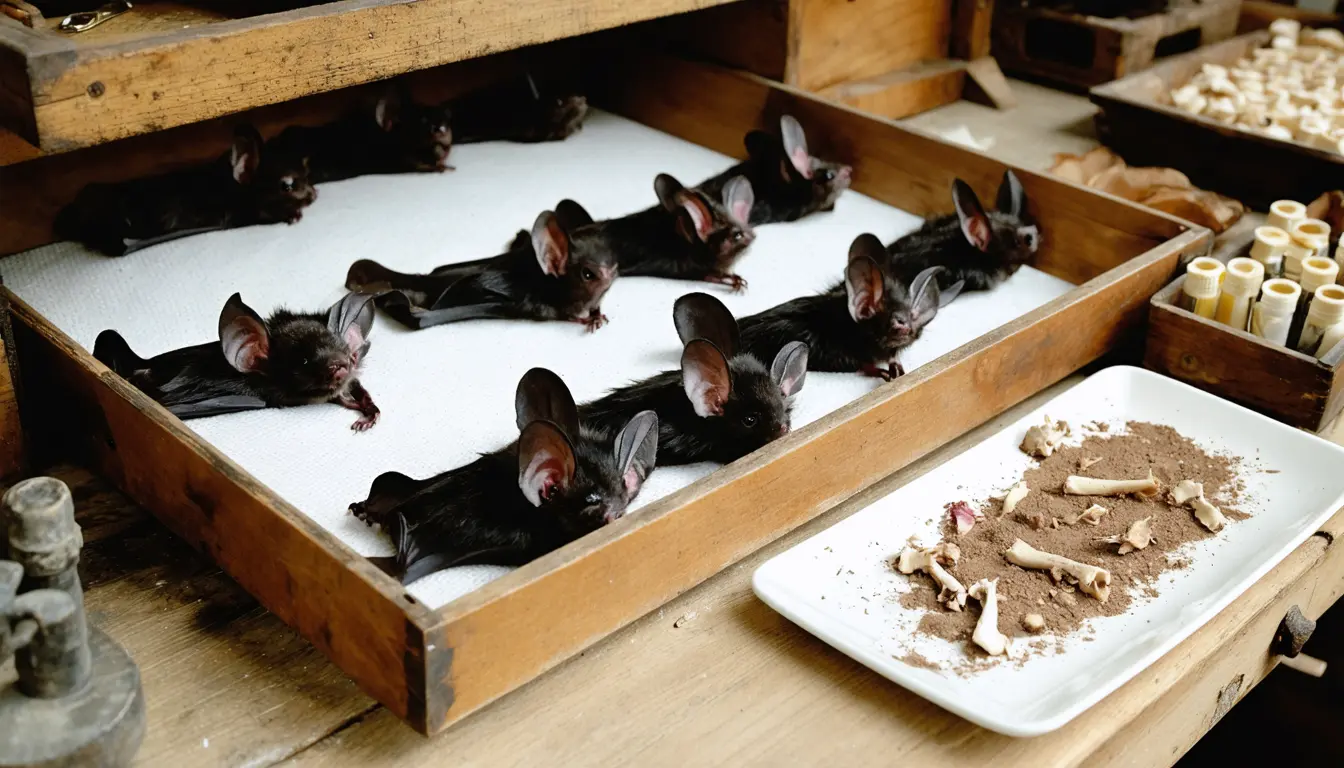
The appeal of this study is its depth in time. Museum specimens collected between 1904 and 1991 sit in the middle [4]. Behind them are six bats from a northern Arizona cave, with conventional radiocarbon ages of roughly 120 to 2,100 years before 1950. Ahead of them are contemporary specimens from 1994 to 2025 and bats captured alive [4]. In principle, that lets researchers ask whether today's bats carry less diversity than their predecessors did. A headcount of a solitary night flier cannot answer that question.
The old end of the sample is thin. Six of the 121 bats are ancient [3][4], about 5% of the total [14]. The other 115 [15] are split between the museum and modern periods. Many of the modern specimens came from a single cave, a sampling bias the authors list as a limitation [7]. Walker said the combined samples "allowed us to reconstruct a much broader picture of how spotted bat populations have changed through time" [13]. The press account does not give the split between periods or diversity figures for each one, so whether spotted bat diversity has fallen since 1904 cannot be checked from it.
The result it does report is geographic. The team described genetic structure, variation and relatedness across the range and found differences between northern and southern populations [6]. "One of the most important findings of our study is that spotted bats in the southwestern United States harbor the greatest genetic diversity across the species' range, making this region a critical reservoir of evolutionary potential for the species," Walker said [5]. Northern populations, she said, "appear to have lower genetic diversity and may be more vulnerable to future environmental change" [10].
The north-south contrast is a correlation with geography. The authors say further studies are needed on how specific human disturbances affect dispersal and population dynamics [8]. North American bats face threats including habitat loss, climate change and white-nose syndrome [12]. The authors' advice covers every kind of population they found. "Our integrative approach across temporal scales highlights the conservation importance of preserving genetically diverse core populations, vulnerable leading-edge populations and isolated relict lineages," the authors said [11].
I'd treat the Southwest finding as usable for setting priorities now, on one condition. That condition is knowing which region the over-sampled cave sits in, because a modern sample drawn mostly from one site can shape how diverse that region appears [7].
What to watch
- Per-period diversity figures in the PLOS One paper showing whether museum-era and modern spotted bats differ genetically.
- Which region the over-sampled modern cave lies in, and whether the north-south contrast holds without it.
- Follow-up work on how specific human disturbances affect spotted bat dispersal, which the authors say is needed.
Clarity's read
What the record supports and how the coverage leans. The claims behind it follow.
Reality
- Evidence50
- Adoption
- Insufficient
- Hype gap+15
- Incentives
- Insufficient
- Confidence45
Claim ledger
Ranked by verification strength, evidence, and original report placement.
- [1]
A study published Oct. 7, 2026, in PLOS One by Faith M. Walker of Northern Arizona University and colleagues describes genetic analysis of ancient, historical and modern samples from North American spotted bats.
- [2]
Spotted bats (Euderma maculatum) are nocturnal, agile fliers that roost solitarily; bats' elusive behavior can hinder scientific observation.
- [3]
Researchers obtained samples from 121 individual spotted bats across three separate time frames and across the species' range in western North America.
- [4]
Samples included live captured bats, historical museum specimens collected between 1904 and 1991, contemporary specimens collected between 1994 and 2025, and six ancient specimens recovered from a northern Arizona cave with conventional radiocarbon ages of approximately 120 to 2,100 years BP (before AD 1950).
- [5]
"One of the most important findings of our study is that spotted bats in the southwestern United States harbor the greatest genetic diversity across the species' range, making this region a critical reservoir of evolutionary potential for the species."
- [6]
The researchers described the genetic structure, genetic variation and genetic relatedness of spotted bats and identified genetic differences between northern and southern populations.
- [7]
The study had limitations including sampling bias: many of the modern specimens originated from a single cave.
- [8]
Future studies are needed to better understand the impacts of specific anthropogenic disturbances on population dispersal and dynamics.
- [9]
"Genetics allows us to see patterns of connectivity, isolation and long-term persistence that would otherwise remain hidden, providing information that can directly inform conservation planning."
- [10]
"In contrast, northern populations appear to have lower genetic diversity and may be more vulnerable to future environmental change."
- [11]
"Our integrative approach across temporal scales highlights the conservation importance of preserving genetically diverse core populations, vulnerable leading-edge populations and isolated relict lineages."
- [12]
Emerging threats to North American bat populations include habitat loss, climate change, white-nose syndrome and other disturbances.
- [13]
"Each sample represented a small piece of the species' history, and together they allowed us to reconstruct a much broader picture of how spotted bat populations have changed through time."
- [14]
The six ancient specimens are about 5% of the 121 bats sampled.
- [15]
115 of the 121 bats came from the museum and modern periods.
Sources
1 independent publisher whose own reporting we read for this story.
- phys.orgAncient spotted bat samples help researchers understand present-day population dynamics
1 article · October 7, 2026
Topics and entities
Follow any of these and your For You feed starts watching them — no settings page required.
Topics
- Conservation GeneticsFollow
- Bat conservationFollow
- Ancient DNAFollow