Science2 publishers3 min readPublished Updated
Four mummies buried beside a Wari temple reopen the question of whether the Wari conquered the Nasca
Corina Kellner's team found four mummies buried beside a Wari temple at Peru's Huaca del Loro, apart from the site's cemetery. She takes the placement as a hint that the Nasca supported the Wari, an idea that pending CT, DNA and isotope results will test.
The Scientist · Science desk
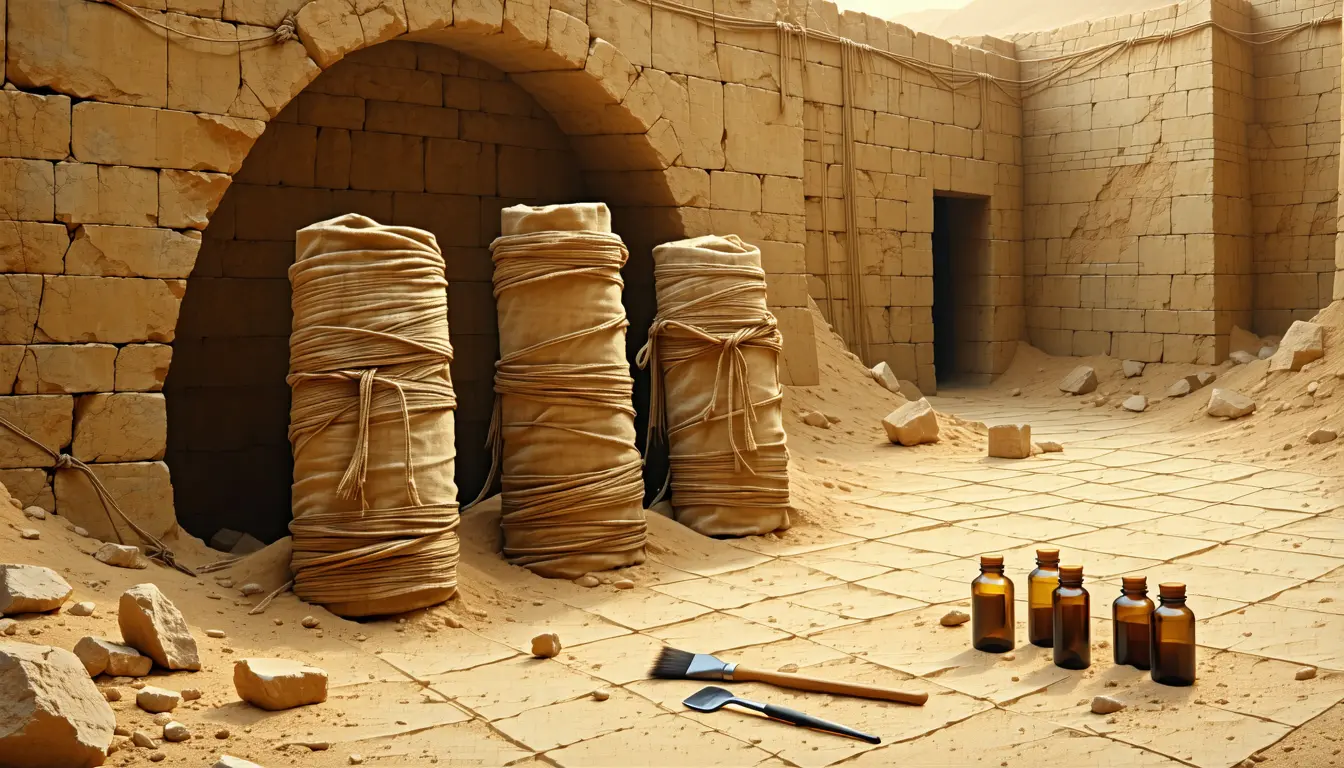
What happened
- Kellner's team was chosen to excavate Huaca del Loro in 2018 and found the four mummies during its second field session there, in 2022.
- The burials had gone undisturbed for more than 1,000 years, which Kellner said is uncommon in Peru.
- The Wari Empire is generally thought to have conquered the Nasca, whose civilization held Peru's south coast from AD 1 to 750.
- The site was occupied during the Middle Horizon, the transition that ended the Nasca civilization and began state influence by the Wari and Bolivia's Tiwanaku.
Compiled by The ScientistSomething wrong?How this is made
Why it matters
- constraint Four burials can show that some people were given a place at a Wari temple. On their own they cannot show how the Nasca population as a whole related to the Wari.
- capability Because the bundles were never disturbed, the CT scans and DNA samples come from individuals whose burial setting was not mixed or robbed by later digging.
- precedent If the lab results back Kellner, accounts of the Middle Horizon on Peru's south coast would have to make room for Nasca support of the Wari alongside, or in place of, conquest.
Kellner's argument starts with a comparison. At Huaca del Loro the dead were buried in the cemetery, and these four were buried somewhere else. "That's typical for a lot of burials in Peru, but what makes these individuals so interesting is that we found them buried by a Wari temple and not in the cemetery like the rest," she said [5]. The layout of the bodies was typical for Peru, and their placement by the temple was the unusual part [5].
The published account does not say whether the four are thought to be local Nasca or people from the Wari heartland around Ayacucho [16]. In my view that is the question the interpretation hangs on. Wari incomers buried at a Wari shrine would fit a conquest account without difficulty. Local people given that place would fit Kellner's.
The lab work could narrow it. The first pass used X-rays. "When we first found these individuals, we were able to get X-rays and worked with a radiologist and a doctor to interpret the results," Kellner said [9]. This summer she spent five weeks in Peru with Melissa Lund, a professor at the Pontifical Catholic University of Peru, and Alexandra Oshiro, a graduate student there [8]. With permission from the Ministry of Culture, and help from Susana Arce, director of the Museo Nacional de Lima, where the mummies are kept, the team took them out of the museum for CT scans and DNA sampling [10].
The part of the design I like best is that they sampled the neighbours as well. "We also took samples from other people and animals found at the site, so that we could run isotopic analysis that will help us figure out diet, relationships and migration patterns," Kellner said [11]. Those samples are the control group. They let the team ask whether the four ate and moved like the people in the cemetery.
Kellner already has a working answer. "These findings make us think that the Wari and the Nasca had a previous relationship and that the Nasca civilization might have supported the Wari Empire," she said [14]. She suggests the tie may have run through ceramic technology, for which the Nasca are known, or through textiles and cotton [15]. The Wari settled in Ayacucho, high country where cotton might have been hard to grow. The Nasca lived at lower elevation, on land suited to cotton and coca [16].
Her stated aim goes beyond a yes-or-no verdict on conquest. "We are looking for colonization techniques to see if there was any type of resistance and to determine how complex their relationship was," she said [13]. I'd treat the cooperation reading as a hypothesis with a test attached. The test has not been run. Isotope analysis at NAU's Anthropology Isotope Paleodiet lab starts only after the DNA and CT results come back [17].
What to watch
- Whether the DNA results tie the four temple burials to each other or to people buried in the Huaca del Loro cemetery.
- Whether isotope values mark the four as locals or as migrants, and how they compare with the other people and animals sampled at the site.
- Publication of the CT, DNA and isotope data in a form other researchers can check.