Science3 publishers2 min readPublished
A retired inventor charred homemade scrolls to find which Herculaneum rolls X-rays can read
The ink and the burned papyrus are both carbon, so X-rays struggle to tell letters from page. In a new PLOS One study, lead added to test ink showed up clearly, and the authors want unopened scrolls screened for it.
The Scientist · Science desk
What happened
- A PLOS One paper published on Sept. 16, 2026 by Douglas Seiler of UC Berkeley, Jacob Michael LaManna of NIST, David Kreimer and colleagues takes up the problem of reading unopened Herculaneum scrolls.
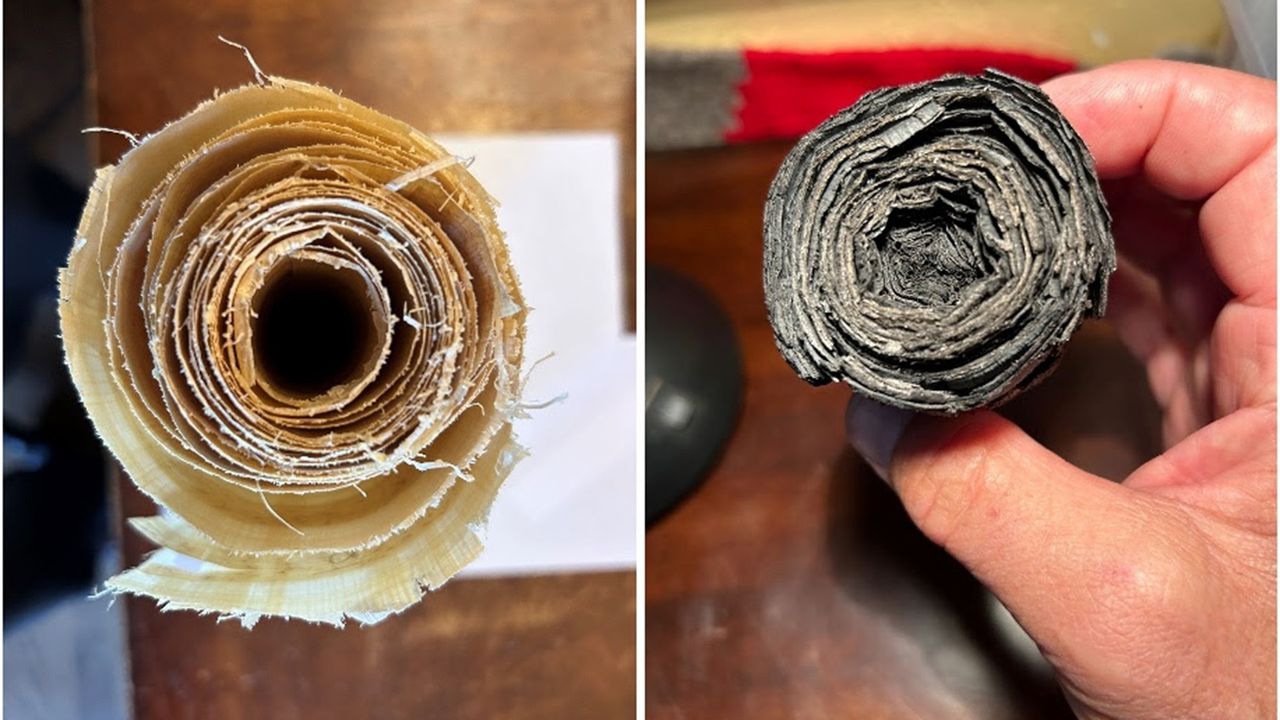
- The team wrote on new papyrus with inks at several lead concentrations, carbonized the scrolls in a high-temperature furnace, and then reread some of the words with X-ray tomography and custom software.
- On flat fragments of charred test papyrus, letters written without lead were invisible in the X-ray images, while letters written with lead-bearing ink could be seen.
- The authors propose scanning unopened scrolls for lead first and virtually unrolling only the ones that contain it, because X-rays separate lead from papyrus more easily.
- Vesuvius buried the library under 65 to 70 feet of rock and ash in 79 CE, carbonizing the scrolls and leaving many of them too fragile to study.
Compiled by The ScientistSomething wrong?How this is made
Why it matters
- capability Because the students' passages were recorded before the papyrus burned, an unrolling program's output can be scored word by word against a known answer, with no ancient artifact in the beam.
- constraint The screening idea only reorders the queue if ancient ink carries enough lead to see, and no method for checking the ancient scrolls has been built yet, so the practical gain is still untested.
- decision Anyone allocating scarce scan time on fragile rolls now has a cheap test to apply before tomography, which changes which scrolls go first rather than how they are imaged.
- contradiction Phys.org credits the already-opened scrolls with previously unknown writings by Epicurus, Discover names Philodemus, and Live Science describes Epicureans and Stoics plus a passage on Plato's burial place, so the tally of what the library has yielded depends on which account you read.
Both the ink and the charred papyrus are mostly carbon, and in a scan the two look so similar that traces of writing are hard to pick out [4]. A sharper scanner runs into the same problem, because two materials that absorb X-rays at nearly the same rate stay hard to separate at any resolution. So the thing to change is the material. Lead is heavy, X-rays distinguish it from papyrus more easily, and lead has already been found in some Herculaneum letters [5][6].
The model scroll was built to test exactly that. Douglas Seiler, a retired inventor who had worked in real estate and banking, funded the study himself and worked with chemists to prepare inks containing different amounts of lead [10][11]. High school students wrote passages from Star Wars and the Bible on fresh papyrus with reed pens [9]. Seiler put the roll in a steel container in his home lab and heated it in a furnace until it charred [8]. Leah Packard-Grams, a papyrus specialist at UC Berkeley, helped check the test inks [28]. "This provides a low-risk method to develop algorithms without endangering the priceless artifacts," the team wrote [20].
X-ray fluorescence found lead at every concentration the team had mixed [13]. Jacob LaManna, a physicist at the National Institute of Standards and Technology, scanned a charred test scroll to build a 3D image of its tightly rolled layers [14]. Michael Cyrus Daugherty then adapted software originally written to examine the rolled layers inside lithium-ion batteries, adjusting it to follow the uneven papyrus and digitally flatten it [15]. Among the words they could make out were "the children of" [16].
The study does not show how much lead the ancient scrolls hold, or where in the roll it sits. The team set the concentrations in its own inks [10], and it still needs a way to check ancient scrolls, nearly 2,000 of which came out of the villa in the 1750s [19][2]. Not all of the model scroll's writing could be deciphered, though the scans did separate the text from the papyrus under it [17]. A separate handheld scanner did detect lead in the charred test scroll [18]. That detection is the screening step in miniature.
The eruption was in 79 CE and the paper came out in 2026, a gap of 1,947 years [27]. "But some of the Herculaneum scrolls aren't copies. These are books directly from the ancient world frozen in time," Seiler said in a press release [23].
What to watch
- Whether a survey of the unopened Herculaneum scrolls finds lead, and in what fraction of them.