ScienceReports disagree4 publishers3 min readPublished
University of Colorado ink lets light hide a tattoo while its pigment stays in the skin
University of Colorado Boulder engineers made three-colour tattoo inks that UV light switches on and bright light switches off, in a Matter & Light study. Because the pigment stays in the skin, the ink hides a tattoo without removing it, and its safety in people has not been established.
The Scientist · Science desk
What happened
- The inks put blue, magenta and yellow photochromic dyes inside nanoparticles of PMMA, a plastic already used in medical implants and dermal fillers.
- A 365-nanometre ultraviolet LED switches the colours on in about two to three seconds, and they last hours to days under indoor light, Bruns told Live Science.
- All three colour channels stayed switchable in the skin for between 1.4 and 2.2 years, according to Live Science.
- New Scientist reports 16 clearly distinguishable colours and at least 300 shades, though the palette has no white and no true cyan.
- PhotoTat is not yet offered in tattoo parlours; Bruns's group hopes to refine the designs over the coming years before making the inks available.
Compiled by The ScientistSomething wrong?How this is made
Why it matters
- contradiction Live Science says bright outdoor sun erases the colours in seconds, while New Scientist says wearers need sunscreen to stop sunlight switching them on; which is right decides whether a hidden tattoo stays hidden outdoors.
- constraint A clinic-only mark would be switched on at every visit, and the blue dye's slow photo-degradation into a permanent purplish tint works against a mark meant to be invisible in between.
- exposure Hiding a PhotoTat tattoo leaves its dye in the dermis, so any future toxicity finding about these dyes applies to everyone already tattooed, whether their design is switched on or off.
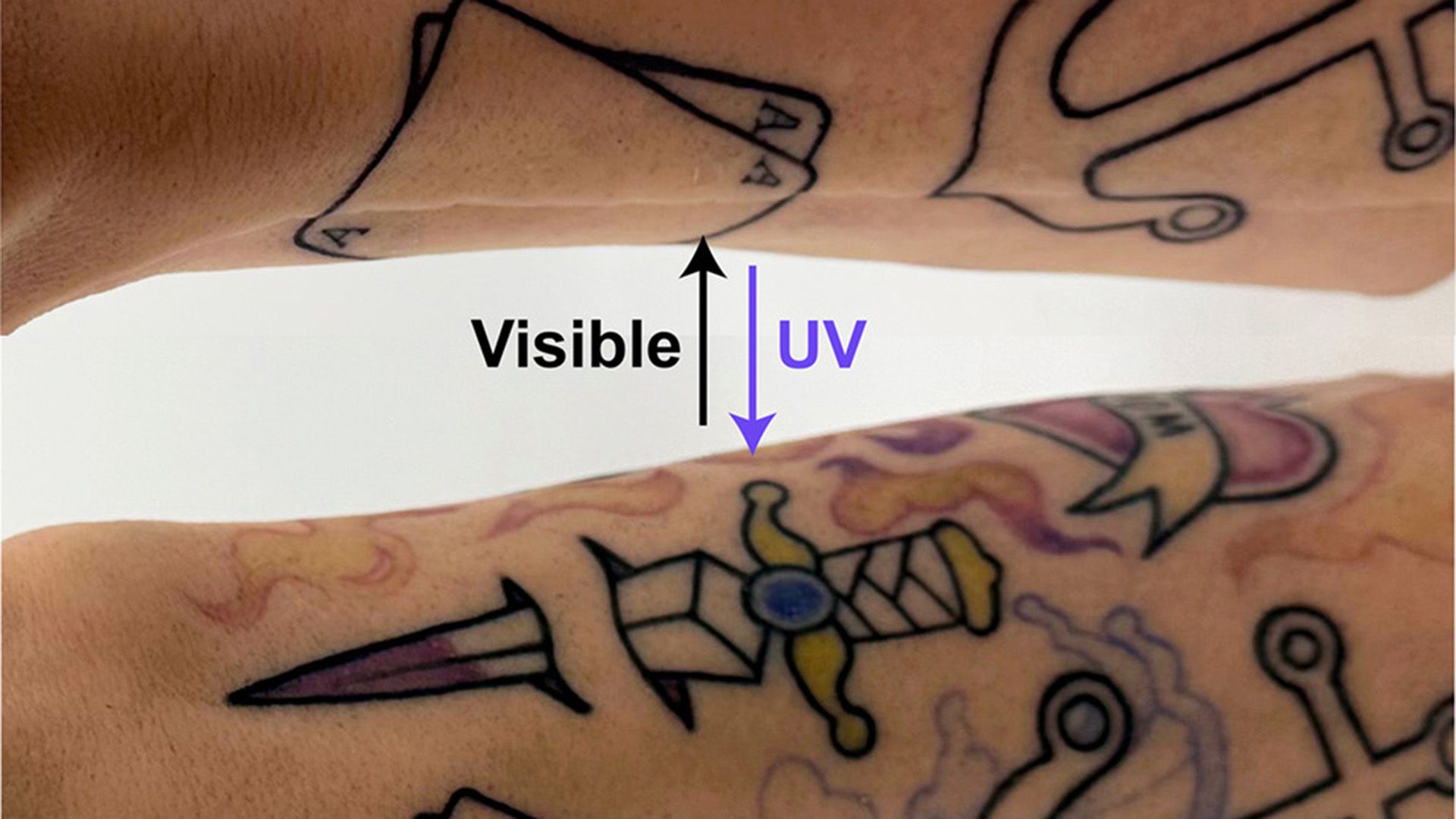
"The tattoo is permanent, but its appearance is not," Carson Bruns, an associate professor of biomedical engineering at the University of Colorado Boulder, told New Scientist [26][1]. By his account a PhotoTat tattoo goes in like any other: pigment particles pushed into the dermis with a needle, using the same machines and methods, and they stay there [28]. Light changes the dye's molecular structure, and with it the colour [7]. He described the cycle this way: "ultraviolet light writes the colour in, bright visible light erases it, and the cycle can be repeated" [8].
The "erased" tattoo in Live Science's account is a transparent dye still sitting in the skin [7][27]. Nothing is removed. "If you never want to see it again, just never turn it on again," Bruns said [29].
The medical case starts with radiotherapy, where many patients get small tattoos to help doctors guide the radiation beams [9]. "They're not beautiful, and they become a permanent reminder of a traumatic experience," Bruns told Phys.org [10]. "With PhotoTat, we could turn an involuntary medical tattoo into something that's only visible to the doctor when you go into the clinic, and then it can be invisible the rest of the time," he said [11]. Live Science reports that similar marks could potentially be switched on during surgery and hidden afterwards [12].
The human skin described in the coverage is Bruns's own [33]. He has tested every version of the inks on himself, according to Live Science [13], and he told New Scientist that his fish-scale PhotoTat tattoo has caused no known side effects in two years [14]. "After over two years in my skin, I haven't seen any obvious fading yet," he said [15]. His results, from one self-experimenter with no comparison group, show the dyes keep switching in living skin but say nothing about how often they cause reactions across many people. New Scientist reports the technology has also been tested on silicon [16].
The shell is PMMA, which Bruns says is non-toxic and has a long history in permanent biomedical implants [17]. The dyes inside it are the open question. Bruns said the toxicity of the colour-changing dyes is unknown, though so is the toxicity of most tattoo pigments [18]. Phys.org reports that Bruns has not yet determined whether the inks are safe for people [19]. Signe Bedsted Clemmensen of the University of Southern Denmark said tattoo ink in the body is a foreign substance that has been linked to cancer, whether it is visible or not [20]. "Therefore, many of the same health considerations and concerns that apply to traditional tattoo ink are also likely to apply to invisible tattoo ink," she said [21]. New Scientist notes that red tattoo ink caused one man to lose all his hair and stop sweating earlier this year, and that tattooing has been linked to localised damage to the immune system [23].
I think the cosmetic ink is the nearer prospect. A clinic-only mark needs everything the cosmetic one does, plus colours that behave the same after many rounds of switching. Before either reaches the public, New Scientist reports, extensive safety studies still have to be carried out [24].
What to watch
- Results from the safety studies New Scientist says must come before PhotoTat reaches the public, especially toxicity data for the dyes themselves.
- Any test of switchable alignment marks in radiotherapy or surgical patients, the use Bruns has proposed.
- A fix for the blue dye's photo-degradation, or a direct measurement of whether sunlight switches the colours on or off in skin.
Clarity's read
What the record supports and how the coverage leans. The claims behind it follow.
Reality
- Evidence55
- Adoption5
- Hype gap+25
- Incentives60
- Confidence60
Perspective Coverage
3 publishers- Builder
- Builder 38%
- Operator
- Operator 48%
- Investor
- Investor 14%
Claim ledger
Ranked by verification strength, evidence, and original report placement.
- [1]
Carson Bruns, an associate professor of biomedical engineering at the University of Colorado Boulder, and colleagues developed tattoo inks that can be switched on and off with light, reported in a study in the journal Matter & Light.
- [2]
Engineers led by Carson Bruns of the University of Colorado Boulder designed multicoloured tattoo inks that switch on and off with different kinds of light, described in a study in Matter & Light.
- [3]
Inks developed by Carson Bruns at the University of Colorado can be turned on and off by exposing them to light.
ReportedSupportedSource: New Scientist3 sources— create a free account to open themView cited source - [4]
PhotoTat contains blue, magenta and yellow inks made with photochromic dyes encapsulated in nanoparticles of polymethyl methacrylate (PMMA), a medical-grade plastic already used in medical implants and dermal fillers.
- [5]
A 365-nanometre UV LED can activate the pigments in around two to three seconds, Bruns said; once activated, colours can persist for hours to days under typical indoor lighting.
ReportedSupportedSource: Bruns, via Live Science3 sources— create a free account to open themView cited source - [6]
Once the wearer exposes their skin to bright outdoor sun, the colours disappear in seconds, erased by the intense light.
- [7]
The dyes change their molecular structure when exposed to specific wavelengths of light; the pigment remains in the skin while the tattoo's appearance changes.
- [8]
"ultraviolet light writes the colour in, bright visible light erases it, and the cycle can be repeated"
ReportedSupportedSource: Carson Bruns, to New Scientist3 sources— create a free account to open themView cited source - [9]
Many people undergoing radiation therapy for cancer have to get small tattoos to help doctors guide the radiation beams.
- [10]
"They're not beautiful, and they become a permanent reminder of a traumatic experience,"
ReportedSupportedSource: Carson Bruns, to Phys.org3 sources— create a free account to open themView cited source - [11]
"With PhotoTat, we could turn an involuntary medical tattoo into something that's only visible to the doctor when you go into the clinic, and then it can be invisible the rest of the time."
ReportedSupportedSource: Carson Bruns, to Phys.org3 sources— create a free account to open themView cited source - [12]
PhotoTat could potentially allow similar markings to be switched on during surgery and hidden afterward.
- [13]
Bruns has tested each iteration of PhotoTat's inks on his own skin.
- [14]
Bruns has had a fish-scale tattoo made with the method for the past two years and says he has experienced no known side effects.
ReportedSupportedSource: New Scientist3 sources— create a free account to open themView cited source - [15]
"After over two years in my skin, I haven't seen any obvious fading yet."
ReportedSupportedSource: Carson Bruns, to New Scientist3 sources— create a free account to open themView cited source - [16]
The technology has been tested on silicon.
ReportedSupportedSource: New Scientist3 sources— create a free account to open themView cited source - [17]
Bruns says the polymer that encapsulates the dyes is non-toxic and has a long history of use in permanent biomedical implants.
ReportedSupportedSource: Bruns, via New Scientist3 sources— create a free account to open themView cited source - [18]
"The colour-changing [dye] toxicity is unknown, but the toxicity of most tattoo pigments is equally unknown,"
ReportedSupportedSource: Carson Bruns, to New Scientist3 sources— create a free account to open themView cited source - [19]
Bruns hasn't yet determined whether the inks are safe for people.
- [20]
Signe Bedsted Clemmensen at the University of Southern Denmark says tattoo ink in the body is a foreign substance, which has been linked to cancer, regardless of whether it is visible or invisible.
ReportedSupportedSource: Clemmensen, via New Scientist3 sources— create a free account to open themView cited source - [21]
"Therefore, many of the same health considerations and concerns that apply to traditional tattoo ink are also likely to apply to invisible tattoo ink,"
ReportedSupportedSource: Signe Bedsted Clemmensen, to New Scientist3 sources— create a free account to open themView cited source - [22]
Bruns and his team found that all three PhotoTat channels remained switchable in the skin for between 1.4 and 2.2 years.
- [23]
Earlier this year red tattoo ink caused one man to lose all his hair and stop sweating; tattooing has also recently been linked to localised damage to the immune system.
ReportedSupportedSource: New Scientist3 sources— create a free account to open themView cited source - [24]
Extensive safety studies need to be carried out before the tattoos will be available to the public.
ReportedSupportedSource: New Scientist3 sources— create a free account to open themView cited source - [25]
Bruns has tried the inks on himself: a black outline of fish scales on his leg filled in with PhotoTat inks.
- [26]
"The tattoo is permanent, but its appearance is not."
ReportedSupportedSource: Carson Bruns, to New Scientist2 sources— create a free account to open themView cited source - [27]
Photochromic dyes change from a transparent state to a coloured one when exposed to certain wavelengths of light.
ReportedSupportedSource: New Scientist3 sources— create a free account to open themView cited source - [28]
There is little mechanical difference between a traditional tattoo and the new inks: both are pigment particles implanted in the dermis with a needle, both stay there permanently, and both are applied with the same machines and methods.
ReportedSupportedSource: Bruns, via New Scientist2 sources— create a free account to open themView cited source - [29]
"If you never want to see it again, just never turn it on again."
ReportedSupportedSource: Carson Bruns, to New Scientist2 sources— create a free account to open themView cited source - [30]
Someone with one of these tattoos would need to apply sunscreen to prevent the colour activating when exposed to sunlight.
- [31]
The light-sensitive tattoos can currently be made from 16 clearly distinguishable colours, with at least 300 shades; white is unavailable and the researchers have been unable to develop a true cyan.
- [32]
The blue ink gradually develops a permanent, purplish colour as the dye slowly photo-degrades over many on/off cycles.
- [33]
The human skin testing described across the three reports is Bruns's own.
- [34]
PhotoTat is not yet available at tattoo parlours; Bruns and colleagues hope to keep improving the designs in coming years and eventually make the inks available to body-art fans.
Sources
4 independent publishers whose own reporting we read for this story.
- livescience.comCool chemistry trick allows new tattoos to 'turn on and off'
1 article · October 9, 2026
- nature.comWatch this invisible tattoo appear under UV light
1 article · October 8, 2026
- newscientist.comTattoos could be turned on and off with light
1 article · October 9, 2026
- phys.orgLight-responsive inks could make tattoos visible on demand, but safety remains unproven
1 article · October 9, 2026
Topics and entities
Follow any of these and your For You feed starts watching them — no settings page required.