ScienceNot yet confirmed elsewhere1 publisher3 min readPublished
Statistics tested on bison shrink the sex gap in paleontology's classic uintathere example
University of Kansas researchers found that about 30 Uintatherium anceps skulls lack the clear two-group split expected if the sexes differed sharply. Run on known-sex bison, the same tests split the sexes almost perfectly, so the long-cited fossil contrast looks overstated.
The Scientist · Science desk
What happened
- Uintatheres, big mammals with prominent horns and canine teeth, have been held up by paleontologists for decades as a prime illustration of sexual dimorphism.
- The project began as an attempt by Kevin Mulcahy and his adviser K. Christopher Beard to identify a broken upper molar found during fieldwork in Montana.
- Bison were picked for comparison because they are big horned herbivores with an ecology like the one proposed for uintatheres.
Compiled by The ScientistSomething wrong?How this is made
Why it matters
- precedent Any fossil dimorphism claim built on guessed male and female groups runs into the circularity Mulcahy describes, and checking the method on a living species of known sex is now a worked example of how to test it.
- constraint The test covers one species from a group that persisted about 20 million years, so on its own it cannot revise the picture of dimorphism for uintatheres as a whole.
- decision Researchers who cite uintatheres as the clean fossil case of males and females looking different now have to decide whether a measured, hedged result is enough to stop citing it that way.
The interpretation under test is specific. "Males have been interpreted as being much larger and possessing far more dramatic cranial features than females," said Kevin Mulcahy, the study's author and a doctoral student at the KU Biodiversity Institute & Natural History Museum [4].
His first look at the American Museum of Natural History skulls was informal. "I just, really hastily, with a ruler, gathered a bunch of measurements of the skulls while we were there," Mulcahy said [7]. He had already noticed "a ton of variation in a way that didn't appear binary" [6]. The statistical question was about shape. A species with strong sexual dimorphism should produce a bimodal distribution, with one mean for males and one for females, while a single peak fits a species without it [8]. The traits he measured in New York gave one spread [9]. "It wasn't like there's one group of specimens that look bigger than another, and then there's another group that are smaller with smaller horns and canines," he said [9].
A null result invites an obvious doubt, and Mulcahy raised it himself: "Maybe it's just that the techniques I'm using aren't robust enough to actually measure sexual dimorphism" [11]. Fossils cannot settle that, because no one knows which skull belonged to a male [12]. Guessing the sexes and then comparing the guesses is, in his words, "super circular, because you could just be picking the most extreme ones to be one sex and the least extreme to be the other. Of course they're going to differ" [12].
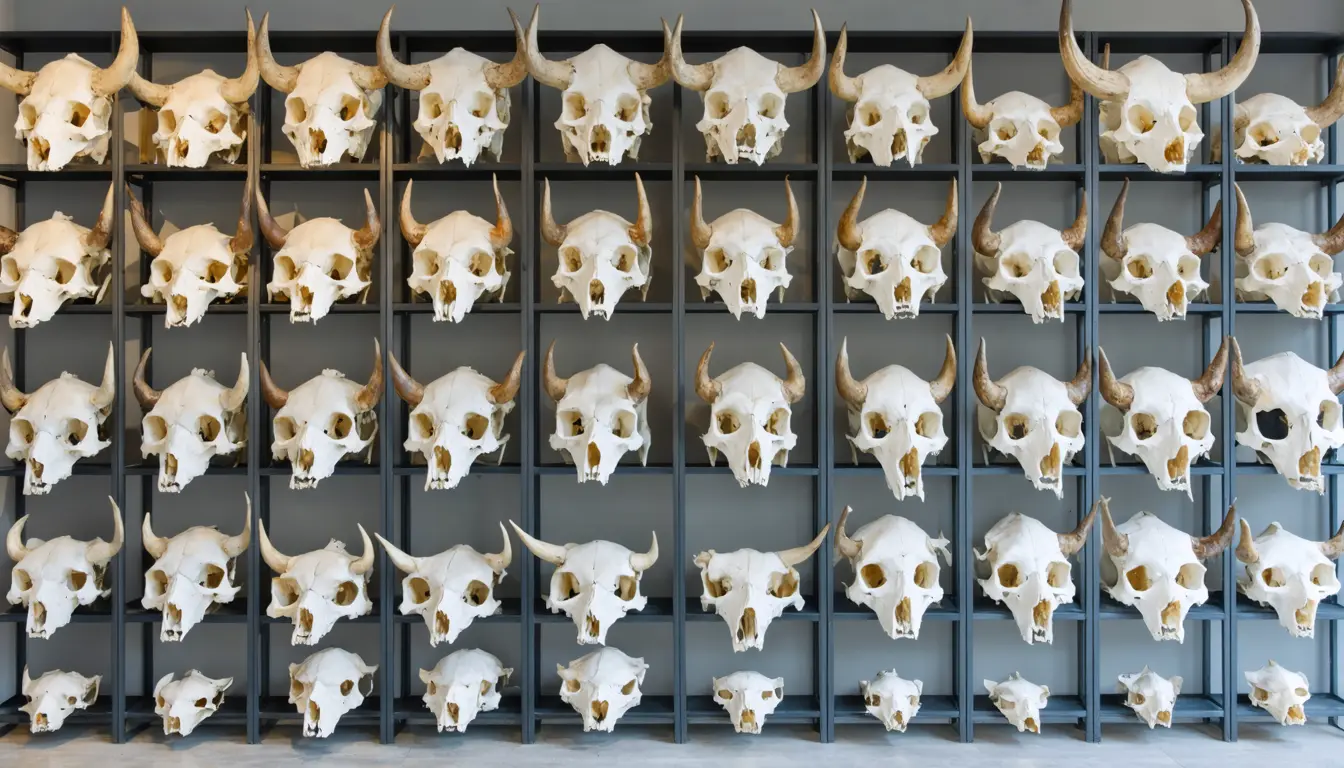
So he ran the same statistics on modern bison, whose sex was known for each specimen [13]. "When I was looking at the bison, it was almost perfect that all of the females were most similar to the females, and all the males were most similar to the males," he said [14]. The bison are a positive control. They show the method picks up dimorphism in a large horned herbivore when the dimorphism is there [14].
The thing this doesn't tell you is how big the difference between uintathere sexes actually was. Mulcahy described "some little signals of dimorphism here and there, but nothing really concrete" [16]. The Kansas result is framed as a gap that might not be as vast as paleontologists long believed [3]. The fossil data set is about 30 skulls of one species, Uintatherium anceps [10]. A sample like that can show the skulls do not split into two clean groups, though it cannot show that males and females were the same size. The press account does not report how many bison were measured or give an effect size for either species.
What to watch
- Whether the same one-peak-or-two tests, run on other uintathere species, also fail to separate two groups.
- Whether the PLOS ONE paper's bison sample size and effect sizes show how large a sex difference the method could miss in about 30 skulls.
- Whether the broken Montana molar that started the project is confirmed as a uintathere.
Clarity's read
What the record supports and how the coverage leans. The claims behind it follow.
Reality
- Evidence45
- Adoption
- Insufficient
- Hype gap+15
- Incentives
- Insufficient
- Confidence40
Claim ledger
Ranked by verification strength, evidence, and original report placement.
- [1]
For decades, paleontologists have held up uintatheres, notable for their large size, prominent horns and canine teeth, as a prime illustration of sexual dimorphism.
- [2]
Uintatheres emerged about 58 million years ago, fewer than 10 million years after a space rock killed the dinosaurs, and show up in the fossil record for the next 20 million years or so.
- [3]
A University of Kansas study published in PLOS ONE shows the differences between male and female uintatheres might not be as vast as paleontologists have long believed.
- [4]
"Males have been interpreted as being much larger and possessing far more dramatic cranial features than females," said study author Kevin Mulcahy, a doctoral student at the KU Biodiversity Institute & Natural History Museum.
- [5]
Mulcahy and his doctoral adviser, K. Christopher Beard, senior curator at the institute, were trying to identify a single broken upper molar from fieldwork in Montana that they suspected could have belonged to the uintathere group, and visited the American Museum of Natural History to compare it with other uintathere teeth.
- [6]
"I noticed a ton of variation in a way that didn't appear binary."
- [7]
"I just, really hastily, with a ruler, gathered a bunch of measurements of the skulls while we were there," Mulcahy said.
- [8]
Mulcahy described testing whether measurements are best fit by a unimodal distribution or, for a species with strong sexual dimorphism, a bimodal distribution with two means, one for males and one for females.
- [9]
After analysis, Mulcahy was not seeing a bimodal distribution in the traits he measured in New York. "It wasn't like there's one group of specimens that look bigger than another, and then there's another group that are smaller with smaller horns and canines," he said.
- [10]
Mulcahy gathered more measurements from specimens at other institutions and used new statistical procedures; his data set included about 30 skulls of one extinct species, Uintatherium anceps.
- [11]
"Maybe it's just that the techniques I'm using aren't robust enough to actually measure sexual dimorphism."
- [12]
"With fossil animals, you don't actually know which specimens are males and which are females. You can guess and then test whether or not the ones you guess are males differ from the ones you guess are females, but that's super circular, because you could just be picking the most extreme ones to be one sex and the least extreme to be the other. Of course they're going to differ."
- [13]
Mulcahy used the same statistical techniques he applied to uintatheres on modern-day bison, because he could be sure of the sex of each specimen.
- [14]
"What I noticed is that the signals of dimorphism I was picking up in bison were a lot clearer. When I was looking at the bison, it was almost perfect that all of the females were most similar to the females, and all the males were most similar to the males."
- [15]
"Bison are another really big herbivore, with a similar sort of ecology that's been proposed for uintatheres, and they also have big horns."
- [16]
"Maybe there were some little signals of dimorphism here and there, but nothing really concrete," Mulcahy said.
Sources
1 independent publisher whose own reporting we read for this story.
Topics and entities
Follow any of these and your For You feed starts watching them — no settings page required.
Topics
- Sexual DimorphismFollow
- Vertebrate PaleontologyFollow
- MorphometricsFollow