ScienceNot yet confirmed elsewhere1 publisher2 min readPublished
Papua New Guinea rock cooled by about 100 degrees C as it sank past 90 km
Researchers found that a Papua New Guinea rock reached about 800 degrees C at 45 km deep, then cooled by about 100 degrees beyond 90 km. The evidence is a single rock, and a co-author offers two explanations that imply different changes to subduction heat models.
The Scientist · Science desk
What happened
- The rock comes from northern Papua New Guinea, where the Australian and Pacific plates converge and subduction carries rocks deep underground.
- Curtin University co-author Axel Schmitt said the result was unexpected because temperatures are normally expected to rise gradually with depth.
- Schmitt noted that subduction zones host earthquakes and volcanoes and carry rocks and elements into the planet as part of the long-term carbon cycle.
- The work, by an international team, is published in Nature Geoscience.
Why it matters
- decision Thermal modellers must choose between adding shear heat at shallow depth and modelling a zone that cooled over time, and each choice alters a different part of the model.
- capability Because garnet inclusions carry both a pressure marker and a clock, other ultrahigh-pressure rocks can be checked for the same hot-then-cool sequence.
- constraint Any revision to earthquake, volcanism or deep-carbon estimates would rest on one rock from one plate boundary until other sites show the pattern.
Averaged from the surface down, the change is large. About 800 degrees C at 45 km [2] is roughly 18 degrees per kilometre [13]. At more than 90 km the rock was near 700 degrees [12], or at most about 8 degrees per kilometre [14]. Those averages ignore how temperature varies along the path, so they are only a rough guide. The paper is titled "Geothermal gradient change during subduction recorded by ultrahigh-pressure eclogite" [9].
Both stages were unusual. "At about 45 kilometers (28 miles) deep, the rock was surprisingly hot, but as it traveled deeper, it entered an environment that was cooler than we would normally expect at that depth," Schmitt said [6]. The phys.org story leads on the heat, opening with "an unexpectedly hot rock" [11].
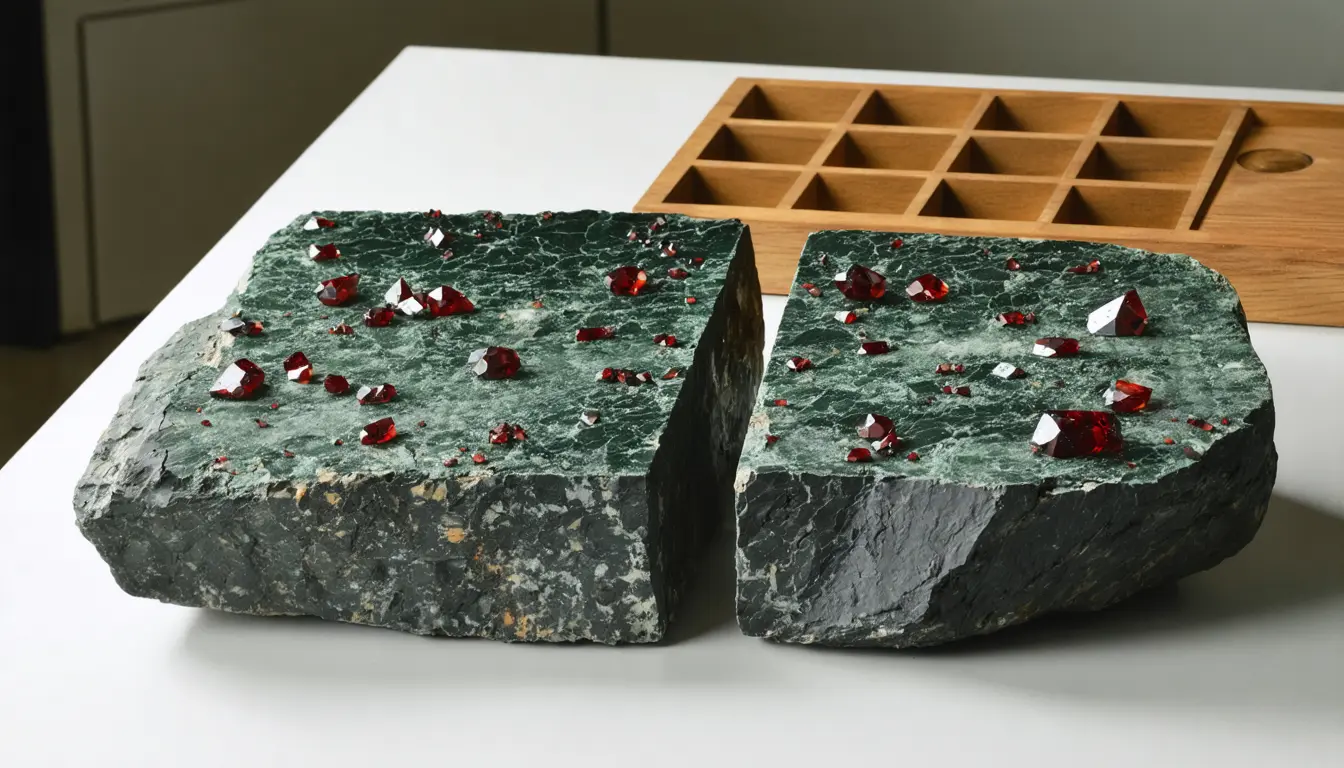
The history comes from tiny crystals of coesite and zircon trapped inside garnet [5]. Coesite forms under extremely high pressures, so finding it puts the rock at 90 km or more [5]. Zircon supplies the dates [5]. The phys.org account does not report those ages or explain how the two temperatures were estimated.
Schmitt offered two explanations. "One possibility is that intense shearing where the tectonic plates meet generates additional heat at relatively shallow depths. Another is that the subduction zone had not yet cooled to the lower temperatures expected," he said [7]. In the first case, the anomaly is extra heat at 45 km. In the second, the rock recorded a zone that was changing while it sank, so the reversal is partly about time as well as depth [7]. The zircon ages bear on that directly. A long gap between the hot and cool stages leaves time for the zone to cool; a short gap would weaken that explanation [5].
Schmitt's summary of the stakes is measured. The thermal structure of subduction zones "may be more complex than previously thought," he said [10]. I think that is the strength the evidence earns. The depth is well fixed, and the cause of the cooling is still open [7].
What to watch
- The zircon ages in the Nature Geoscience paper, and whether the gap between the hot and cool stages is long enough for the zone to have cooled.
- Thermal models that add shear heating at the plate boundary, and whether they reproduce about 800 degrees C at 45 km.
- Ultrahigh-pressure eclogites from other margins that show, or fail to show, the same hot-then-cool sequence.
Clarity's read
What the record supports and how the coverage leans. The claims behind it follow.
Reality
- Evidence50
- Adoption
- Insufficient
- Hype gap+25
- Incentives
- Insufficient
- Confidence55
Claim ledger
Ranked by verification strength, evidence, and original report placement.
- [1]
The rock comes from northern Papua New Guinea, where the Australian and Pacific tectonic plates move toward each other, causing rocks to be carried deep underground through subduction.
- [2]
The rock experienced temperatures of about 800 degrees C at a depth of 45 km and became about 100 degrees C colder after reaching depths of more than 90 km.
- [3]
Study co-author Dr. Axel Schmitt of Curtin University said the finding was unexpected because temperatures would normally be expected to gradually increase with depth.
- [4]
The research, by an international team, is published in the journal Nature Geoscience.
- [5]
The researchers reconstructed the rock's history from tiny inclusions of coesite and zircon trapped inside garnet. Coesite forms under extremely high pressures, showing the rock reached at least 90 km; zircon provides age information on when this happened.
- [6]
"At about 45 kilometers (28 miles) deep, the rock was surprisingly hot, but as it traveled deeper, it entered an environment that was cooler than we would normally expect at that depth."
- [7]
"One possibility is that intense shearing where the tectonic plates meet generates additional heat at relatively shallow depths. Another is that the subduction zone had not yet cooled to the lower temperatures expected."
- [8]
Schmitt said subduction zones are sites of earthquakes and volcanic activity and play an important role in Earth's long-term carbon cycle, carrying rocks and elements deep into the planet.
- [9]
The paper is titled "Geothermal gradient change during subduction recorded by ultrahigh-pressure eclogite".
- [10]
"The findings suggest the thermal structure of these zones may be more complex than previously thought, helping scientists better understand how subduction operates over millions to billions of years."
- [11]
The phys.org account opens by describing the discovery of "an unexpectedly hot rock" beneath Earth's surface as challenging understanding of how heat is distributed inside the planet.
- [12]
The rock's temperature at more than 90 km depth was about 700 degrees C.
- [13]
Averaged from the surface, about 800 degrees C at 45 km is roughly 18 degrees C per km.
- [14]
Averaged from the surface, about 700 degrees C at more than 90 km is at most about 8 degrees C per km.
Sources
1 independent publisher whose own reporting we read for this story.
- phys.orgMysterious Papua New Guinea rock reveals unexpected cooling as it descended deeper underground
1 article · October 7, 2026
Topics and entities
Follow any of these and your For You feed starts watching them — no settings page required.
Entities
- Axel SchmittFollow
- Jan SchönigFollow
- Curtin UniversityFollow
- Nature GeoscienceFollow
- Papua New GuineaFollow