Science1 publisher3 min readPublished
Iron minerals carrying up to 15% water survive core-mantle boundary conditions in the lab
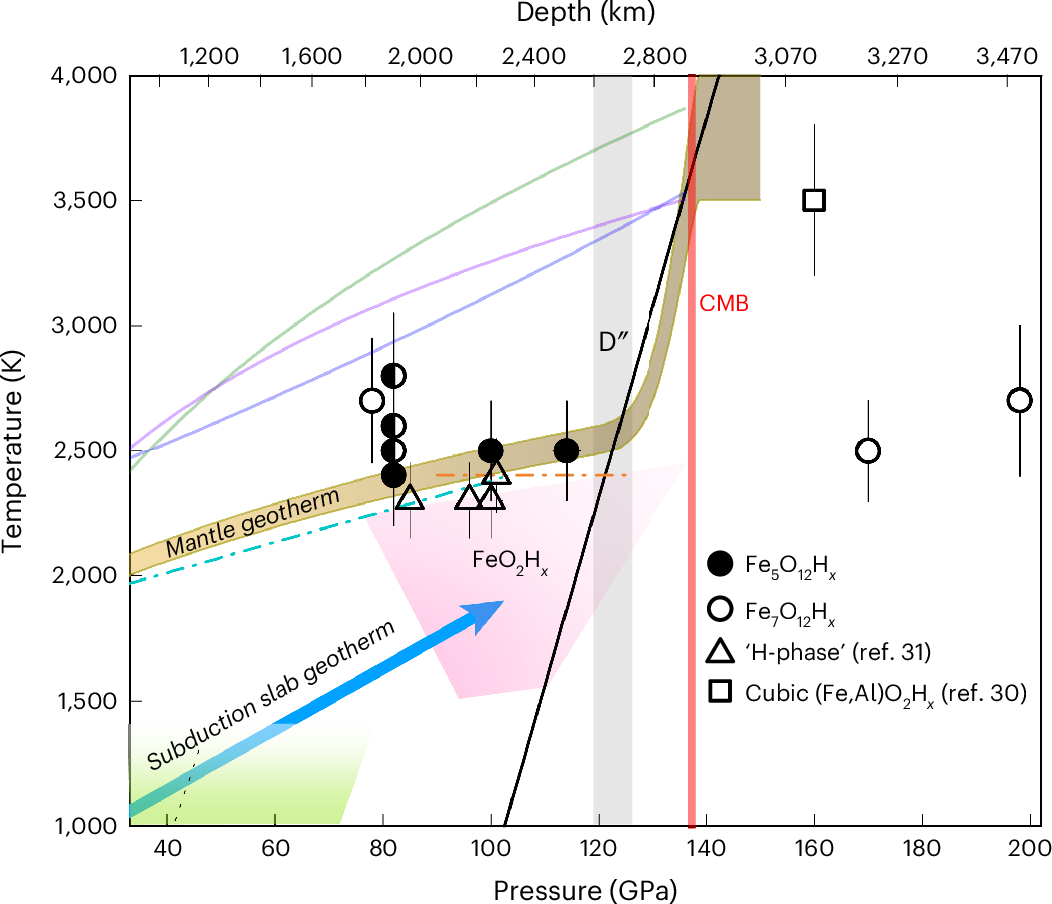
Researchers publishing in Nature Geoscience found that two iron oxyhydroxides holding up to 15% water by weight stay stable at core-mantle boundary conditions. That makes the deepest mantle a plausible store of Earth's original water, pending evidence that the minerals exist there.
The Scientist · Science desk
What happened
- The team produced the minerals by squeezing samples between two tiny diamond anvils while firing a laser at them.
- The phases fit both main theories of mantle water: dense enough to sink to the mantle's base with subducting plates, and tough enough to survive the impacts of Earth's formation.
- Mantle convection could lift the minerals in plumes that melt and release their water, contributing to volcanic hotspots at the surface.
- Steve Jacobsen, a University of Colorado Boulder mineralogist not involved in the work, said the minerals might explain ultra-low seismic velocity patches atop the core-mantle boundary.
Compiled by The ScientistSomething wrong?How this is made
Why it matters
- capability Plume and hotspot models gain a specific mineral to test as the carrier that brings deep water up to surface volcanoes.
- exposure The reservoir idea now has to square with seismology: any claim that these phases sit at the base of the mantle can be checked against the ultra-low velocity patches already observed there.
- precedent Formation models for other rocky planets, including exoplanets that are mostly molten rock, have a new high-pressure water store to account for.
Jacobsen, the outside mineralogist Live Science consulted, put the pressure at the core-mantle boundary at "more than a million times the pressure we feel at the surface" [3]. The paper, by Yuan and colleagues, appeared on Sept. 8 in Nature Geoscience [1]. Its title calls the minerals "possible reservoirs of water" [1].
The water figure is a maximum. At the 15% ceiling [5], five pounds of the most water-rich material would carry about three-quarters of a pound of water [1]. Jacobsen gave a household version. "If you add up all the H and O atoms in the formula and combine them into H2O, just a five-pound piece of the stuff would contain a pint of liquid water," he said [6].
His claim about the oceans comes with conditions. "If this material existed in the early Earth, spread out across the base of the mantle, even just a few percent of it would potentially be enough to supply the formation of the oceans," he said [7]. The sentence opens with "If." An anvil run shows that a phase can exist at depth. The ocean argument also needs abundance: how much of the material formed, and how much sits at the base of the mantle now. Live Science's account says plainly that the study does not prove the minerals are moving water around the mantle, though their existence gives a pathway for the first time [13].
Deep water matters because it keeps the mantle moving. According to Live Science, water lets mantle material deform and convect, and without it the material is too stiff to move and drag the crust along [8]. Water is a large part of why Earth has plate tectonics [8]. The two standard explanations for mantle water are subduction, where a sinking plate carries surface water down, and primordial water left from the planet's formation and stored near the core-mantle boundary [9]. The density that fits the subduction story could also let these phases carry water on into the core [10].
The thing this doesn't tell you is whether any of the material is down there today. The closest link to observation is Jacobsen's suggestion about the seismic patches, and his verb is "might" [14]. A mineral that could explain a seismic anomaly is a candidate for it. Showing that it is the cause is a separate job, and it belongs to seismology.
The authors describe the findings as crucial for understanding mantle motion, volcanic activity and the workings of other rocky planets, according to Live Science [15]. I think the stability measurement is the part of this paper most likely to last. The reservoir is still a hypothesis. It now has a specific mineral, and a specific seismic target, to be tested against.
What to watch
- Seismic comparisons testing whether dense iron oxyhydroxides can account for the ultra-low velocity patches on top of the core-mantle boundary.
- Any estimate of how much of this material could have formed in the early Earth, the quantity Jacobsen's ocean scenario depends on.
- Follow-up experiments on how readily the phases melt and release water under the conditions of a rising plume.