ScienceNot yet confirmed elsewhere1 publisher2 min readPublished
High CO2 and scarce phosphate leave diatoms holding about 26% less phosphorus per unit carbon
Chinese researchers grew a diatom for 880 days and found high CO2 cut its phosphorus per unit carbon by about 26% when phosphate was scarce. The cells still grew faster, so in this species extra CO2 changed what the plankton are made of as well as how fast they multiply.
The Scientist · Science desk
What happened
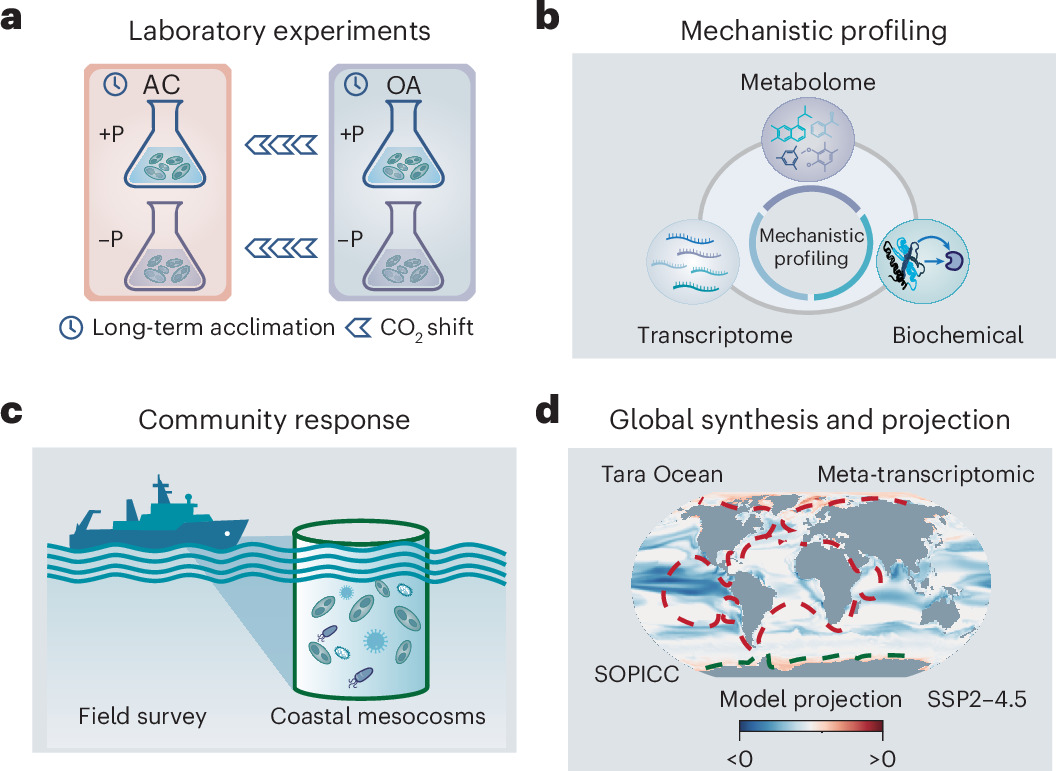
- Cultures ran under four conditions for more than 1,000 generations: a present-day control, low phosphate alone, high CO2 alone, and high CO2 with low phosphate.
- Lines that evolved under high CO2 kept growing faster and photosynthesising at higher rates after they were returned to normal CO2 levels.
- To get by on less phosphorus, the cells drained their phosphorus reserves and switched to phosphorus-free membrane lipids.
- Natural coastal plankton communities showed results similar to the lab cultures, most clearly where phosphate was scarce.
Why it matters
- constraint Ocean models that give phytoplankton a fixed phosphorus-to-carbon recipe would miss a shift of about a quarter, the size seen here under high CO2 and low phosphate.
- exposure Animals that graze on diatoms would take in about 35% more carbon for each unit of phosphorus they eat, if ratios like the lab's held in phosphate-poor seas.
- constraint A short CO2 exposure would catch the reversible phosphorus cut but could not show the growth gain was inherited. Telling the two apart took a return to normal CO2 after 1,000 generations.
The study can say something about the combination because it crossed the two stressors. Rising CO2 was already known to boost plankton growth and low phosphate to limit it. How the pair together alters nutrient use was the open question, according to the phys.org account [5]. Only the combined arm, read against each stressor alone and a present-day control, can answer it [4].
The length of the run matters as much as the grid. More than 1,000 generations in 880 days works out to an average generation time of at most about 21 hours [3][15]. After 1,000 generations, the team moved the high-CO2 lines back to ordinary CO2 to see which changes stayed [6].
The answer split. The growth gain persisted, and the authors interpret it as inherited [7]. The phosphorus cut did not persist. It reversed when CO2 levels changed, so the cells' phosphorus allocation stayed flexible [9]. Of the reserve-draining and the switch to phosphorus-free lipids, the authors wrote: "As a result, carbon accumulation becomes progressively decoupled from phosphorus storage" [10][11].
The 26% figure is phosphorus relative to carbon in the high-CO2 cultures under low phosphate [8]. Turned around, it means roughly 35% more carbon for each unit of phosphorus, because 1 divided by 0.74 is about 1.35 [16]. Extra CO2 still bought faster growth in these cultures [7]. The cells it produced held less phosphorus behind each unit of carbon [8].
How far that carries beyond the flask is open. The team, led by the Yellow Sea Fisheries Research Institute and Harbin Institute of Technology, worked with one diatom species, Thalassiosira pseudonana [2]. The authors themselves cautioned that the direction of ocean acidification-linked changes in phosphorus metabolism is unlikely to be universal across taxa [13]. The paper, in Nature Geoscience, also used global gene-expression data and Earth system models to project changes through 2100 [1][14]. The phys.org summary does not report those projections, the size of the growth gain or the number of replicate cultures [14].
I'd put more weight on the phosphorus result. It has a field check in natural coastal communities [12], while the inherited growth gain so far rests on cultures of a single species [2][7].
What to watch
- The Earth system projections to 2100 in the Nature Geoscience paper, and whether they show the phosphorus shift changing nutrient balance at ocean scale.
- Repeats of the high-CO2, low-phosphate design in other phytoplankton groups, to test the authors' warning that the direction of the change will differ across taxa.
- Field measurements of phosphorus-to-carbon ratios in phosphate-poor coastal plankton as seawater CO2 rises.
Clarity's read
What the record supports and how the coverage leans. The claims behind it follow.
Reality
- Evidence58
- Adoption
- Insufficient
- Hype gap+12
- Incentives
- Insufficient
- Confidence52
Claim ledger
Ranked by verification strength, evidence, and original report placement.
- [1]
The study, Bingkun Wang et al, 'Ocean acidification reshapes phytoplankton phosphorus metabolism under phosphate-limited conditions', was published in Nature Geoscience in 2026.
- [2]
A team led by the Yellow Sea Fisheries Research Institute and Harbin Institute of Technology in China grew the diatom species Thalassiosira pseudonana in the laboratory.
- [3]
The diatoms were cultured for 880 days, spanning more than 1,000 generations.
- [4]
The diatoms were tested in four setups: a control mimicking current ocean conditions, low phosphate, high carbon dioxide, and combined high carbon dioxide with low phosphate.
- [5]
It was already known that rising carbon dioxide can boost plankton growth and low phosphate can limit it; what was missing was an understanding of how the two stressors together change nutrient use.
- [6]
To test whether changes were inherited or temporary stress reactions, the team moved diatoms that had evolved under high carbon dioxide back to normal carbon dioxide levels after 1,000 generations.
- [7]
Under high carbon dioxide, diatoms grew faster and maintained higher rates of photosynthesis even when placed back under normal carbon dioxide levels, suggesting the changes had become inherited.
- [8]
Under low-phosphorus conditions, diatoms exposed to high carbon dioxide contained about 26% less organic phosphorus relative to carbon over time.
- [9]
The drop in phosphorus content reversed when carbon dioxide levels changed, meaning internal phosphorus allocation remains flexible rather than permanently fixed.
- [10]
Cells drained their backup phosphorus stores and switched to phosphorus-free membrane lipids, allowing them to keep growing on a leaner phosphorus budget.
- [11]
"As a result, carbon accumulation becomes progressively decoupled from phosphorus storage," the scientists wrote.
- [12]
Natural coastal plankton communities mirrored the lab results, particularly where phosphate was scarce.
- [13]
The researchers noted that "the direction of OA-linked [ocean acidification] changes in P metabolism is unlikely to be universal across taxa."
- [14]
The study authors analyzed global gene-expression data and used Earth system models to forecast global changes through 2100.
- [15]
More than 1,000 generations in 880 days implies an average generation time of at most about 21 hours.
- [16]
A 26% fall in phosphorus relative to carbon corresponds to roughly 35% more carbon per unit of phosphorus.
Sources
1 independent publisher whose own reporting we read for this story.
- phys.orgThe internal chemistry of phytoplankton changes as oceans become more acidic
1 article · October 7, 2026
Topics and entities
Follow any of these and your For You feed starts watching them — no settings page required.
Topics
- PhytoplanktonFollow
- Marine nutrient cyclingFollow
- Ocean AcidificationFollow
Entities
- Thalassiosira pseudonanaFollow
- Yellow Sea Fisheries Research InstituteFollow
- Harbin Institute of TechnologyFollow
- Nature GeoscienceFollow