ScienceNot yet confirmed elsewhere1 publisher3 min readPublished Updated
Australian sea lions and long-nosed fur seals hear best near 3.2 kHz in first in-air tests
Curtin and Taronga researchers ran the first hearing tests on Australian sea lions and long-nosed fur seals and found both hear best near 3.2 kHz. Four zoo animals tested in air supplied the curves, so underwater hearing and the noise levels that cause harm are still unmeasured.
The Scientist · Science desk
What happened
- Set against noise from boats, ships, aircraft, trains and construction, the fur seals' hearing showed many of those sounds would be audible to animals resting on land.
- The Australian sea lion is endangered, with an estimated population of about 12,000, and relies on hearing to communicate, find food, navigate and detect threats.
- The results appear as two papers, the fur seal audiograms in Conservation and the sea lion audiograms in Animals.
Why it matters
- capability Noise assessments for shipping, coastal development and offshore projects can now check a proposed sound against measured hearing data for these two Australian species.
- exposure Because seals on land can hear aircraft, trains and construction as well as vessels, land-side projects near haul-out sites have a case to answer in the same noise assessment.
- constraint With two animals per species, any noise limit built on these curves inherits unknown individual variation across roughly 12,000 wild Australian sea lions.
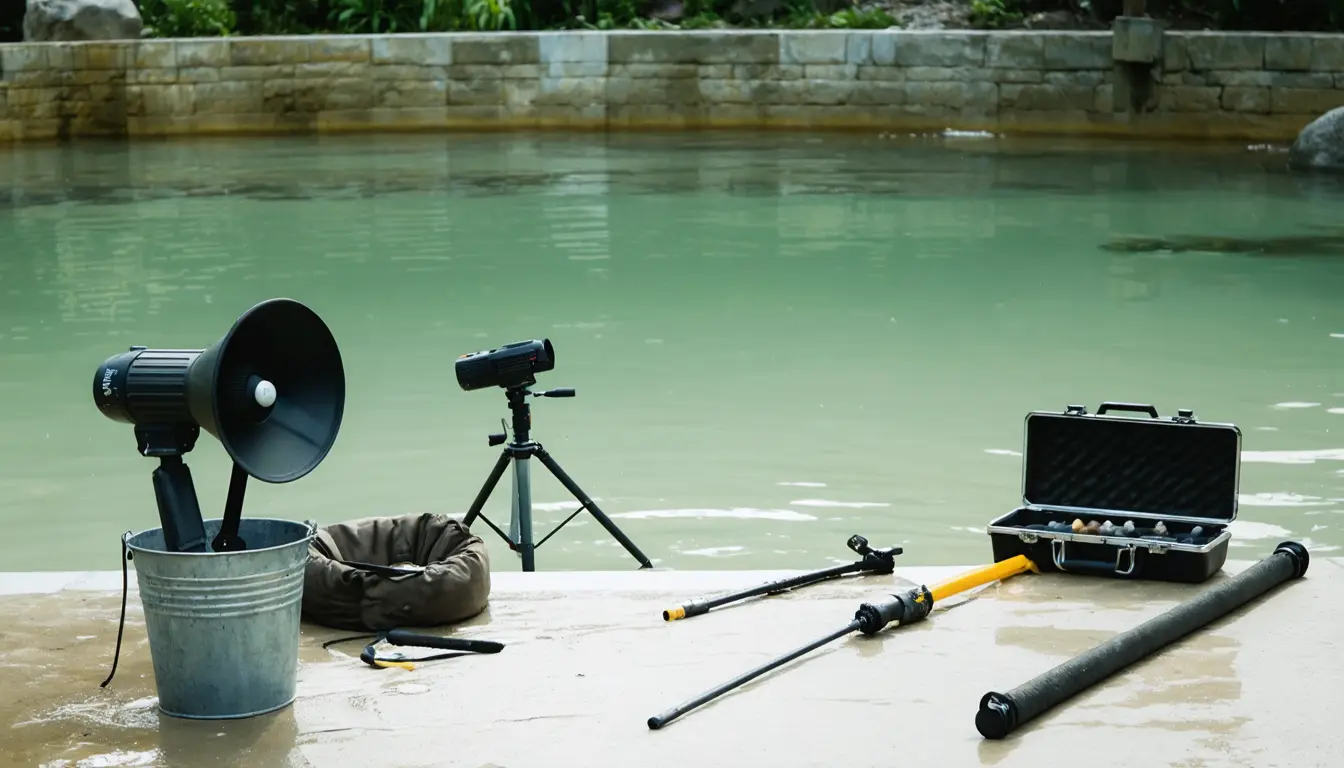
A paddle press is a behavioural answer. Each animal was trained to push the paddle only when it heard a tone, and keepers rewarded correct responses with fish [4]. Dr. Benjamin Pitcher, a behavioural biologist at Taronga Conservation Society Australia [11], said: "The seals and sea lions were given the choice to participate voluntarily in the hearing tests using positive reinforcement, allowing us to measure what they could actually perceive while keeping the animals engaged in the process" [8].
The sample is small. Four animals took part, two of each species, all at Taronga Zoo Sydney [13]. Lead researcher Christine Erbe described the Australian sea lion as endangered, with "an estimated population of only about 12,000 animals" [7]. For that species, the hearing curve now on record comes from two individuals. Two captive animals cannot show how much hearing varies across a wild population, or whether these two hear better or worse than most.
The headline figure is a peak. Both species were most sensitive near 3.2 kHz [1], the frequency at which the quietest tone still drew a paddle press. The published summary gives that peak but does not report threshold levels in decibels or the full span of frequencies tested. An assessor needs those numbers to set a vessel's or a construction site's noise against the curve.
Both audiograms were measured in air [3]. For the fur seals, the team compared the hearing curve with noise from boats, ships, aircraft, trains and construction, and found that many of those sounds would be audible to animals hauled out on land [12]. The summary describes that comparison for the fur seals only.
Erbe, of Curtin's Center for Marine Science and Technology [11], presented the result as a precondition. "Before we can understand whether a noise is affecting an animal, we need to know whether it can hear that noise in the first place," she said [5]. "These hearing tests give us that baseline and allow us to start asking how noises from ships, boats, aircraft and coastal construction might affect seals and sea lions" [6].
I think her framing is the right way to read these papers. They tell a regulator which sounds these animals can detect in air, and Pitcher said the findings "could help inform environmental impact assessments and noise management as shipping, coastal development and offshore industries expand" [9]. Hearing a sound and being harmed by it are separate measurements. Pitcher said the second is still to come: "We now know what these animals can hear in air. The next step is to understand how noise affects them underwater, and when it begins to interfere with their behavior or hearing" [10].
What to watch
- Hearing tests on more animals of each species, which would show whether the two-animal curves hold across a population.
- A comparison of the Australian sea lions' hearing with boat, aircraft and construction noise like the one run for the fur seals.
- Whether environmental impact assessments for Australian shipping, coastal or offshore projects begin citing these audiograms.
Clarity's read
What the record supports and how the coverage leans. The claims behind it follow.
Reality
- Evidence55
- Adoption
- Insufficient
- Hype gap+10
- Incentives
- Insufficient
- Confidence60
Claim ledger
Ranked by verification strength, evidence, and original report placement.
- [1]
Both species were most sensitive to sounds around 3.2 kilohertz, providing the first detailed baseline of hearing sensitivity for the two Australian species.
ReportedSupportedSource: phys.org report3 sources— create a free account to open themView cited source - [2]
Curtin University and Taronga Conservation Society Australia researchers conducted the first hearing tests on Australian sea lions and long-nosed fur seals.
ReportedSupportedSource: phys.org report2 sources— create a free account to open themView cited source - [3]
The studies, 'Aerial Audiograms of Two Long-Nosed Fur Seals (Arctocephalus forsteri)' and 'In-Air Behavioral Audiograms of Two Australian Sea Lions (Neophoca cinerea)', were published in Conservation and Animals respectively.
ReportedSupportedSource: phys.org report2 sources— create a free account to open themView cited source - [4]
Marine keepers trained two Australian sea lions and two long-nosed fur seals at Taronga Zoo Sydney to respond to sounds by pressing a paddle when they heard a tone, rewarding correct responses with fish.
ReportedSupportedSource: phys.org report2 sources— create a free account to open themView cited source - [5]
"Before we can understand whether a noise is affecting an animal, we need to know whether it can hear that noise in the first place."
ReportedSupportedSource: Christine Erbe, quoted by phys.org2 sources— create a free account to open themView cited source - [6]
"These hearing tests give us that baseline and allow us to start asking how noises from ships, boats, aircraft and coastal construction might affect seals and sea lions."
ReportedSupportedSource: Christine Erbe, quoted by phys.org2 sources— create a free account to open themView cited source - [7]
"The research is particularly important for the endangered Australian sea lion, which has an estimated population of only about 12,000 animals and relies on hearing for communication, finding food, navigation and detecting threats."
ReportedSupportedSource: Christine Erbe, quoted by phys.org2 sources— create a free account to open themView cited source - [8]
"The seals and sea lions were given the choice to participate voluntarily in the hearing tests using positive reinforcement, allowing us to measure what they could actually perceive while keeping the animals engaged in the process."
ReportedSupportedSource: Benjamin Pitcher, quoted by phys.org2 sources— create a free account to open themView cited source - [9]
"The findings could help inform environmental impact assessments and noise management as shipping, coastal development and offshore industries expand."
ReportedSupportedSource: Benjamin Pitcher, quoted by phys.org2 sources— create a free account to open themView cited source - [10]
"We now know what these animals can hear in air. The next step is to understand how noise affects them underwater, and when it begins to interfere with their behavior or hearing."
ReportedSupportedSource: Benjamin Pitcher, quoted by phys.org2 sources— create a free account to open themView cited source - [11]
Professor Christine Erbe, the lead researcher, is from Curtin's Center for Marine Science and Technology; Dr. Benjamin Pitcher is a behavioral biologist at Taronga Conservation Society Australia.
ReportedSupportedSource: phys.org report2 sources— create a free account to open themView cited source - [12]
The researchers compared the long-nosed fur seals' hearing with noise from boats, ships, aircraft, trains and construction, finding many of these sounds would be audible to the animals when hauled out on land.
- [13]
Four animals in total were tested, two per species.
Sources
1 independent publisher whose own reporting we read for this story.
- phys.orgHearing tests reveal how sea lions and fur seals hear human-made noise
2 articles · October 9, 2026
Topics and entities
Follow any of these and your For You feed starts watching them — no settings page required.
Topics
- Marine mammal bioacousticsFollow
- Wildlife conservationFollow
- Anthropogenic noise pollutionFollow