ScienceNot yet confirmed elsewhere1 publisher3 min readPublished
One oblique hit, two Deimos mysteries, and a moon weaker than anyone budgeted for
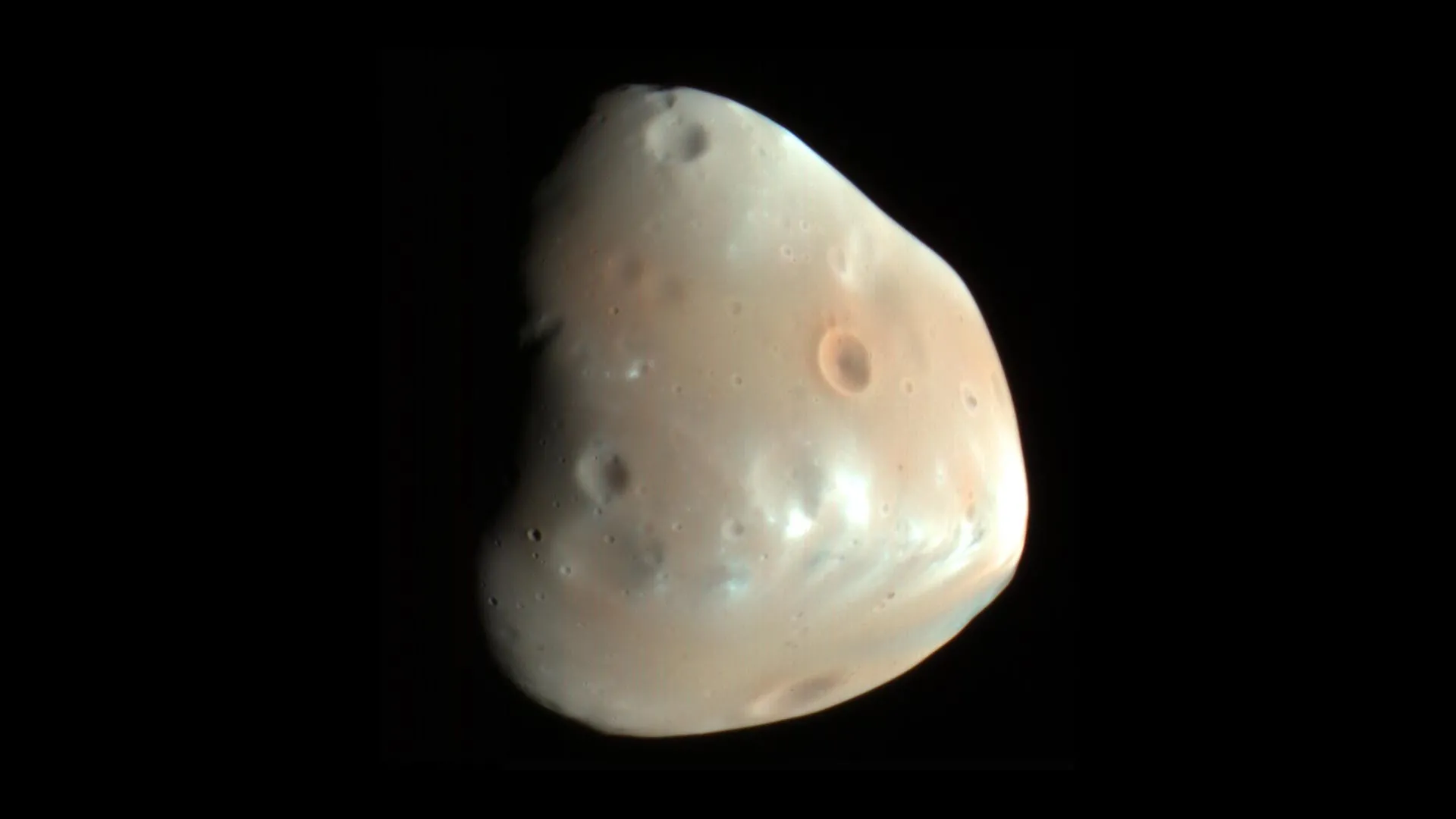
The first paper built on ESA Hera's Deimos flyby argues a single roughly 320-metre impactor did both jobs, and that the moon is porous and fragile. JAXA's MMX inherits that finding.
The Scientist · Science desk
What happened
- In that model one event both excavated the depression near the south pole and produced the regolith now covering much of the surface.
- Hera's observations indicate the moon is more porous and more fragile than had been assumed.
- The team ran about a hundred simulations, each taking roughly a week, sweeping impactor size, speed, angle and interior structure.
Why it matters
- constraint A porous, weak Deimos takes competent rock off the table as a design assumption for anything that touches the surface, and load-bearing capacity becomes the number that governs hardware.
- cost Reconstructing one small moon's surface history consumed roughly two years' worth of cluster time at one of the few institutions whose code can attempt the run.
- precedent A cruise-phase pass over a body that was never the destination has now yielded a journal paper, which raises what agencies will be expected to extract from gravity-assist geometry.
- capability If the blanket is ejecta from the same event, regolith depth becomes a readable record of the impact rather than an obstruction between instruments and the crater floor.
The reason to give a hundred-run parameter sweep any weight is what the code behind it was tested against. The Bern Smoothed Particle Hydrodynamics code has been in development at the University of Bern for around two decades, represents colliding bodies as millions of particles, and lets the modellers dial gravity, density and material strength [9]. The same approach was used earlier to simulate NASA's DART spacecraft hitting Dimorphos [10], which remains the only full-scale impact on a small body that anyone actually performed and measured. That lineage is the argument for trusting the Deimos numbers, and it is worth naming, because nothing about Deimos itself is available for a second look.
The mechanism the team is proposing is narrow. The impact has to be energetic enough to excavate the depression near the south pole and still leave the moon intact [13], and the debris has to end up everywhere rather than piled around the crater. The obliquity is what buys both: according to the University of Bern release, a roughly 320-metre asteroid arriving at an angle threw material around the entire body without breaking it apart [2]. Neither the depression nor the widespread debris layer had a settled explanation before this [15], and the team varied impactor size, speed, angle and its assumptions about Deimos's interior to find the combination that reproduced them [8].
Which is where the Hera data does its real work. The flyby observations point to a moon that is more porous and more fragile than assumed [3], and a weak, porous target is precisely the interior assumption that makes a survivable global-resurfacing impact plausible. Sabina Raducan led the study, which appears in Nature Astronomy and is the first publication to use anything from Hera's pass at Deimos [4], with collaborators at the Observatoire de la Cote d'Azur, the University of Arizona and the University of Tokyo [5].
The authors say the findings could help guide future missions, and they name JAXA's Martian Moons eXploration mission [6]. Porosity is the operating part of that. A body described as fragile and porous does not respond to contact the way competent rock does, and anchoring and sample acquisition both depend on how much load the surface carries before it collapses. If the regolith really is ejecta from one event that never escaped, then loose material is the default condition across the moon rather than a patch to steer around [13].
The compute bill is worth stating plainly. About a hundred simulations at roughly a week each [7] is on the order of a hundred weeks of runtime, close to two years if the runs were laid end to end [16]. Raducan says the code runs on Bern's cluster and is one of few capable of this class of simulation [11]. That is a short list of places able to check the result, on a moon that was not even the spacecraft's destination [12].
What to watch
- The Nature Astronomy paper's actual porosity and bulk density figures for Deimos, and the resolution of the Hera flyby images they rest on.
- Whether the MMX team revises contact, anchoring or sample-acquisition margins in response to a weaker-than-assumed target.
- Hera's arrival at Dimorphos, which will test the same code against the DART impact it was calibrated on.
Clarity's read
What the record supports and how the coverage leans. The claims behind it follow.
Reality
- Evidence52
- Adoption22
- Hype gap+12
- Incentives62
- Confidence55
Claim ledger
Ranked by verification strength, evidence, and original report placement.
- [1]
A University of Bern release dated 26 August 2026 reports that a single asteroid impact may explain two of Deimos's puzzling features: its large southern depression and its unusually smooth, dusty surface.
- [2]
Simulations suggest a roughly 320-metre asteroid struck Deimos at an angle, throwing debris around the entire moon without breaking it apart.
- [3]
New observations from ESA's Hera spacecraft indicate that Deimos is surprisingly porous and fragile.
- [4]
The study, led by Dr Sabina Raducan, is published in Nature Astronomy and is the first scientific publication to use observations gathered when ESA's Hera spacecraft flew past Deimos.
- [5]
The international collaboration was led by the University of Bern and included researchers from the Observatoire de la Cote d'Azur, the University of Arizona and the University of Tokyo, among other institutions.
- [6]
The findings could help guide future missions, including the Japan Aerospace Exploration Agency's Martian Moons eXploration (MMX) mission.
- [7]
Raducan: "We carried out about a hundred simulations -- each one took about a week."
- [8]
The researchers tested many scenarios, changing the impactor's size, speed and impact angle while also varying assumptions about the internal structure of Deimos.
- [9]
The Bern SPH code has been developed at the University of Bern over roughly two decades to model collisions involving asteroids, comets and planets; colliding objects are represented by millions of individual particles, and researchers can adjust gravity, density and material strength.
- [10]
The same modelling approach was previously used to simulate NASA's DART spacecraft crashing into Dimorphos.
- [11]
Raducan says the code runs on a high-performance computing cluster at the University of Bern and is one of the few codes capable of performing this type of simulation; she co-chairs the Hera Impact Physics Working Group for ESA's Hera mission.
- [12]
Hera is currently travelling toward its main destination, the asteroid moon Dimorphos, and its main mission is to examine closely what happened when NASA's DART spacecraft struck Dimorphos.
- [13]
According to the simulations, the depression near Deimos's south pole was most likely produced by a single asteroid impact that was powerful but not strong enough to destroy the moon, and the same collision could also have generated the regolith that now blankets much of it.
- [14]
Deimos is the smaller and more distant of Mars' two moons, roughly oval with a prominent depression near its south pole; Phobos is heavily cratered while Deimos appears smoother because much of its surface is covered by loose dust and rocky debris.
- [15]
Spacecraft have imaged Deimos in increasing detail over decades, but scientists have not been certain what created either the southern depression or the widespread layer of debris.
- [16]
About a hundred simulations at roughly one week each amounts to on the order of 100 weeks of runtime, close to two years if the runs were executed one after another.
Sources
1 independent publisher whose own reporting we read for this story.
- sciencedaily.comOne asteroid strike may explain two mysteries of Mars’ moon Deimos
1 article · August 26, 2026
Topics and entities
Follow any of these and your For You feed starts watching them — no settings page required.
Topics
Entities
- University of BernFollow
- Bern Smoothed Particle Hydrodynamics codeFollow
- Sabina RaducanFollow
- Martin JutziFollow
- HeraFollow
- European Space AgencyFollow
- DARTFollow
- Martian Moons eXplorationFollow
- Japan Aerospace Exploration AgencyFollow
- DeimosFollow
- PhobosFollow
- DimorphosFollow
- Nature AstronomyFollow
- Observatoire de la Côte d'AzurFollow
- University of ArizonaFollow
- University of TokyoFollow
- International Space Science InstituteFollow
- Vrije Universiteit BrusselFollow
- ScienceDailyFollow