ScienceIndependently confirmed2 publishers2 min readPublished Updated
Niobium in old Hubble spectra points to a planet that may have formed after its star died
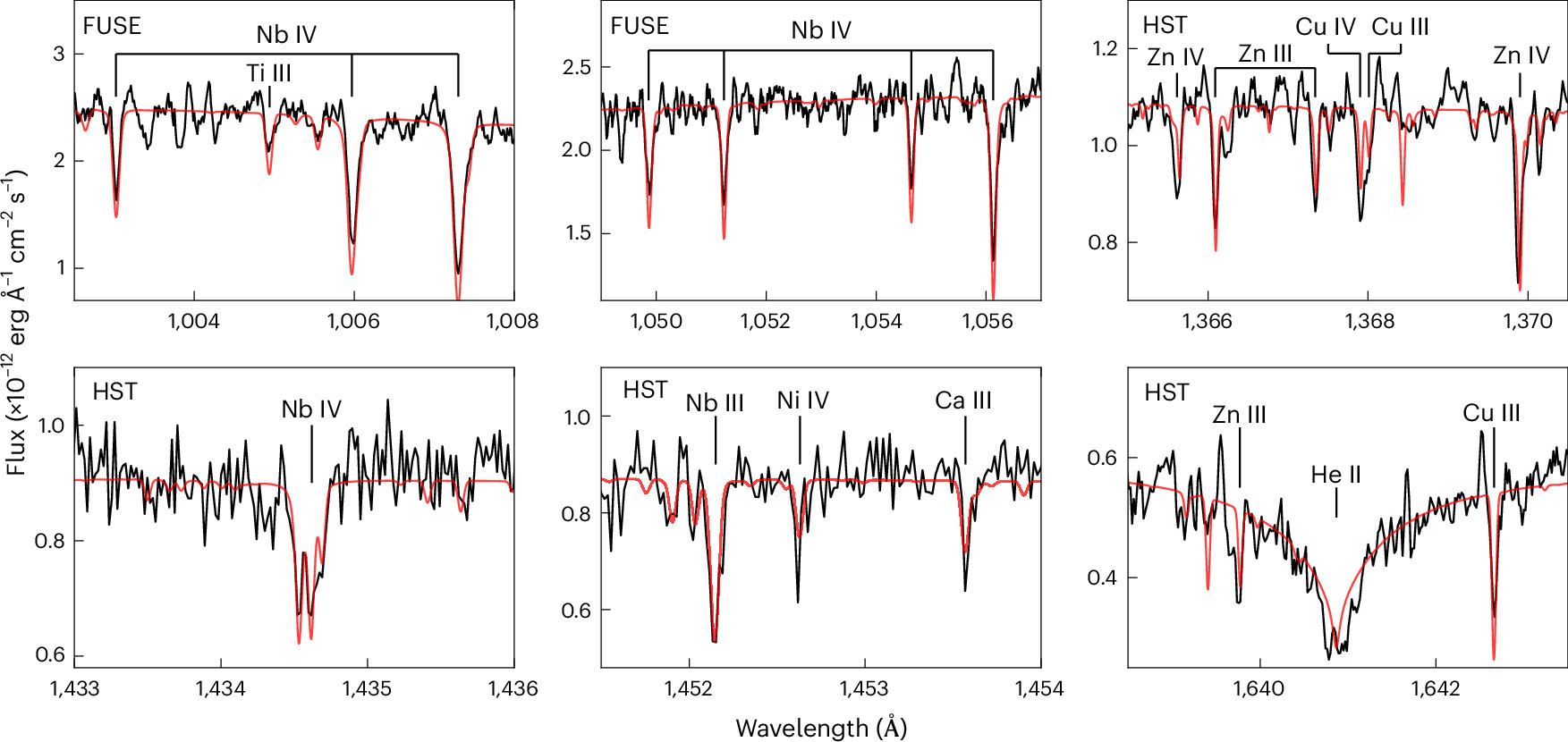
Astronomers re-reading 1999 Hubble spectra of white dwarf HS 0209+0832 found unusually high niobium that may trace matter the star shed as it died. The team proposes that some of that debris built a gas giant hinted at in TESS data, though the planet remains a candidate.
The Scientist · Science desk
What happened
- Lead author Jamie Williams of the University of Warwick used an updated chemical database to match many of about 100 previously unidentified spectral features to niobium.
- Archival data from NASA's retired FUSE ultraviolet mission also showed strong niobium signatures in the system.
- Four months of TESS monitoring picked up repeating brightness changes that may mark a planet about 6 million kilometers from the white dwarf, far closer than Mercury is to the Sun.
- The researchers estimate the candidate is roughly the size of Jupiter and appears to be losing its atmosphere.
Why it matters
- constraint With one system and one unconfirmed planet, the result can at most show that planets can form around a white dwarf; saying how often that happens would need a sample of such systems.
- precedent If the candidate is confirmed and tied to the debris, an excess of elements heavier than iron in a white dwarf's spectrum becomes a way to choose targets for second-generation planet searches.
- capability Because an updated chemical database was enough to name the niobium, archived white-dwarf spectra with unexplained features can be searched for heavy elements without new telescope time.
A white dwarf is what remains of a low-mass star's core after the star has exhausted its fuel and shed its outer layers into space [13]. The case for a planet built from those layers rests on niobium, because of where that element is made. "Niobium and other elements heavier than iron are astronomically special because, unlike many common elements, they are not formed in the cores of stars by thermonuclear fusion," said Nicholas Stone, a theoretical astrophysicist at the University of Wisconsin-Madison and a member of the team [6]. "The presence of niobium is a signpost of these 'death' throes, and the expulsion of the dying star's innards into space," Stone said [7]. According to Williams, the unusually large amount in this system may trace matter expelled during the star's death, not material left over from its birth [12].
The Nature Astronomy study, published Oct. 5, builds its claim in three steps of unequal strength [1]. Identifying the element is the firmest step, since data from two separate instruments show it [4][9]. TESS supplies only a candidate planet, inferred from changes in the star's brightness [10]. The last step, that some of the expelled material gathered into a gas giant while the rest dispersed, is the team's proposal [8]. The release does not say how the researchers excluded a planet that formed with the star and survived its death.
"When Jamie asked me about niobium in relation to this study, I was truly gobsmacked, as that element had not been reported in any other white dwarf analyzed to date," said Boris Gaensicke, a co-author also at the University of Warwick [14]. That comparison counts only white dwarfs in which someone has identified the element. Williams said the niobium signature was one "I was unfamiliar with when I first found it in the archival data" [5]. In this system, the niobium went unidentified from the 1999 observation until the 2026 study, a gap of about 27 years [3][16].
We think the niobium is the solid finding here. The second-generation planet is a hypothesis built on it, and it depends on the TESS candidate being confirmed. Williams framed the stakes more widely. "Rather than the white dwarf stage being a kind of epilogue to the story of a star and its planets, this research points to the systems we are familiar with only being the first chapter of a potentially much longer tale, with some new characters showing up," Williams said [15].
What to watch
- Confirmation of the TESS candidate around HS 0209+0832 by a second method, ideally one that measures its mass.
- A report of niobium in any other white dwarf, a detection Gaensicke said had not been made in any white dwarf analyzed so far.
Clarity's read
What the record supports and how the coverage leans. The claims behind it follow.
Reality
- Evidence55
- Adoption
- Insufficient
- Hype gap+25
- Incentives30
- Confidence60
Claim ledger
Ranked by verification strength, evidence, and original report placement.
- [1]
According to a study published Oct. 5 in Nature Astronomy, an unusual chemical signature suggests that the white dwarf HS 0209+0832 could be home to a second-generation planet.
ReportedSupportedSource: NASA release via ScienceDaily2 sources— create a free account to open themView cited source - [2]
The NASA release carried by ScienceDaily is dated October 9, 2026, and reports the study as published Oct. 5.
ReportedSupportedSource: NASA release via ScienceDaily2 sources— create a free account to open themView cited source - [3]
Hubble observed HS 0209+0832 in 1999, but scientists at the time were unable to identify roughly 100 chemical features in the data.
ReportedSupportedSource: NASA release via ScienceDaily2 sources— create a free account to open themView cited source - [4]
Jamie Williams, lead author and a doctoral candidate at the University of Warwick, returned to the 1999 Hubble observations using an updated chemical database and found that niobium accounted for many of the previously unexplained signatures.
ReportedSupportedSource: NASA release via ScienceDaily2 sources— create a free account to open themView cited source - [5]
"What Hubble is showing us in this white dwarf system is something we haven't seen before: a high abundance of the element niobium, the signature of which I was unfamiliar with when I first found it in the archival data," Williams said.
ReportedSupportedSource: Jamie Williams, University of Warwick2 sources— create a free account to open themView cited source - [6]
"Niobium and other elements heavier than iron are astronomically special because, unlike many common elements, they are not formed in the cores of stars by thermonuclear fusion," said Nicholas Stone, a theoretical astrophysicist at the University of Wisconsin-Madison and member of the research team.
ReportedSupportedSource: Nicholas Stone, University of Wisconsin-Madison2 sources— create a free account to open themView cited source - [7]
"The presence of niobium is a signpost of these 'death' throes, and the expulsion of the dying star's innards into space," Stone said.
ReportedSupportedSource: Nicholas Stone, University of Wisconsin-Madison2 sources— create a free account to open themView cited source - [8]
The researchers propose that after the star expelled chemically enriched material, some of it gathered together and formed a gas giant planet, while most of the remaining material dispersed into space and the planet remained in orbit.
ReportedSupportedSource: Research team, per NASA release2 sources— create a free account to open themView cited source - [9]
The team checked the Hubble result against observations from NASA's retired FUSE (Far Ultraviolet Spectroscopic Explorer) mission, which also revealed strong niobium signatures in the HS 0209+0832 system.
ReportedSupportedSource: NASA release via ScienceDaily2 sources— create a free account to open themView cited source - [10]
TESS monitored the white dwarf for four months and detected repeating changes in brightness that indicate a planet may be orbiting about 6 million kilometers (3.7 million miles) from the star, far closer than Mercury is to the Sun.
ReportedSupportedSource: NASA release via ScienceDaily2 sources— create a free account to open themView cited source - [11]
The researchers estimate the candidate world is a gas giant roughly the size of Jupiter that appears to be losing its atmosphere.
ReportedSupportedSource: Research team, per NASA release2 sources— create a free account to open themView cited source - [12]
Williams said the unusually large amount of niobium in the HS 0209+0832 system points to a different origin: instead of coming from material associated with a star's birth, it may trace matter expelled during the star's death.
ReportedSupportedSource: Jamie Williams, per NASA release2 sources— create a free account to open themView cited source - [13]
A white dwarf is the leftover core of a low-mass star that has exhausted its nuclear fuel and shed its outer layers of gas and dust into space. A second-generation planet takes shape later from material released by a dying star, unlike ordinary planets that form alongside young stars.
- [14]
"When Jamie asked me about niobium in relation to this study, I was truly gobsmacked, as that element had not been reported in any other white dwarf analyzed to date," said co-author Boris Gaensicke of the University of Warwick.
- [15]
"Rather than the white dwarf stage being a kind of epilogue to the story of a star and its planets, this research points to the systems we are familiar with only being the first chapter of a potentially much longer tale, with some new characters showing up," said Jamie Williams.
- [16]
About 27 years passed between Hubble's 1999 observation of HS 0209+0832 and the 2026 study that identified the niobium.
Sources
2 independent publishers whose own reporting we read for this story.
- sciencedaily.comHubble Space Telescope may have found a planet born after its star died
1 article · October 9, 2026
- Astronomers Detect Potential ‘Second Generation’ Planet Around Dying Stellar White Dwarf
universetoday.com
1 article · October 10, 2026
Topics and entities
Follow any of these and your For You feed starts watching them — no settings page required.
Topics
- Archival astronomyFollow
- Stellar nucleosynthesisFollow
- White dwarfsFollow
- Second-generation planetsFollow
- ExoplanetsFollow
Entities
- University of Wisconsin-Madison Department of MedicineFollow
- Nature AstronomyFollow
- Transiting Exoplanet Survey SatelliteFollow
- NiobiumFollow
- HS 0209+0832Follow
- Jamie WilliamsFollow
- NASAFollow
- University of WarwickFollow
- FUSEFollow
- Nicholas StoneFollow
- Boris GaensickeFollow
- Hubble Space TelescopeFollow