Science1 publisher3 min readPublished
JWST catches galaxies pushing carbon and oxygen into space 500 million years after the Big Bang
University of Arizona astronomers used JWST to detect carbon and oxygen flowing out of three galaxies seen 500 million years after the Big Bang. The result suggests heavy elements spread earlier than astronomers expected, though three galaxies picked from hundreds of spectra cannot yet show how common such outflows were.
The Scientist · Science desk
Drafted by a language model from the sources cited here and checked against its claim ledger before publication. How we use AISend a correction
What happened
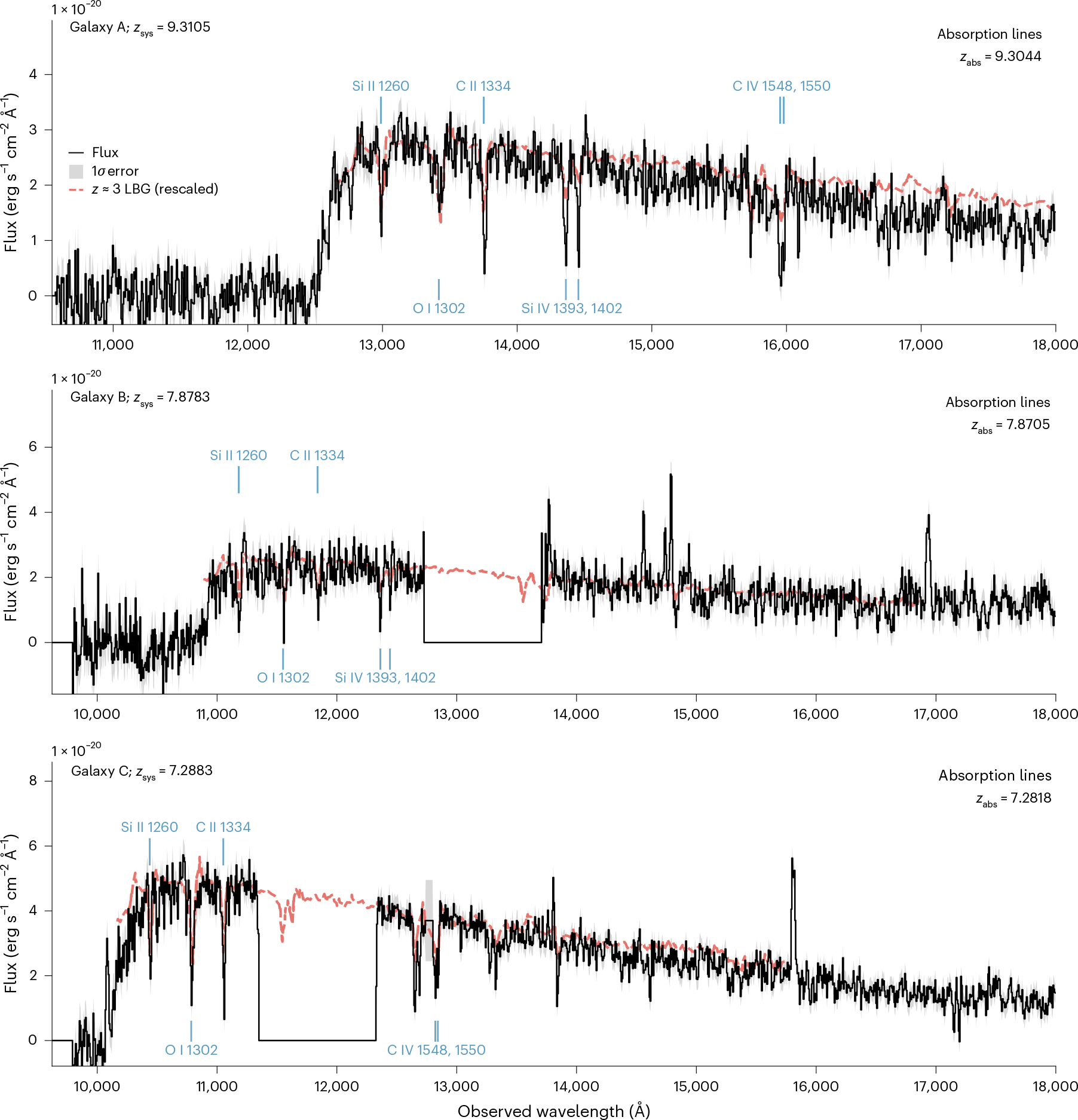
- Yongda Zhu, the paper's first author, searched publicly available JWST spectra of hundreds of galaxies by hand in one night and found three showing carbon, oxygen and silicon.
- The absorption lines were blueshifted relative to the galaxies themselves, showing the gas was moving outward toward intergalactic space.
- The chemical signatures around these young galaxies resembled those found around far more mature galaxies billions of years later.
Compiled by The ScientistSomething wrong?How this is made
Why it matters
- constraint Pictures of the early universe that treat gas around galaxies at this age as nearly pure hydrogen and helium now have three measured exceptions to account for.
- constraint If the university's summary is right that early enrichment erased traces of the first stars, searches for those stars' chemical record have less untouched gas to work with.
- capability Because the three turned up in public archive spectra, any team can run the same search across the wider JWST archive and turn three examples into a measured rate.
Three galaxies out of hundreds of searched spectra looks like a rare phenomenon. It may only be a hard measurement. The absorption features are extremely faint, and the team needed nearly 30 hours of JWST exposure to identify them [6]. A galaxy whose spectrum lacks the lines could be surrounded by clean gas, or it could be too dim for the lines to show. So the three galaxies establish that early outflows carrying heavy elements existed [7]. How often they happened needs a larger sample observed to a uniform depth.
Zhu, a postdoctoral researcher at the University of Arizona's Steward Observatory [11], described the approach plainly. "We used the galaxies themselves as background light sources," he said. "As light from the galaxies traveled toward Earth, it passed through surrounding gas, and we were able to look at the light's absorption patterns to detect specific elements." [5]
Finding metals in that gas is one result. Showing the gas is leaving is another, and it comes from velocity. The absorption lines were blueshifted relative to each galaxy's own redshift. According to the release, that offset showed the gas "moving outward, carrying oxygen, carbon and other heavy elements away from the galaxies and into intergalactic space" [8].
The timing is what makes this a surprise. The galaxies appear as they were roughly 500 million years after the Big Bang, when the universe was about 3% of its current age [2]. Astronomers had generally expected gas around galaxies that young to be nearly pristine, mostly hydrogen and helium [3]. Instead, the chemical signatures looked like those around far more mature galaxies billions of years later [9]. The Nature Astronomy paper's central claim is that early galaxies were sending carbon and oxygen into surrounding space much sooner than expected [1]. "We observed that heavy elements escaped from galaxies very, very early in cosmic time," Zhu said [4].
Zhu hedged the larger step himself. "Not only were the galaxies producing these elements, but they were also dispersing them, possibly seeding other galaxies," he said [4]. "Possibly" is accurate. Absorption shows gas leaving three galaxies; where that gas ends up is a further inference. The university's summary goes further, saying the early enrichment is "potentially erasing traces of its very first stars" [10]. Of everything in the release, the first-stars claim sits furthest from the measurement, and the release text does not set out the evidence behind it.
I think the outflow detection is the strongest part of the result, because it rests on a velocity offset read directly from the spectra [8]. The broader statement, that the young universe became chemically enriched much earlier than expected [10], currently rests on three objects chosen by eye [7]. The release frames the open question as how quickly heavy elements escaped the first galaxies and spread outward [12]. For these three, the answer is within about 500 million years of the Big Bang [2].
What to watch
- A systematic search of the public JWST archive for the same blueshifted absorption signature, which would give the fraction of early galaxies with metal-bearing outflows.
- Whether the Nature Astronomy paper estimates how much carbon and oxygen the outflows carry and how far from the galaxies the gas reaches.
- Any direct test of the summary's claim that early enrichment erased the chemical traces of the first stars.