Science2 publishers2 min readPublished
The hottest of the new giant-impact simulations builds an intact Moon in about five hours
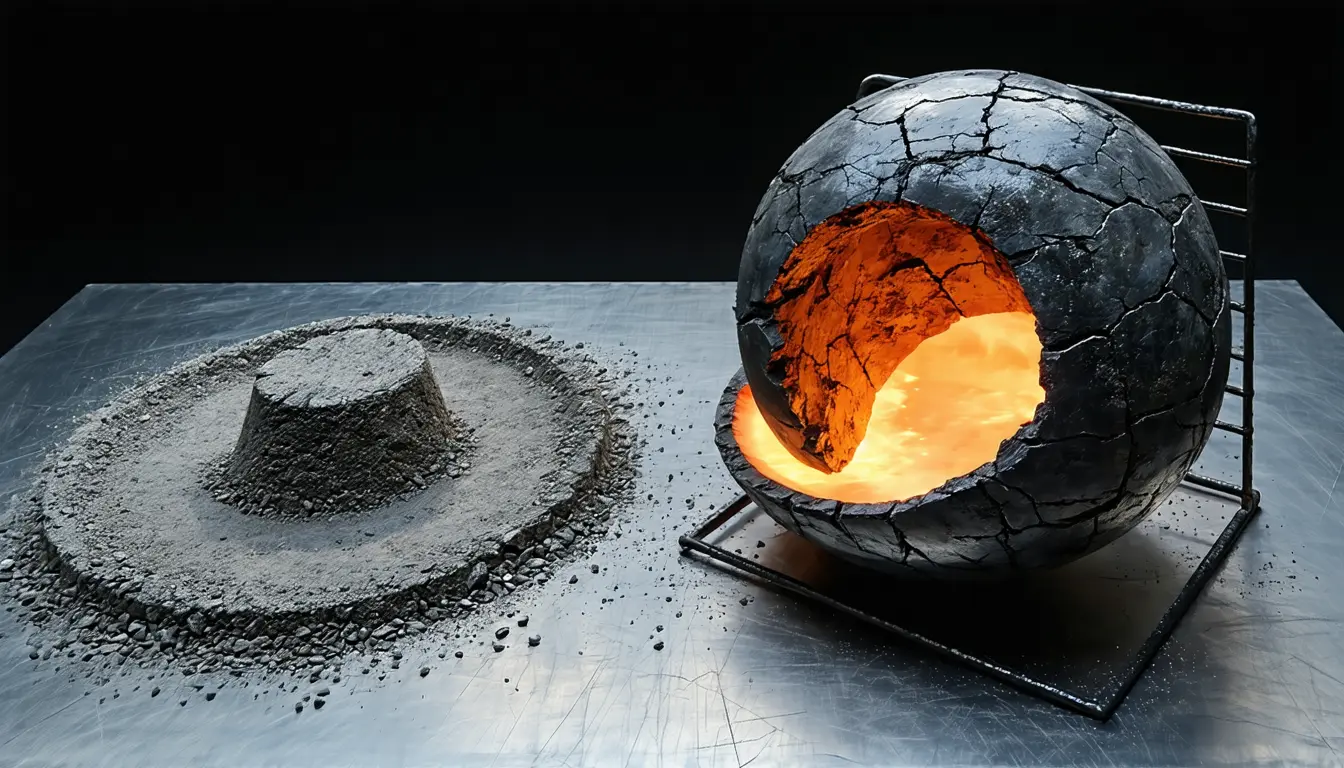
For the first time, the Earth-Theia collision has been simulated with temperature-dependent rock strength. Some runs still make the familiar debris disk; the hottest assemble an intact Moon in about five hours.
The Scientist · Science desk
What happened
- A Southwest Research Institute and University of Arizona team simulated the Earth-Theia collision with the material strength of both bodies included for the first time, publishing in The Astrophysical Journal Letters on Sept. 1.
- Some of the runs produce the familiar orbiting disk of debris that later assembles into the Moon, while others produce an intact Moon in only about five hours.
- Earlier models, including the foundational 2001 simulations led by Robin Canup and Erik Asphaug, treated the two worlds as fluids on the grounds that the impact melted and vaporized much of both.
- Live Science reports that the five-hour result came from the most extreme case, with both bodies at their hottest, and that there is no way of knowing how hot or how strong they actually were.
Compiled by The ScientistSomething wrong?How this is made
Why it matters
- constraint Assembly time now hangs on a temperature nobody has measured, so on this evidence the debris-disk route and the five-hour route cannot be ranked against each other.
- decision Modelers who reach for a fluid approximation on planet-scale impacts have to defend it now that Asphaug, a co-author of the 2001 fluid study, says the approximation should be reconsidered.
- capability If the outcome depends on how hot the bodies were, then the Moon we can sample becomes usable as a constraint on the date of the collision, which the Arizona announcement says the results may help narrow.
- precedent Other ancient impacts modeled as fluid collisions are now open to the same re-run; Live Science names Ganymede's tilt and Titan's origin as candidates.
Strength enters these simulations through temperature, and both bodies were young when they collided. Their surfaces were soft or molten, and Live Science reports that the softness would have cushioned the impact and let the debris stay largely intact, so a moon could gather faster [12]. Cool them and the outcome changes. A more brittle Earth and Theia scatter a larger field of rock, which takes longer to coalesce [13]. Adeene Denton ran the collision in a version of smoothed particle hydrodynamics developed at the University of Arizona and the University of Bern, with a strength model that lets simulated rock and metal resist deformation the way real material does [11].
The assumption under test was stated openly in the older work. "Because the collision was considered violent enough to melt and vaporize large portions of Earth and Theia, those previous papers assumed that it is okay to approximate them as fluids," Asphaug said [7]. "Based on our new results, however, we think that it is time to reconsider that" [8]. Denton, a geologist and planetary scientist at the Southwest Research Institute in Boulder, got the idea from earlier work on the Pluto-Charon system [10][22]. "We weren't sure if it would matter for our moon or not. When we did the simulations, we found it actually matters quite a bit," she said [9].
The five hours covers assembly. The Moon then sat under a magma ocean that took hundreds of millions of years to solidify [21]. Neither write-up gives the number of runs, the temperature range used, or whether the intact-Moon outcomes reproduce the Moon's measured mass [20]. That last check is what would separate a candidate history from an artifact of the parameter sweep.
Temperature and timing are tied together. Apollo samples put the Moon at about 4.5 billion years old and the collision at roughly 100 million years after the sun formed, which places the sun's birth near 4.6 billion years ago [15][16]. Live Science reports that when the giant impact hypothesis was first proposed, in 2001 by its account, researchers thought the collision came much later, and later means cooler and more brittle [17]. The University of Arizona announcement says the strength results may also help narrow down when the impact happened [18]. ScienceDaily describes the 2001 paper, led by Robin Canup and Erik Asphaug, as a foundational study of the giant impact scenario [5].
What to watch
- Whether another group reproduces the five-hour intact-Moon outcome using an independent strength code.
- Any observational or modeling bound on how hot Earth and Theia were at impact; such a bound would pick one branch over the other.