Science1 publisherNot yet confirmed elsewhere2 min readPublished
NASA and the Energy Department place space nuclear work under one agreement from fuel to launch
NASA and the Energy Department signed one memorandum covering space nuclear work from fuel production to launch, ahead of a 2028 reactor flight. It takes effect Nov. 1, and a December 2025 executive order already calls for a launch-ready lunar reactor by 2030.
The Scientist · Science desk
What happened
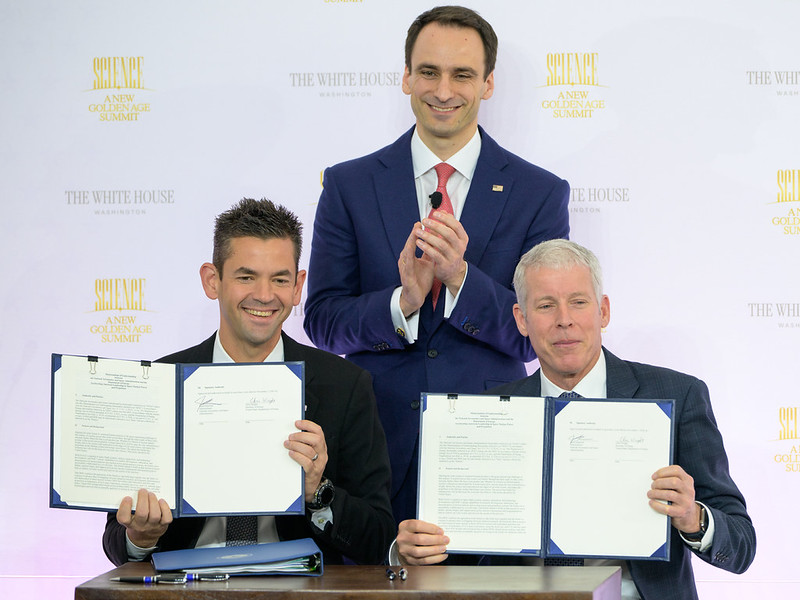
- NASA Administrator Jared Isaacman and Energy Secretary Chris Wright signed the memorandum on Thursday at the Golden Age Summit in Washington, hosted by the Office of Science and Technology Policy.
- NASA says Space Reactor-1 Freedom will take nuclear propulsion from laboratory research into operational deep-space use, and treats it as the step before Lunar Reactor-1.
- Dragonfly, a car-sized rotorcraft bound for Titan, will carry a Multi-Mission Radioisotope Thermoelectric Generator and 24 light-weight radioisotope heater units.
- NASA and DOE also plan to supply 24 similar heater units to keep instruments warm on ESA's Rosalind Franklin Mars rover.
Compiled by The ScientistSomething wrong?How this is made
Why it matters
- precedent Later fission missions can start inside an agreement that is already in force between NASA and DOE.
- exposure Because fuel production and launch integration sit in one agreement, a delay at either end becomes a schedule problem for both agencies.
- constraint SR-1's planned launch comes about two years before the 2030 deadline, leaving little time for anything learned in flight to reach a launch-ready lunar reactor.
The document's formal title is "Accelerating American Leadership in Space Nuclear Power and Propulsion" [1]. NASA calls it "a framework for end-to-end collaboration" [2]. Its scope starts before there is any hardware, with advanced research and fuel production, and continues past launch into operations [3]. According to the release, safety "remains the central pillar" across all of it [15].
It is harder to judge whether this turns fission missions into a standing inter-agency programme. The release describes the framework's scope [3]. It does not include the memorandum's text, and it does not say which agency pays for or approves each stage. It does describe the agreement as one that "fortifies existing collaborations on fission and radioisotope power systems" [7], so the partnership was in place before the signature.
The case for calling it a programme rests on two named reactors, and they do different jobs [8][9]. SR-1 is a propulsion reactor for deep space. LR-1 is a fission surface power system that has to keep a future Moon base running "through darkness and shadow" [9]. NASA says SR-1 "paves the way" for LR-1 [9]. I would treat that as a planning claim until NASA shows which designs or test data the two reactors share.
The radioisotope work has firmer numbers attached. Dragonfly will carry 24 heater units and Rosalind Franklin is due to receive another 24, so the two missions need 48 between them [17]. NASA says it continues to expand its use of radioisotope power systems [14].
In my view the memorandum formalises a partnership that already existed, and SR-1 will be the first fission hardware it can be judged on [7][8]. Isaacman described the work as groundwork. "The work we're doing today is laying the foundation for the fission-powered spacecraft of tomorrow and opening an entirely new frontier for exploration and discovery," he said [12]. Wright said, "The Energy Department is proud to partner with NASA as we help American space missions reach uncharted territory" [13].
What to watch
- Publication of the memorandum's text, or any implementing agreement that assigns funding and approval authority for each stage.
- Whether Space Reactor-1 Freedom keeps its 2028 launch date.
- Design reviews or test milestones for Lunar Reactor-1 that show progress toward the 2030 launch-ready deadline.
Clarity's read
What the record supports and how the coverage leans. The claims behind it follow.
Reality
- Evidence45
- Adoption
- Insufficient
- Hype gap+45
- Incentives80
- Confidence40
Claim ledger
Ranked by verification strength, evidence, and original report placement.
- [1]
NASA and DOE signed a Memorandum of Understanding titled "Accelerating American Leadership in Space Nuclear Power and Propulsion" on Thursday.
- [2]
The memorandum establishes a framework for end-to-end collaboration between NASA and DOE.
- [3]
The agreement unites both agencies across the full spectrum of space nuclear development, spanning advanced research and fuel production to rigorous testing, launch integration, and operations.
- [4]
The signing took place between NASA Administrator Jared Isaacman and U.S. Secretary of Energy Chris Wright during the Golden Age Summit, hosted by the Office of Science and Technology Policy in Washington.
- [6]
President Trump's December 2025 Executive Order on Ensuring American Space Superiority directs NASA to develop a launch-ready lunar surface reactor by 2030; NASA says it is making steady progress toward that goal with DOE.
- [7]
NASA says the agreement "fortifies existing collaborations on fission and radioisotope power systems."
- [8]
When NASA's Space Reactor-1 Freedom launches in 2028, nuclear propulsion will advance "from laboratory research to operational deep-space application," according to NASA.
- [9]
NASA says SR-1 "paves the way" for Lunar Reactor-1, the fission surface power system that will sustain the future Moon Base "through darkness and shadow."
- [10]
The Dragonfly mission to Saturn's moon Titan, scheduled for launch in 2028, will rely on a Multi-Mission Radioisotope Thermoelectric Generator and 24 Light Weight Radioisotope Heater Units to power and warm the car-sized rotorcraft.
- [11]
NASA and DOE plan to support ESA's Rosalind Franklin Mars rover by providing 24 similar heater units to maintain instrument temperatures.
- [12]
"The work we're doing today is laying the foundation for the fission-powered spacecraft of tomorrow and opening an entirely new frontier for exploration and discovery."
- [13]
"The Energy Department is proud to partner with NASA as we help American space missions reach uncharted territory."
- [14]
In addition to fission power, NASA continues to expand its use of radioisotope power systems.
- [15]
Across all these efforts, an uncompromising commitment to safety "remains the central pillar," according to NASA.
- [16]
About two years separate SR-1 Freedom's planned 2028 launch from the 2030 deadline for a launch-ready lunar surface reactor.
- [17]
Dragonfly and the Rosalind Franklin rover together account for 48 radioisotope heater units.
Sources
1 independent publisher whose own reporting we read for this story.
- nasa.govNASA, Energy Department Advance New Era of Nuclear-Powered Exploration
1 article · October 8, 2026
Topics and entities
Follow any of these and your For You feed starts watching them — no settings page required.
Topics
- Radioisotope power systemsFollow
- Space nuclear powerFollow
- Lunar ExplorationFollow
Entities
- NASAFollow
- US Department of EnergyFollow
- Jared IsaacmanFollow
- Chris WrightFollow
- Space Reactor-1 FreedomFollow
- Lunar Reactor-1Follow
- DragonflyFollow
- Rosalind Franklin roverFollow
- European Space AgencyFollow
- Office of Science and Technology PolicyFollow
- Multi-Mission Radioisotope Thermoelectric GeneratorFollow