Science2 publishers2 min readPublished
Crew-13's Dragon targets a U.S. record with a 7-hour-50-minute trip to the space station
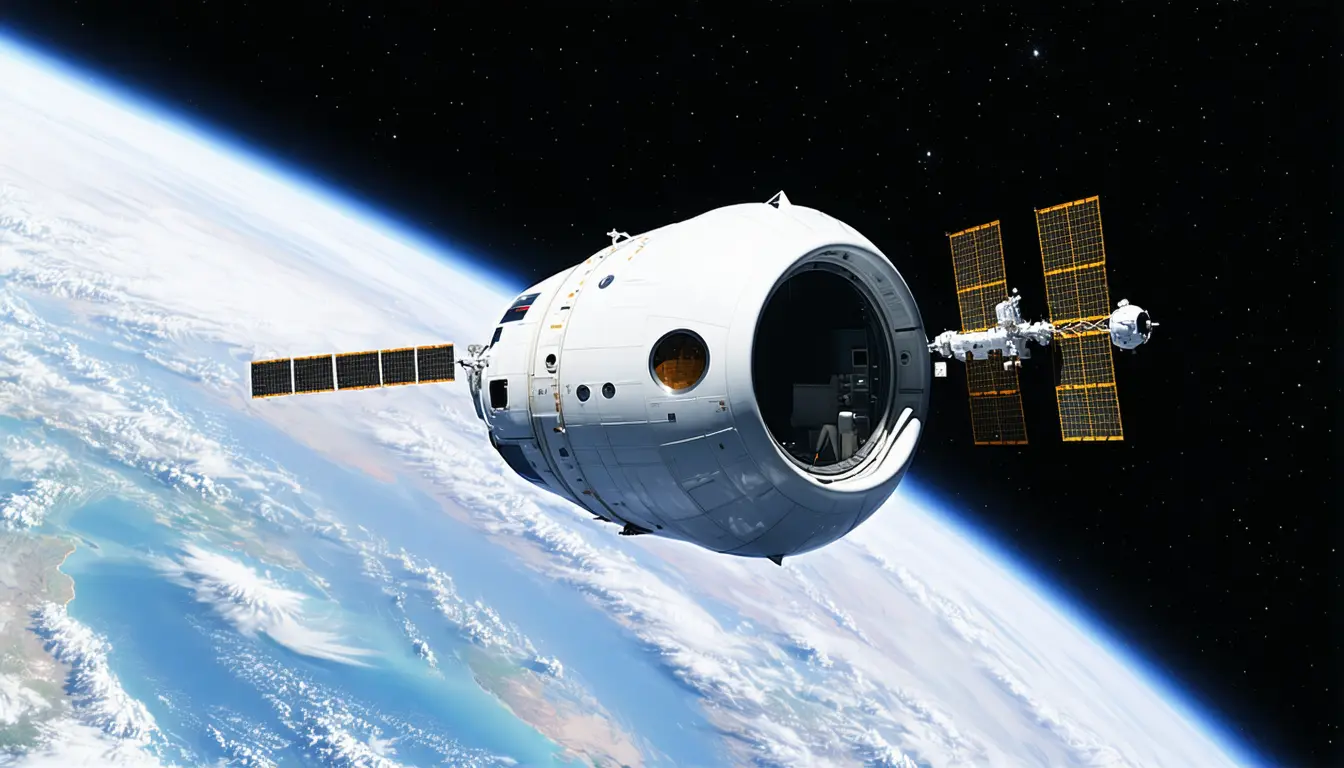
NASA's Crew-13 launched four crew Thursday on a Dragon due to dock at the space station 7 hours 50 minutes later, a U.S. record by NASA's account. NASA stated the record before the docking took place, so it holds only once the 7 p.m. arrival happens.
The Scientist · Science desk
What happened
- NASA's Jessica Watkins and Luke Delaney, Canadian Space Agency astronaut Joshua Kutryk and Roscosmos cosmonaut Sergey Teteryatnikov flew on a Falcon 9 from Cape Canaveral at 11:10 a.m. EDT.
- Dragon is set to dock autonomously at the forward port of the station's Harmony module at about 7 p.m. EDT.
- Planned research includes producing human stem cell-derived tissues to model conditions such as heart disease and Parkinson's and to test drugs against them.
Compiled by The ScientistSomething wrong?How this is made
Why it matters
- constraint The record gives a rank with no margin, and it cannot be used to judge how much the transit has shortened.
- exposure Crew-12's return is sequenced behind the handover, so any slip in Crew-13's 7 p.m. docking keeps four people on the station longer.
- capability If the docking holds, a crew goes from launch pad to station hatch in under 10 hours on automatic maneuvers, with ground teams monitoring.
The two clock times in NASA's release agree with each other. Liftoff at 11:10 a.m. EDT [1] and a docking at about 7 p.m. [3] are 7 hours 50 minutes apart [1], the same flight time NASA gives for Dragon [5]. Only the launch had happened when the release went out. The docking is written in the future tense [3].
NASA calls the planned docking "the fastest launch-to-docking by a U.S. spacecraft in the history of the International Space Station" [4]. The qualifier limits the comparison to American vehicles. NASA did not disclose the previous U.S. mark. Without it, the size of the improvement cannot be worked out from the release.
The approach is automated. SpaceX will monitor a series of automatic spacecraft maneuvers from its mission control center in Hawthorne, California, while NASA watches station operations from Johnson Space Center in Houston [6]. The target is the forward port of the Harmony module [3].
The record counts only to docking. After docking, the crew change out of their spacesuits and prepare cargo for offload before opening the hatch at around 8:45 p.m. [7]. That puts hatch opening 1 hour 45 minutes after docking [3] and 9 hours 35 minutes after launch [2].
The four join the Expedition 75 crew, which includes NASA astronaut Anil Menon and Roscosmos cosmonauts Pyotr Dubrov and Anna Kikina [8]. After a brief handover, Crew-12 returns to Earth with NASA's Jessica Meir and Jack Hathaway, ESA's Sophie Adenot and Roscosmos cosmonaut Andrey Fedyaev [9]. That leaves seven people named in the release aboard [4]. Lori Glaze, associate administrator of NASA's Human Spaceflight Mission Directorate, said "Our steady cadence of commercial crew launches demonstrates the essential role the International Space Station plays in sustaining our presence in Earth's orbit and sharpening the tools we'll take forward to the Moon and Mars." [14] The evidence in the release for that cadence is the swap itself: one Dragon crew arrives and, after the handover, the other leaves [9].
NASA Administrator Jared Isaacman said the four "will carry forward important work aboard the International Space Station" [13]. The release lists that work, all of it as plans. The crew will use microgravity to produce human stem cell-derived tissues for disease modeling and drug testing for conditions such as heart disease and Parkinson's [10]. Crop work centres on a new, mostly autonomous plant growth system, plus tests of how plants grow outside dedicated facilities [11]. Human-health studies continue on factors linked to blood-flow abnormalities in microgravity, alongside a test of a new inflight diagnostic device [12].
What to watch
- Whether Dragon docks at about 7 p.m. and the hatch opens near 8:45 p.m.; a slip would change the record claim.
- Whether NASA publishes the previous U.S. launch-to-docking time, so the margin can be measured.
- The date Crew-12 undocks and returns after the handover.