ScienceNot yet confirmed elsewhere1 publisher2 min readPublished
Haida Gwaii swordfish carcass gives British Columbia roughly its third record of the species
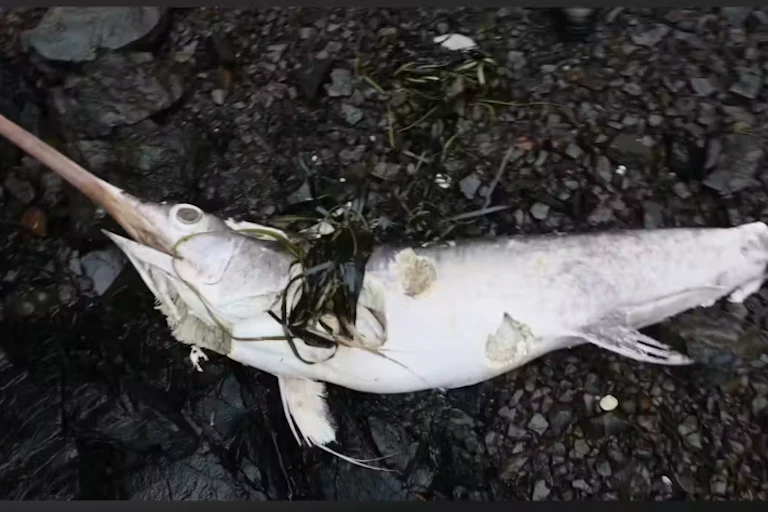
Filmmaker Quinn Barabash found a nearly two-metre swordfish on Haida Gwaii, a fish thought to have been documented in B.C. only twice before. The fisheries researchers who wrote up the find use it to urge B.C. managers to prepare for heat-driven catch failures.
The Scientist · Science desk
What happened
- During the 2014-16 marine heat wave called the Blob, ocean sunfish, Humboldt squid and triggerfish were sighted off B.C., followed more recently by tropical barracuda and a great white shark.
- The authors' Nature Communications study of three decades of data on 1,246 species in 254 regions found that very hot water and very low primary production raise the odds of extremely low catches.
- This year's El Nino, developing in the tropical Pacific, is forecast to be one of the strongest on record.
- Since 2013 the North Pacific has warmed faster than any other ocean basin, so extremes there land on an already warmer baseline.
Compiled by The ScientistSomething wrong?How this is made
Why it matters
- decision Ahead of a strong El Nino, the authors' proposal puts a specific choice before B.C. managers: build early warnings and flexible plans that let quotas change before an extreme event peaks.
- exposure Pacific salmon, whose declines are already linked to ocean warming, are among the stocks a warm year would hurt even as it draws warm-water visitors north.
- constraint Emissions cuts cannot spare near-term fisheries, because the authors' projections show much of that risk is already locked in, leaving adaptation to cover the coming years.
Two earlier records plus this carcass make about three swordfish on record in B.C. [16]. With a count that small, who happened to be on a remote beach matters as much as where the fish swim. The species is highly migratory and normally lives in temperate and warmer tropical water far south of Haida Gwaii [2]. Even the earlier tally is hedged: swordfish are "thought to have been documented" in the province only twice before [2]. The find is a carcass [1], so it fixes where the fish came ashore. It does not establish where the fish lived.
The authors of the piece wrote the Nature Communications catch study [5]. They suggest that long-term warming, alongside the developing El Niño, may be making B.C. waters more attractive to warm-water species [3]. The visitors seen since the Blob fit that idea [4]. Sightings like these are opportunistic, though. They show that a species reached a coast. Without a measure of how hard people were looking each year, they cannot show whether arrivals are becoming more frequent. The authors make a related point. "These sightings make good headlines, but the bigger story is what ocean warming and environmental extremes mean for marine ecosystems and the fisheries and communities that depend on them," they wrote [14].
Their catch study is the firmer evidence. Two consecutive years of extreme temperatures raised the likelihood of extremely low catches by 40% globally [6]. That is a relative increase. The thing this doesn't tell you is the starting probability. A 40% rise matters less for an outcome that is rare to begin with than for one that is already common, and the phys.org summary reports only the relative figure. The study is also built from historical records [5], so on its own it shows an association. The authors' proposed mechanism is the reason to suspect the link is causal: extremes disrupt food webs and stock productivity, and the effects can last for years after the water cools [15].
I think the case for planning holds, but it rests on the catch record. In earlier work, the same team found that marine heat waves could more than double the impact of long-term warming on Northeast Pacific fish stocks by midcentury [9]. That projection covers stocks B.C. already fishes. With about three records in the province [16], the swordfish is too rare a find to measure a range shift.
What to watch
- Whether El Nino warmth reaches B.C.'s coast this winter, and whether more swordfish or other warm-water species turn up with it.
- The absolute probabilities behind the study's 40% figure, to show how much added risk two hot years carry for a given stock.
- Whether B.C. fisheries managers adopt early-warning triggers or in-season quota changes before the El Nino peaks.
Clarity's read
What the record supports and how the coverage leans. The claims behind it follow.
Reality
- Evidence55
- Adoption
- Insufficient
- Hype gap+15
- Incentives45
- Confidence50
Claim ledger
Ranked by verification strength, evidence, and original report placement.
- [1]
Filmmaker and outdoorsperson Quinn Barabash found a swordfish carcass nearly two meters (6.6 feet) long on the remote shores of Haida Gwaii in northern British Columbia.
- [2]
Swordfish are large-bodied, highly migratory fish typically found in temperate and warmer tropical waters far south of Haida Gwaii; they are thought to have been documented in B.C. only twice before.
- [3]
Long-term ocean warming alongside the developing El Nino may be making B.C.'s waters more attractive to warm-water species.
- [4]
During the 2014-16 marine heat wave known as the Blob, ocean sunfish, Humboldt squid and triggerfish were sighted off B.C.; more recently, tropical barracuda and a great white shark have been spotted.
- [5]
The authors' global study published in Nature Communications analyzed three decades of data covering 1,246 species across 254 regions and found that unusually high ocean temperatures and very low primary production can substantially increase the likelihood of extremely low fish catches.
- [6]
Two consecutive years of extreme temperatures increased the likelihood of extremely low catches by 40% globally.
ReportedSupportedSource: phys.org article authors, describing their Nature Communications studyView cited source - [7]
This year's El Nino, developing in the tropical Pacific, is forecast to be one of the strongest on record.
- [8]
The North Pacific has warmed faster than any other ocean basin since 2013, meaning extreme events are unfolding on top of an already warmer baseline.
- [9]
Another study by the authors' team found that marine heat waves could more than double the impacts of long-term ocean warming on fish stocks in the Northeast Pacific by midcentury.
ReportedSupportedSource: phys.org article authors, describing their own earlier studyView cited source - [10]
Declining Pacific salmon populations have been linked to ocean warming and are affected at all stages of their life cycle.
- [11]
Early warning systems and flexible, climate-informed plans could give fisheries managers and fishing communities time to adjust fishing strategies, quotas or other activities before an extreme event reaches its full impact.
- [12]
The authors' projections have shown that much of the near-term climate risk to fish and fisheries is already locked in; climate adaptation is essential to manage these risks.
- [13]
Unusually warm ocean temperatures on B.C.'s coast may create more favorable conditions for warm-water species but can be devastating for species that cannot tolerate the high temperatures.
- [14]
"These sightings make good headlines, but the bigger story is what ocean warming and environmental extremes mean for marine ecosystems and the fisheries and communities that depend on them."
- [15]
Extreme events can abruptly disrupt marine food webs and the productivity of fish stocks, and the effects can last years after the water cools.
- [16]
The Haida Gwaii swordfish is about the third record of the species in British Columbia.
Sources
1 independent publisher whose own reporting we read for this story.
- phys.orgWhat a swordfish washing up on British Columbia's coast says about our changing oceans
1 article · October 9, 2026
Topics and entities
Follow any of these and your For You feed starts watching them — no settings page required.
Topics
- Fisheries managementFollow
- El Nino-Southern OscillationFollow
- Marine heat wavesFollow
- Ocean WarmingFollow
Entities
- Haida GwaiiFollow
- Quinn BarabashFollow
- William W. L. CheungFollow
- Nature CommunicationsFollow
- The ConversationFollow