ScienceNot yet confirmed elsewhere1 publisher2 min readPublished
Plant enzymes evolved to sort mirror-image molecules through a key active-site mutation plus peripheral changes
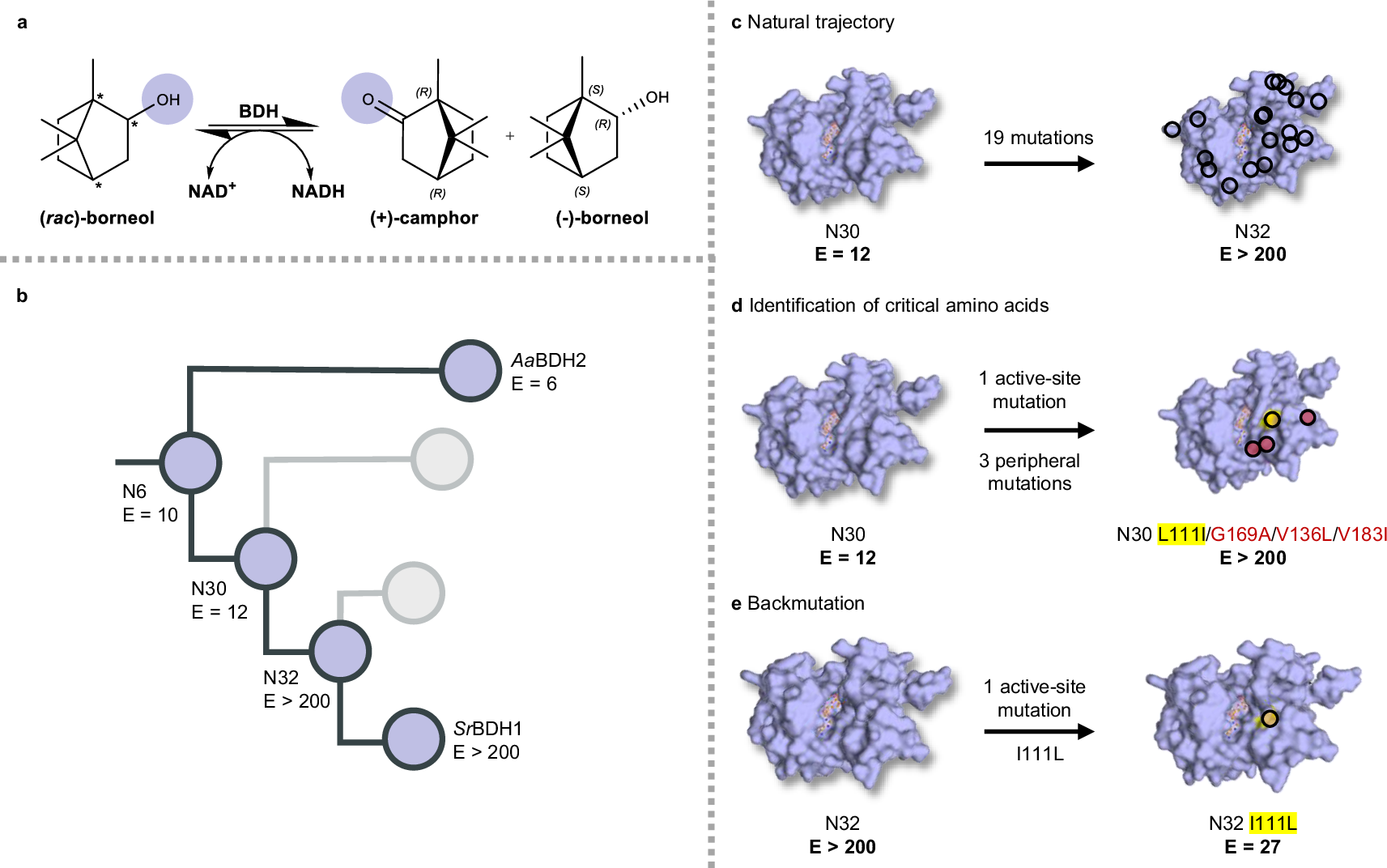
A Berlin-led team rebuilt ancient plant enzymes and traced their choice between two mirror-image molecules to 19 mutations, just one in the active site. The Nature Communications study points enzyme engineers toward protein dynamics as the lever for building selectivity.
The Scientist · Science desk
What happened
- The sequences came from ancestral sequence reconstruction across a family tree of 97 plant borneol dehydrogenase sequences; the team then made the inferred ancient proteins in the lab and compared them.
- Adding the lone active-site mutation to the unselective ancestor N30 doubled its preference between the two forms, and taking it back out of the selective ancestor N32 erased that enzyme's preference.
- N30 became strongly selective only when three further mutations, all located well away from the catalytic pocket, were present alongside the active-site change.
Compiled by The ScientistSomething wrong?How this is made
Why it matters
- capability Catalyst designers get a lever beyond the active site: residues that set how long a substrate holds a reactive pose can decide which mirror form an enzyme makes.
- constraint With selectivity partly governed by residues far from the catalytic pocket, engineers screening enzymes for enantioselectivity cannot limit their mutations to the active site.
- precedent Enzymes that distinguish enantiomers are already prized by the chemical and pharmaceutical industries, and the reconstruction approach shows which kinds of residues to target to build that selectivity on purpose.
Eighteen of the nineteen amino-acid differences between the two ancestors sat outside the active site. [16] The reconstructed proteins showed no obvious structural differences that would explain why one form was favoured and another ignored. [11] The difference was in how the molecules moved. In molecular dynamics simulations, the form the enzyme reacted with better held a catalytically productive position for longer, while the other was gripped less tightly and sat more exposed to the surrounding water. [12]
Many natural molecules, menthol and limonene among them, come in two mirror-image forms that can smell, taste or act on the body quite differently. [1] The enzymes in this study, borneol dehydrogenases, turn the alcohol borneol into camphor. [5] Borneol comes in two such forms, like a left and a right hand, and some enzymes strongly favour making one while others barely tell borneol from isoborneol. [6] The work was led by Bernhard Loll at Freie Universitaet Berlin with Robert Kourist at Graz University of Technology and Lynn Kamerlin at Georgia Institute of Technology. [15]
"What was crucial here was not major structural changes to the enzyme but the interplay of many small changes that influenced the dynamics of the enzyme and bound molecule," Loll said. [13] He added that the result "provides us with important indications of how enzymes could be specifically engineered for biotechnological applications in the future." [14]
The study does not deliver a general design rule. It retraces one evolutionary path, in one plant enzyme family, from an ancestor that barely discriminated to a descendant that strongly does. [3] But it does show that selectivity can be built from many small, distributed changes to an enzyme's dynamics, and that residues well away from the reaction can decide the outcome. [10]
What to watch
- Whether the same dynamics-and-distal-residue pattern holds in enzyme families beyond plant borneol dehydrogenases.
- Whether engineers can use the distal-residue finding to design enantioselective catalysts instead of screening for them by trial.
- The full Nature Communications paper for the identities of the four key residues and the measured selectivity values.
Clarity's read
What the record supports and how the coverage leans. The claims behind it follow.
Reality
- Evidence55
- Adoption
- Insufficient
- Hype gap+10
- Incentives
- Insufficient
- Confidence55
Claim ledger
Ranked by verification strength, evidence, and original report placement.
- [1]
Many naturally occurring molecules such as menthol or limonene exist in two mirror-image forms, known as enantiomers, that look almost identical but can differ in smell, taste or effect on the body.
- [2]
Enzymes can often distinguish between enantiomers with precision, which makes them valuable to the chemical and pharmaceutical industries; how this precision evolved naturally had remained largely unknown.
- [3]
A team led by researchers from Freie Universitaet Berlin, Graz University of Technology and Georgia Institute of Technology reconstructed one such evolutionary path.
- [4]
The study, titled 'Deciphering the Evolutionary Origin of the Enantioselectivity of Short-Chain Dehydrogenases from Plants Toward 1-Borneol,' is published in Nature Communications.
- [5]
The team studied a group of plant enzymes called borneol dehydrogenases, which convert the alcohol borneol into camphor.
- [6]
Borneol exists in two mirror-image forms comparable to a left and a right hand; some enzymes strongly prefer forming one over the other, while others barely distinguish borneol from isoborneol.
- [7]
Using ancestral sequence reconstruction, the team computationally inferred sequences of ancient enzymes from a borneol dehydrogenase family tree of 97 plant sequences, reproduced them in the laboratory and compared them.
- [8]
The oldest unselective ancestor, N30, was compared with a younger, highly selective ancestor, N32; between them were 19 single amino-acid mutations, only one of which lay in the enzyme's active site.
- [9]
Introducing that single active-site mutation into the unselective ancestor doubled its selectivity for the two borneol forms, and reversing it in the selective ancestor made that enzyme lose its preference.
- [10]
Only in combination with three additional mutations far from the active site did ancestor N30 become highly selective for one of the two borneol forms, showing that peripheral areas of an enzyme can affect the reaction at the catalytic site.
- [11]
The reconstructed enzymes initially showed no obvious structural differences that would explain selectivity, but computational simulations showed the two borneol forms behaved differently in the enzyme-substrate complex.
- [12]
The form that reacted better with the enzyme stayed in a catalytically productive position for longer, while the other was held less tightly and more exposed to the water in which it was dissolved.
- [13]
What was crucial here was not major structural changes to the enzyme but the interplay of many small changes that influenced the dynamics of the enzyme and bound molecule.
- [14]
This provides us with important indications of how enzymes could be specifically engineered for biotechnological applications in the future.
- [15]
The research team was led by Dr. Bernhard Loll (Freie Universitaet Berlin), Professor Robert Kourist (Graz University of Technology, Austria) and Professor Lynn Kamerlin (Georgia Institute of Technology, United States).
- [16]
Of the 19 amino-acid changes between ancestors N30 and N32, 18 lay outside the active site.
Sources
1 independent publisher whose own reporting we read for this story.
- phys.orgHow plant enzymes learned to tell mirror-image molecules apart
1 article · October 9, 2026
Topics and entities
Follow any of these and your For You feed starts watching them — no settings page required.
Topics
Entities
- Freie Universität BerlinFollow
- Graz University of TechnologyFollow
- Georgia Institute of TechnologyFollow
- Nature CommunicationsFollow
- Bernhard LollFollow
- Robert KouristFollow
- Lynn KamerlinFollow
- Borneol dehydrogenaseFollow