ScienceNot yet confirmed elsewhere1 publisher2 min readPublished
Cesium atoms trapped in one-dimensional tubes bind into the Bethe strings predicted in 1931
University of Innsbruck physicists made Bethe strings, predicted by Hans Bethe in 1931, from cesium atoms in thousands of one-dimensional tubes. Because the atoms' attraction is tunable, physicists now have a controllable gas for studying bound states of many particles.
The Scientist · Science desk
What happened
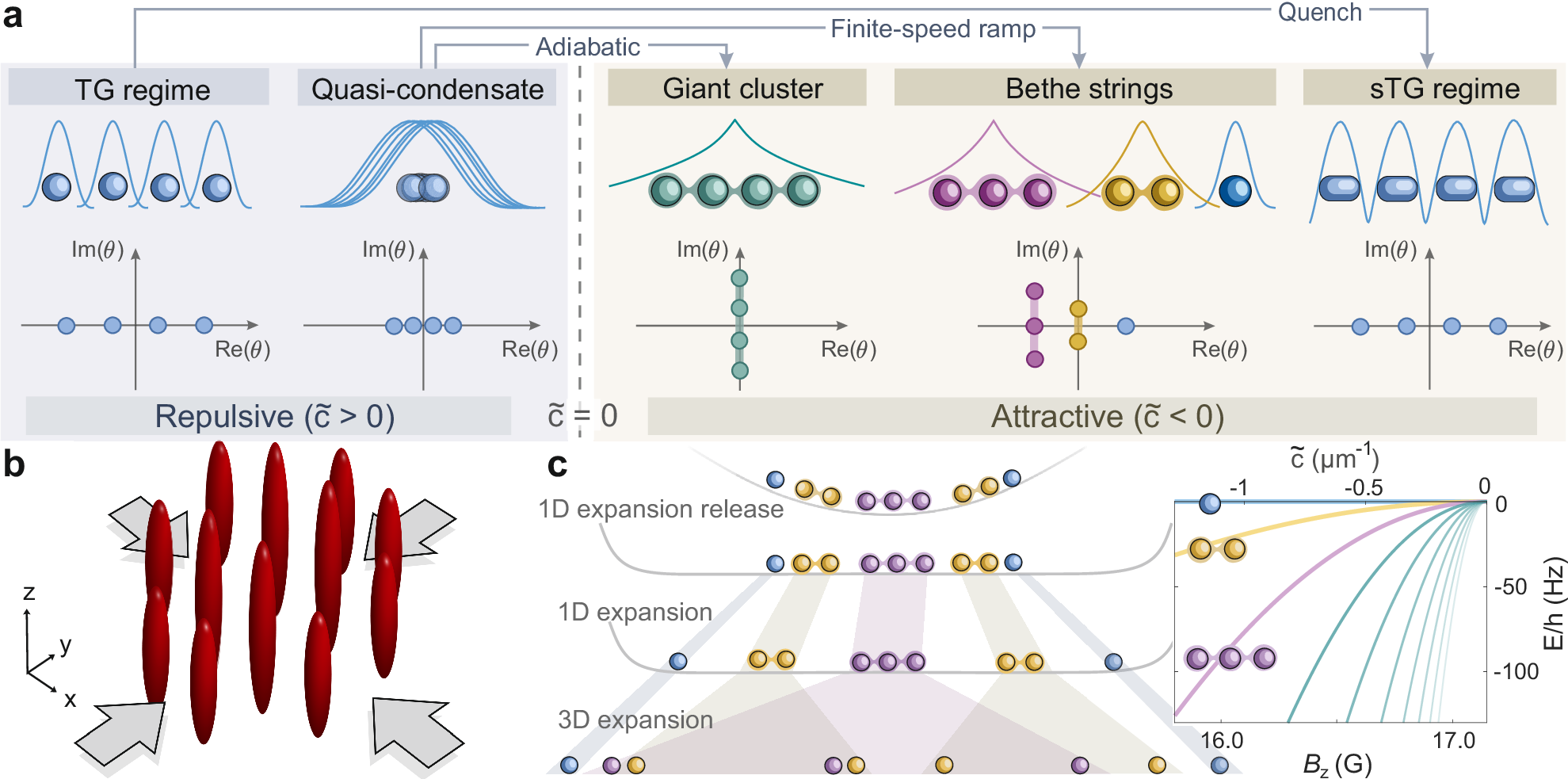
- Switching the cesium atoms' interactions from repulsive to attractive bound them into clusters of several different sizes, some of them holding six or more particles.
- When the team released the atoms from the tubes into three-dimensional space, the strings fell apart and their binding energy turned into motion that sped the atoms apart.
- Bethe strings had been detected experimentally before, in solid-state magnetic systems.
- Theory teams at the University of Amsterdam and the Technical University of Munich worked with the Innsbruck group, and the results appeared in Nature Communications.
Compiled by The ScientistSomething wrong?How this is made
Why it matters
- capability Physicists can now set how strongly the atoms attract and then drive the resulting strings into collisions, so predictions from Bethe's mathematics can be checked in a system under experimental control.
- constraint Binding is inferred from an energy excess over an unbound control, so the published account supports the existence of strings more firmly than it supports the six-particle cluster count.
- capability With Bethe strings now made in a gas as well as in magnetic solids, theorists have two physically different systems in which to check the same predictions.
The release's summary says the strings were "created and directly observed" [15]. What the team measured is a difference in energy, and the design of that measurement is the strongest part of the work. Bethe strings can exist only in one dimension, held together by the particles' interactions with no chemical bond involved [2]. Taking the atoms out of their tubes therefore has a predictable effect on any string present, and the energy it frees can be measured [11].
The control is the repulsive gas. When the atoms push each other away, nothing binds, and expansion inside the tubes and expansion into three dimensions gave essentially the same energy [12]. That rules out the possibility that removing the confinement adds energy on its own [12]. Only with attractive interactions did the three-dimensional release carry an excess [12]. Because the interaction strength is adjustable [6], the bound and unbound runs use the same atoms, cooled to within a few billionths of a degree of absolute zero, in the same set of tubes [5].
The collision result came from the in-tube expansion. "One of the simplest experiments was to let the strings expand," said Milena Horvath, one of the lead authors [8]. As the strings spread along their tubes they ran into one another, and the bound structures held [9]. "This is a remarkable feature of the strings: they can collide without breaking apart," Horvath said [10].
The release does not give the size of the energy excess, or explain how the team established that some clusters held six or more particles [7]. Readers will have to go to the Nature Communications paper for those details [3].
Bethe's prediction was 95 years old when the release came out [17]. The experiment was led by Hanns-Christoph Nägerl [4]. Sudipta Dhar, another lead author, described what the gas adds. "Bethe strings were predicted almost a century ago as part of a beautiful mathematical description of quantum many-body systems," Dhar said. "Now we can create them in the laboratory, manipulate them and make them collide and probe their remarkable collisional stability." [13]
What to watch
- The Nature Communications paper's figures for the size of the three-dimensional energy excess and for how many clusters of each size formed.
- Whether the Innsbruck group maps how cluster sizes change as the attraction between the atoms is turned up or down.
- Whether another cold-atom group reproduces the energy signature in its own one-dimensional traps.
Clarity's read
What the record supports and how the coverage leans. The claims behind it follow.
Reality
- Evidence45
- Adoption
- Insufficient
- Hype gap+20
- Incentives40
- Confidence50
Claim ledger
Ranked by verification strength, evidence, and original report placement.
- [1]
In 1931, physicist Hans Bethe proposed that particles in certain quantum systems restricted to one dimension could join together into collective states now called Bethe strings.
- [2]
In Bethe strings the particles are bound by their interactions with one another rather than by chemical bonds, and the states can exist only in one dimension.
- [3]
University of Innsbruck researchers created and detected Bethe strings in an ultracold gas, working with theory teams from the University of Amsterdam and the Technical University of Munich; the results were published in Nature Communications.
- [4]
The experiment was led by quantum physicist Hanns-Christoph Nägerl.
- [5]
The researchers cooled a cloud of cesium atoms to within a few billionths of a degree above absolute zero and separated it into several thousand extremely narrow tubes, in which the atoms move along a single direction.
- [6]
The researchers can precisely adjust how strongly the atoms interact.
- [7]
Changing the interactions from repulsive to attractive caused the atoms to bind into bound states of several different sizes; some of the larger clusters contained six or more particles.
- [8]
"One of the simplest experiments was to let the strings expand," said Milena Horvath, one of the lead authors.
- [9]
When the atoms expanded while still confined in their one-dimensional tubes, the strings collided with one another and the bound structures survived.
- [10]
"This is a remarkable feature of the strings: they can collide without breaking apart," said Milena Horvath.
- [11]
When the confinement was removed and the atoms expanded freely in three dimensions, the bound states fell apart; the energy that had bound them turned into motion and the atoms spread apart faster.
- [12]
With repulsive interactions, when the particles were unbound, both expansion measurements produced essentially the same energy; when Bethe strings were present, the three-dimensional expansion contained extra energy released as the bound states broke apart.
- [13]
"Bethe strings were predicted almost a century ago as part of a beautiful mathematical description of quantum many-body systems. Now we can create them in the laboratory, manipulate them and make them collide and probe their remarkable collisional stability," said Sudipta Dhar, another lead author.
- [14]
Bethe strings have previously been detected experimentally in solid-state magnetic systems.
- [15]
The release summary says scientists "created and directly observed" Bethe strings in an ultracold gas.
- [17]
Bethe's prediction was 95 years old at the date of the release.
Sources
1 independent publisher whose own reporting we read for this story.
- sciencedaily.comA quantum prediction from 1931 just came to life
1 article · October 9, 2026
Topics and entities
Follow any of these and your For You feed starts watching them — no settings page required.
Entities
- Hans BetheFollow
- Bethe stringsFollow
- University of InnsbruckFollow
- Hanns-Christoph NägerlFollow
- Milena HorvathFollow
- Sudipta DharFollow
- Alvise BastianelloFollow
- Nature CommunicationsFollow
- Technical University of MunichFollow
- University of AmsterdamFollow