ScienceNot yet confirmed elsewhere1 publisher2 min readPublished
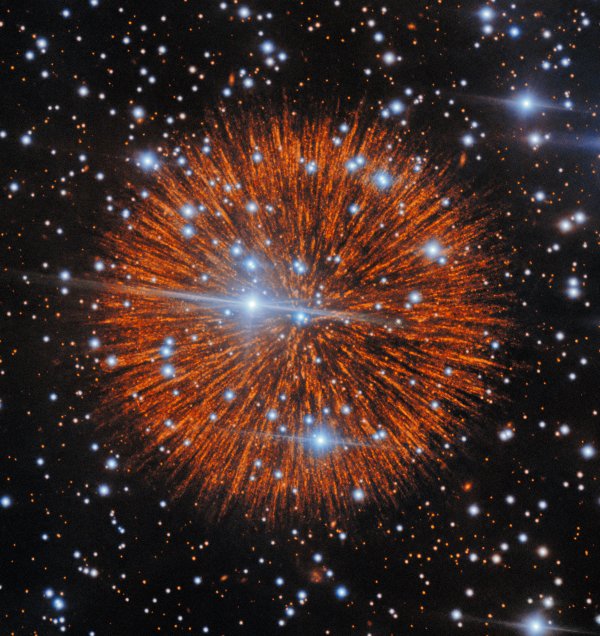
Gemini North resolves the streaks of Pa 30, likely remnant of the 1181 supernova, into knots of gas
Gemini North imaging shows the streaks of Pa 30, the probable remnant of the 1181 supernova, are knots of gas strung like pearls. Because it is the Milky Way's only known Type Iax remnant, astronomers plan to use its features to look for more like it.
The Scientist · Science desk
What happened
- The researchers think Pa 30 formed when two white dwarfs, the dense cores left behind by spent stars, collided.
- The central star sits exactly in the middle of the nebula, not kicked aside as in other supernovae, a sign the explosion was fairly symmetrical.
- The supernova of 1181 stayed visible for 185 consecutive days and was recorded by Japanese, Chinese and Arabic astronomers.
- Its likely remnant was found only in 2013, during a citizen science campaign that was searching for planetary nebulae.
Why it matters
- constraint If gas around the progenitor shaped the knots, as NOIRLab suggests, they record local conditions, so a search keyed to knotted filaments could pass over Type Iax remnants that formed in different surroundings.
- capability A surviving star left exactly at the center gives models of white dwarf collisions a fairly symmetrical Type Iax case that they have to reproduce.
- precedent A recorded supernova's remnant turned up in a volunteer hunt for planetary nebulae, so surveys built for other targets are a reasonable place to look for the next object like Pa 30.
The team picked out the structure in sulfur emission lines and counted roughly ten times as many filamentary features as previous images could resolve [5]. That factor is measured against older pictures, so it reports a gain in resolution on the same nebula [5]. According to NOIRLab, which operates Gemini North for the National Science Foundation [2], the knotted form suggests that thermal or density variations in the circumstellar medium shaped the ejected material as it expanded [13].
The detail depends on distance [12]. Pa 30 lies 7,500 light-years from Earth, while the center of the Milky Way is about 26,000 light-years away [11], roughly 3.5 times farther [17]. "We can see this much detail because of Pa 30's proximity to Earth," said Ilaria Caiazzo, a study author and astrophysicist at the Institute of Science and Technology Austria [12]. "This proximity makes Pa 30 uniquely valuable for study." [12]
The plan to use Pa 30 as a guide depends on its classification, and Discover Magazine's report gives that with a hedge: the explosion "may have been" a rare Type Iax supernova, a lower-energy event much fainter than the more common Type Ia [7]. The difference shows up in what is left. According to NASA, Type Ia explosions usually destroy the white dwarf, while Type Iax events leave a battered one behind [16]. Pa 30 still has a central star, the so-called zombie [7]. That fits the second pattern. The tie to 1181 is a judgment too, reached through follow-up observations that made Pa 30 the most likely remnant [4]. The report does not describe which measurements in the new paper, published in The Astrophysical Journal [1], support the Type Iax reading.
We think the search plan is sound on this evidence, with one condition. A template drawn from a sample of one [14] needs a second remnant before any of its features can be called typical of the class. "While we can see Type Iax supernovae in distant galaxies as point sources of light, resolving the remnants of such explosions is only possible in our own galaxy and in very few nearby ones," Caiazzo said [15]. "Eventually, we plan to use Pa 30's distinctive properties to search the Milky Way and nearby galaxies for similar objects." [15]
What to watch
- A second Type Iax remnant found in the Milky Way or a nearby galaxy, showing which of Pa 30's features are typical of the class.
- Independent age estimates for the nebula that strengthen or weaken its link to the supernova of 1181.
- Observations of the surrounding gas that test whether temperature or density variations shaped the knots.
Clarity's read
What the record supports and how the coverage leans. The claims behind it follow.
Reality
- Evidence55
- Adoption
- Insufficient
- Hype gap+10
- Incentives
- Insufficient
- Confidence50
Claim ledger
Ranked by verification strength, evidence, and original report placement.
- [1]
Astronomers re-examined Pa 30 using the Gemini North telescope in Hawaii; their findings are published in The Astrophysical Journal.
ReportedSupportedSource: Discover Magazine2 sources— create a free account to open themView cited source - [2]
The Gemini North telescope is operated by the National Science Foundation's NOIRLab.
ReportedSupportedSource: Discover Magazine2 sources— create a free account to open themView cited source - [3]
The nebula's 'firework' streaks are actually knots of gas that closely resemble pearls on a string.
- [4]
Based on follow-up observations, astronomers have gauged the Pa 30 nebula to be the most likely remnant of the historic 1181 supernova.
- [5]
Upon analyzing sulfur emission lines, the researchers found that Pa 30 had roughly ten times as many filamentary features as previous images could resolve; these features turned out to be knots of gas, not smooth streaks.
- [6]
The researchers believe Pa 30 arose from a collision between two white dwarfs, dense stellar cores left behind after a star has exhausted its nuclear fuel and shed its outer layers.
- [7]
The supernova that created Pa 30 may have been a rare Type Iax supernova, a lower-energy, incomplete explosion much fainter than the more commonly observed Type Ia; a central star remains and is referred to as a 'zombie star'.
- [8]
The latest observations show Pa 30's star is exactly centered, not 'kicked away' like other stars after supernovae, implying the supernova was quite symmetrical.
- [9]
The 1181 supernova remained visible for 185 consecutive days; historical records indicate Japanese, Chinese and Arabic astronomers witnessed it.
- [10]
The remnant was discovered in 2013 during a citizen science campaign to find planetary nebulae.
- [11]
Pa 30 sits 7,500 light-years from Earth; the center of the Milky Way is about 26,000 light-years away.
- [12]
"We can see this much detail because of Pa 30's proximity to Earth," said study author Ilaria Caiazzo, an astrophysicist at the Institute of Science and Technology Austria. "This proximity makes Pa 30 uniquely valuable for study."
ReportedSupportedSource: Ilaria Caiazzo, in a statement quoted by Discover MagazineView cited source - [13]
According to NOIRLab, the knot-like structure suggests there may have been thermal or density variations in the circumstellar medium that shaped the ejected supernova material as it expanded away from the explosion.
- [14]
So far, Pa 30 is the only Type Iax supernova remnant known to exist in the Milky Way.
- [15]
"While we can see Type Iax supernovae in distant galaxies as point sources of light, resolving the remnants of such explosions is only possible in our own galaxy and in very few nearby ones," said Caiazzo. "Eventually, we plan to use Pa 30's distinctive properties to search the Milky Way and nearby galaxies for similar objects."
- [16]
According to NASA, Type Ia supernovae usually destroy white dwarfs, while Type Iax supernovae leave behind a battered and bruised white dwarf.
- [17]
The center of the Milky Way is about 3.5 times farther from Earth than Pa 30.
Sources
1 independent publisher whose own reporting we read for this story.
- discovermagazine.comRemnant From Rare Supernova Seen Nearly 850 Years Ago Hides a Zombie Star at its Center
1 article · October 10, 2026
Topics and entities
Follow any of these and your For You feed starts watching them — no settings page required.