Science2 publishers3 min readPublished
Gemini North images resolve the 1181 supernova remnant Pa 30 into chains of gas knots
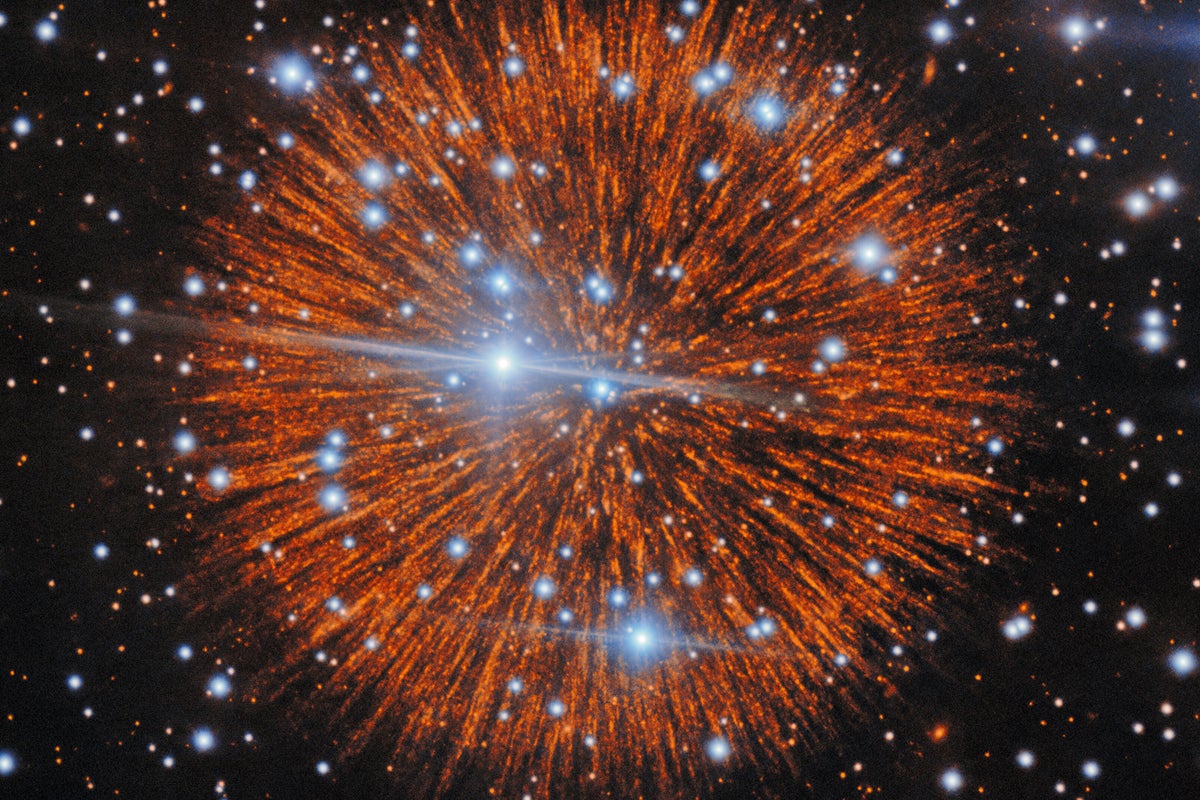
Gemini North images show the streaks of Pa 30, left by the 1181 'zombie' supernova, are chains of gas knots that could each hold Neptune's orbit 10 times. The knots look close to uniform in size, so models of rare Type Iax explosions now have a specific pattern to reproduce, and the team has yet to try.
The Scientist · Science desk
Drafted by a language model from the sources cited here and checked against its claim ledger before publication. How we use AISend a correction
What happened
- In ionized sulfur light, the images show roughly 10 times as many filamentary features as earlier pictures of Pa 30 could resolve.
- Pa 30 is the only known remnant of its kind in the Milky Way, and the only one anywhere where telescopes can see the surviving star at its core.
- A citizen scientist first spotted the nebula in 2013, and it was later tied to the explosion that Japanese, Chinese and Arabic observers recorded independently in 1181.
- The results appear in The Astrophysical Journal, from a team co-led by Ilaria Caiazzo of ISTA and Tim Cunningham, now at the University of Warwick.
Compiled by The ScientistSomething wrong?How this is made
Why it matters
- constraint A simulation of how this explosion spread its debris now has to produce chains of similar-sized clumps along each filament, because smooth streaks no longer match what the telescope sees.
- constraint Any model tuned to Pa 30 rests on a single Milky Way example, since none of the few similar remnants in other galaxies shows a surviving star at its core.
- precedent If new telescopes find more remnants of this type in the galaxy, as Cunningham expects, the knot pattern can be compared across objects and tested as a general feature of these explosions.
The new detail came from two emission lines: red light from ionized sulfur, S II, and blue-green light from doubly ionized oxygen, O III [18]. The factor of 10 in the sulfur data is a count against what earlier images could resolve [19], so it measures how much sharper the view has become.
Along each filament the knots form tight chains, and they appear to have remarkably uniform sizes [11]. "The planetary region of our solar system could fit in each knot about 10 times with room to spare," said Ilaria Caiazzo of the Institute of Science and Technology Austria, who co-led the team with Tim Cunningham [1][12]. "The knots are quite strikingly uniform. We are excited to try to model them." [12] The published accounts do not give a measured spread of knot sizes or a knot count.
The thing this doesn't tell you is why the gas clumps at one scale. The paper's title, "Detection of knots in the supernova type Iax remnant Pa 30" [15], describes a detection, and Caiazzo's own words put the modelling still ahead [12]. In my view the uniformity is the most useful part of the result anyway. A simulation of how an incomplete explosion throws off its debris now has a concrete check. It has to make chains of similar-sized clumps, and smooth streaks fail. That holds only if the size distribution in the paper is as narrow as the description.
Distance is why the check exists at all. Pa 30 is about 7,500 light-years away, and the galaxy's center is about 26,000 [5]. That puts the remnant at less than a third of the distance to the center [20]. "We can see this much detail because of Pa 30's proximity to Earth," Caiazzo said. "This proximity makes Pa 30 uniquely valuable for study." [8]
The star that survived is what makes this a Type Iax supernova, a rare class in which the blast does not fully destroy the star [7][17]. Researchers have proposed that Pa 30 formed when two white dwarfs, dense Earth-sized stellar remnants, collided [7]. Both reports present that origin as a proposal. The star sits almost exactly at the nebula's center [13], a position The Independent calls unusual [14].
In the Milky Way, the sample is one. The 1181 event is one of just five supernovae recorded before the telescope era whose remnants had long remained unidentified [4]. Cunningham, of the Center for Astrophysics | Harvard & Smithsonian and now an assistant professor at the University of Warwick [1][16], expects more. "Reliable historical records of stellar explosions extend back only about a thousand years. For all we know, there might well be similar remnants still lurking in the dark in our own galaxy," he said [9]. "We will likely identify more similar objects as new telescopes continue to inspect the depths of our night sky." [10]
What to watch
- The size distribution and knot count in the Astrophysical Journal paper, which will show how narrow 'strikingly uniform' really is.
- Simulations, from Caiazzo's team or others, that try to make uniform knot chains from a white-dwarf collision.
- Discovery of a second Type Iax remnant in the Milky Way, which would give Pa 30's knots something to be compared against.