Science4 publishersIndependently confirmed3 min readPublished
MeerKAT and Webb trace the most distant fast radio burst to a small galaxy at redshift 2.15
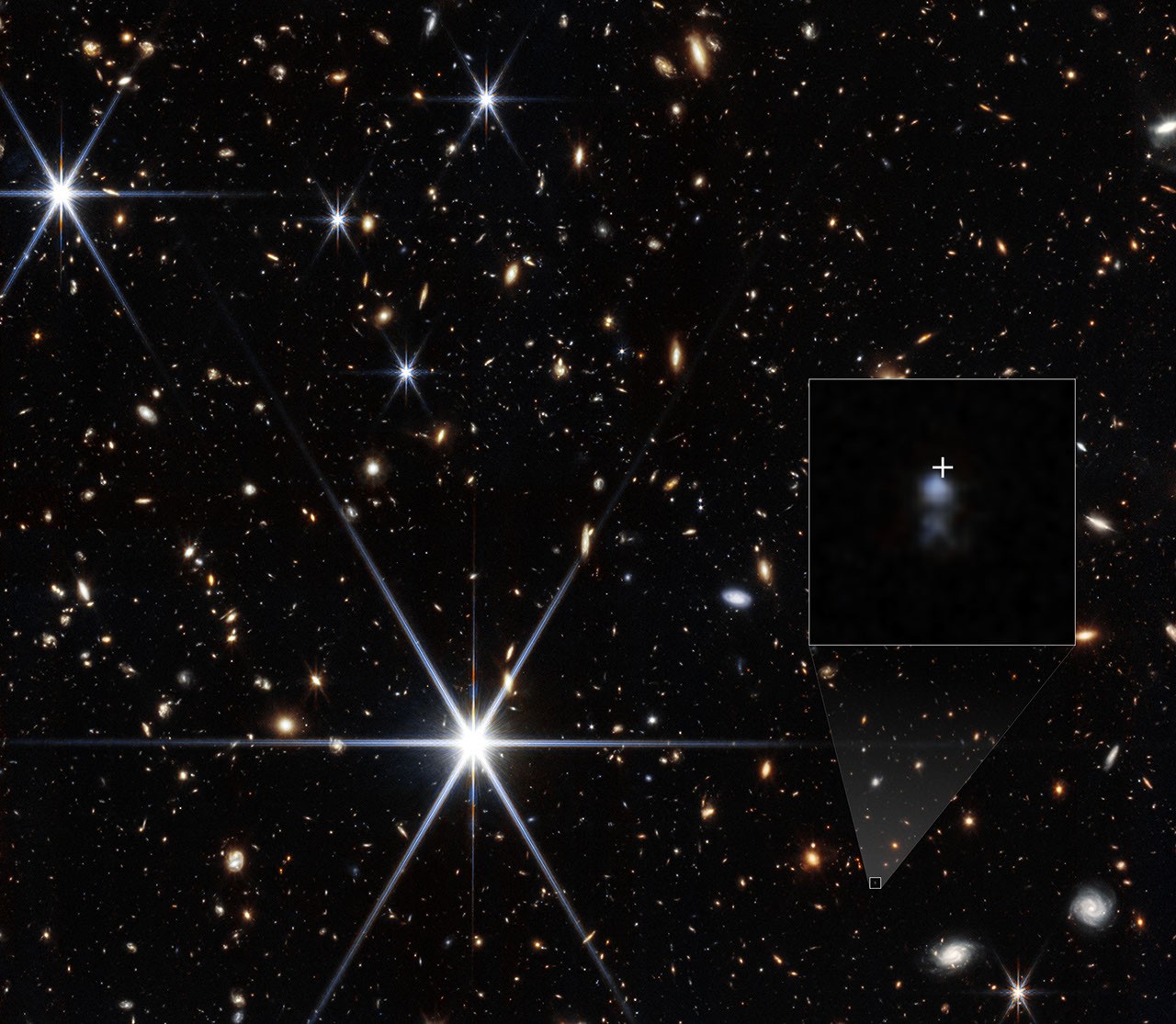
MeerKAT and JWST traced fast radio burst FRB 20240304B to a galaxy seen 3 billion years after the Big Bang, more than doubling the distance record. The small, star-forming host is one data point for young magnetars as the source of at least some of these flashes.
The Scientist · Science desk
What happened
- MeerKAT, an array of 64 radio telescopes in South Africa, made the initial detection of the millisecond burst.
- The host galaxy was too faint for the largest ground-based telescopes, so the team needed JWST to pinpoint it and measure its distance.
- The study, led by Manisha Caleb and Themiya Nanayakkara of the University of Sydney, was published in Science.
Compiled by The ScientistSomething wrong?How this is made
Why it matters
- capability A precise radio position followed by a triggered JWST image can now find FRB hosts too faint for any ground telescope, so distant bursts can be tied to a specific galaxy.
- capability With a measured redshift for a burst that crossed most of cosmic history, its dispersion can be used to study matter between galaxies that is otherwise hard to observe.
- constraint Each new distant host needs a radio localization first and then JWST time from a programme for time-sensitive work, and both limit how fast the sample grows.
The team knew the burst was far away before they had seen anything at its position. The radio signal arrived heavily dispersed, and that alone pointed to a distant source [4]. Deep searches with powerful ground-based telescopes then "saw essentially nothing; it looked like empty sky," the researchers told Live Science [10]. "The most likely explanation was that the galaxy was simply too faint to be detected in those observations. That is where JWST became transformative," they wrote [11].
The JWST time came through Director's Discretionary Time, a route meant for time-sensitive observations. The first step was a very deep image with the Near Infrared Camera [12]. "Suddenly, there it was: a very faint galaxy almost exactly where we expected the host of the FRB to be," Nanayakkara said [13].
I like the design. The position and the distance come from different instruments measuring different things. MeerKAT supplied "a very precise position on the sky," in Nanayakkara's words [2]. The dispersion depends on the material the signal crossed on its way here [16]. The spectral lines measure something else: how far the expansion of the universe has stretched light of known laboratory wavelength. JWST's spectrograph found hydrogen and oxygen lines, and their shift gave a redshift of about 2.15 [14]. "We are therefore seeing this galaxy as it was when the universe was only around three billion years old, so roughly one-fifth of its current age," Nanayakkara said [15]. Neither account reports how likely it is that an unrelated faint galaxy would sit that close to the burst position by chance.
FRB 20240304B more than doubles the previous FRB distance record [3]. That record was set in 2023 by a burst whose discovery also involved University of Sydney astronomers [9].
JWST also showed the host was smaller than expected, metal-poor and forming a lot of stars [5]. "The galaxy hosting this burst is surprisingly small, metal-poor and undergoing a very active episode of star formation," said Laura Driessen, a co-author at the University of Sydney [6]. Magnetars are highly magnetised neutron stars formed when massive stars explode. The team argues that a young, vigorously star-forming galaxy fits magnetar formation better than mergers of older neutron stars [7].
Astronomers have detected thousands of fast radio bursts [8]. This is one host, and the team limits its claim to at least some of them [7]. I think the magnetar point holds for this burst and goes no further. One galaxy at redshift 2.15 cannot say what share of all FRBs come from magnetars.
"Once our radio telescopes find and localize a suitable new source, we can trigger the JWST observations," Nanayakkara said [18]. So the number of hosts this distant depends first on radio arrays localizing bursts, then on getting JWST time [12]. Caleb said, "What is particularly exciting about our result is that we've now demonstrated that we can identify and study an FRB from when the universe was young." [17] Ben Stappers of the University of Manchester, principal investigator of MeerTRAP, said "The next step is to push this frontier further and see how close we can get to the first generations of stars." [19]
What to watch
- Further MeerKAT-localized bursts followed up with JWST, and whether their distant hosts are also small, metal-poor and star-forming, which would test the magnetar link beyond a single galaxy.
- Published measurements of the intergalactic gas along this burst's path, the use the University of Sydney team highlights for the signal.
Clarity's read
What the record supports and how the coverage leans. The claims behind it follow.
Reality
- Evidence74
- Adoption
- Insufficient
- Hype gap+10
- Incentives35
- Confidence72
Perspective Coverage
3 publishers- Builder
- Builder 52%
- Operator
- Operator 38%
- Investor
- Investor 10%
Claim ledger
Ranked by verification strength, evidence, and original report placement.
- [1]
FRB 20240304B was initially detected with MeerKAT, an array of 64 radio telescopes in South Africa.
- [2]
Nanayakkara said MeerKAT revealed "both the detection of the fast radio burst and, importantly, a very precise position on the sky."
ReportedSupportedSource: Themiya Nanayakkara, to Live Science3 sources— create a free account to open themView cited source - [3]
The burst originated when the universe was only about 3 billion years old, making it the most distant FRB yet detected and more than doubling the previous distance record; the MeerTRAP project used MeerKAT to detect it before identifying its host galaxy with JWST.
ReportedSupportedSource: phys.org (University of Sydney); also reported by Live Science3 sources— create a free account to open themView cited source - [4]
The researchers knew the FRB was far away because of the large dispersion of the radio signal.
- [5]
JWST's observations showed the host galaxy was smaller than expected, metal-poor, and forming a lot of stars.
- [6]
"The galaxy hosting this burst is surprisingly small, metal-poor and undergoing a very active episode of star formation," said Dr. Laura Driessen, a co-author at the University of Sydney.
ReportedSupportedSource: Laura Driessen, via phys.org3 sources— create a free account to open themView cited source - [7]
The research provides evidence that at least some FRBs may originate from young magnetars, highly magnetized neutron stars formed in supernovas; the young, vigorously star-forming host is more consistent with magnetar formation than with mergers of older neutron stars.
ReportedSupportedSource: phys.org (University of Sydney)3 sources— create a free account to open themView cited source - [8]
Astronomers have detected thousands of FRBs; they last only milliseconds and their origins remain unclear.
- [9]
In 2023, University of Sydney astronomers were involved in the discovery of what was then the most distant fast radio burst, a record now surpassed by FRB 20240304B.
ReportedSupportedSource: phys.org (University of Sydney)3 sources— create a free account to open themView cited source - [10]
Initial searches with powerful ground-based telescopes "saw essentially nothing; it looked like empty sky," the researchers told Live Science.
ReportedSupportedSource: Nanayakkara and Caleb, email to Live Science2 sources— create a free account to open themView cited source - [11]
"The most likely explanation was that the galaxy was simply too faint to be detected in those observations. That is where JWST became transformative."
ReportedSupportedSource: Nanayakkara and Caleb, email to Live Science2 sources— create a free account to open themView cited source - [12]
The team got JWST time through Director's Discretionary Time, a program aimed at time-sensitive observations, and used JWST's Near Infrared Camera to take a very deep image of the target region.
- [13]
"Suddenly, there it was: a very faint galaxy almost exactly where we expected the host of the FRB to be," Nanayakkara said.
ReportedSupportedSource: Themiya Nanayakkara, to Live Science2 sources— create a free account to open themView cited source - [14]
JWST's Near Infrared Spectrograph obtained a spectrum showing hydrogen and oxygen; measuring how far those lines, of known laboratory wavelength, had been shifted by cosmic expansion gave a redshift of about 2.15.
ReportedSupportedSource: Live Science; Nanayakkara2 sources— create a free account to open themView cited source - [15]
"We are therefore seeing this galaxy as it was when the universe was only around three billion years old, so roughly one-fifth of its current age."
ReportedSupportedSource: Themiya Nanayakkara, to Live Science2 sources— create a free account to open themView cited source - [16]
As the radio signal traveled across most of cosmic history, it carried information about the material it encountered, giving astronomers a way to study otherwise invisible matter between galaxies.
ReportedSupportedSource: phys.org (University of Sydney)2 sources— create a free account to open themView cited source - [17]
"What is particularly exciting about our result is that we've now demonstrated that we can identify and study an FRB from when the universe was young."
ReportedSupportedSource: Manisha Caleb, via phys.org2 sources— create a free account to open themView cited source - [18]
"Once our radio telescopes find and localize a suitable new source, we can trigger the JWST observations."
ReportedSupportedSource: Themiya Nanayakkara, to Live Science2 sources— create a free account to open themView cited source - [19]
Ben Stappers of the University of Manchester, principal investigator of the MeerTRAP project, said "The next step is to push this frontier further and see how close we can get to the first generations of stars."
ReportedSupportedSource: Ben Stappers, via phys.org2 sources— create a free account to open themView cited source - [20]
The discovery, led by Dr. Manisha Caleb and Dr. Themiya Nanayakkara at the University of Sydney, is published in Science under the title 'A fast radio burst at redshift 2, three billion years after the Big Bang'.
ReportedSupportedSource: phys.org (University of Sydney)2 sources— create a free account to open themView cited source - [21]
The study was published Thursday, Oct. 8, in the journal Science.
- [22]
The host galaxy was invisible to the largest ground-based telescopes, requiring JWST to pinpoint it and measure its distance.
ReportedSupportedSource: phys.org (University of Sydney)2 sources— create a free account to open themView cited source
Sources
4 independent publishers whose own reporting we read for this story.
- livescience.comJames Webb telescope pinpoints the most distant 'fast radio burst' ever seen
1 article · October 8, 2026
- phys.orgAstronomers pinpoint the most distant fast radio burst ever detected
1 article · October 8, 2026
- scientificamerican.comAstronomers discover record-breaking ancient cosmic outburst
1 article · October 8, 2026
- theguardian.comAstronomers detect mysterious burst of energy from a galaxy far, far away
1 article · October 8, 2026
Topics and entities
Follow any of these and your For You feed starts watching them — no settings page required.
Topics
- Fast Radio BurstsFollow
- Radio AstronomyFollow
- MagnetarsFollow