Science1 publisherNot yet confirmed elsewhere3 min readPublished
Betelgeuse's 2,200-day cycle finally has a candidate object, found where models said to look
A SPHERE/VLT detection at 6 sigma places a faint companion at the separation two papers predicted for December 2024. Confirmation waits on catching it on the far side.
The Scientist · Science desk
What happened
- Astronomers have found the best evidence yet for a companion star to Betelgeuse, the brightest star in the constellation Orion.
- The evidence is based on data from the SPHERE instrument on the European Southern Observatory's Very Large Telescope (VLT) in Chile.
- Betelgeuse is a red supergiant located about 548 light-years away and is the 10th brightest star in the night sky.
- Betelgeuse's brightness varies over a period of roughly 420 days, superimposed on a longer 2200-day modulation.
- For decades astronomers have suspected some of Betelgeuse's brightness variations could be caused by a companion star that modifies the distribution of cosmic dust the star produces and expels, which in turn changes the amount of its light reaching Earth.
Compiled by The ScientistSomething wrong?How this is made
Why it matters
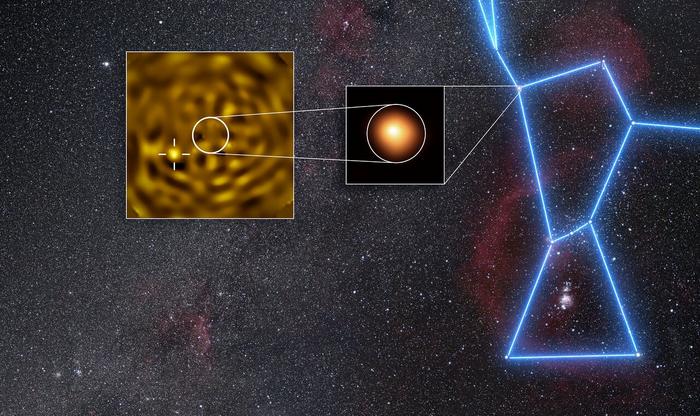
Astronomers using the SPHERE instrument on the European Southern Observatory's Very Large Telescope in Chile report the best evidence yet for a companion star to Betelgeuse, the brightest star in Orion [s1c1][s1c2]. The detection matters less as a discovery than as a successful prediction: the team pointed at a specific place at a specific time because two earlier papers said the object would be there [s1c6].
Betelgeuse is a red supergiant about 548 light-years away and the 10th brightest star in the night sky [s1c3]. Its brightness rises and falls on a period of roughly 420 days, with a longer 2,200-day modulation layered on top [s1c4]. That second, slower cycle is the one that has resisted explanation for decades, and the long-standing suspicion has been that a companion star periodically rearranges the dust Betelgeuse throws off, changing how much of its light reaches Earth [s1c5]. Until now that was an inference from a light curve. There was no object.
Two studies, published in The Astrophysical Journal in 2024 and 2025 and circulated earlier as preprints, predicted that the companion would reach maximum elongation from Betelgeuse in December 2024 [s1c6]. The same studies also concluded it would be too faint for current instruments to see, so the team led by Miguel Montargès of the Observatoire de Paris - PSL requested VLT time expecting to set upper limits rather than to make a detection [s1c7][s1c8]. They imaged the predicted region and then ran post-processing developed for exoplanet searches, a difficult job given Betelgeuse's brightness and large angular size, according to Montargès [s1c9].
What came out was a signal at 6 sigma, which Montargès calls a "Betelbuddy" [s1c10]. For comparison, astronomers at NOIRLab reported an upper limit of 1.5 sigma in 2025 [s1c11], and 5 sigma is the conventional threshold for calling something an observation [s1c12]. The new result is four times the nominal significance of the previous limit [s1d1].
The team is explicit that this is not yet a confirmed bound companion. The test is to observe half a period after the first detection, when the object should appear on the opposite side of the supergiant, followed by further tracking to pin down semi-major axis, eccentricity and inclination [s1c13][s1c14]. Those parameters are what feed into the question that actually matters: Betelgeuse will eventually explode, and Montargès says interactions between the two stars could advance or delay that supernova [s1c15]. The work is published in Astronomy and Astrophysics [s1c17].
Two things to watch. First, the far-side observation; a 2,200-day cycle is about six years, so half of it is roughly 1,100 days from the December 2024 detection, while the researchers describe the next attempt as taking place next year [s1d2][s1c13]. Second, the method. Montargès says 30% of red supergiants in the galaxy show the same kind of light variation, which makes this a possible route to finding more such binaries around evolved stars [s1c16].
Clarity's read
What the record supports and how the coverage leans. The claims behind it follow.
Reality
- Evidence60
- Adoption
- Insufficient
- Hype gap+18
- Incentives58
- Confidence52
Claim ledger
Ranked by verification strength, evidence, and original report placement.
- [1]
The team gathered enough data to identify a companion Montarges calls a "Betelbuddy" with a confidence of 6 sigma.
- [2]
Astronomers have found the best evidence yet for a companion star to Betelgeuse, the brightest star in the constellation Orion.
- [3]
The evidence is based on data from the SPHERE instrument on the European Southern Observatory's Very Large Telescope (VLT) in Chile.
- [4]
Betelgeuse is a red supergiant located about 548 light-years away and is the 10th brightest star in the night sky.
- [5]
Betelgeuse's brightness varies over a period of roughly 420 days, superimposed on a longer 2200-day modulation.
- [6]
For decades astronomers have suspected some of Betelgeuse's brightness variations could be caused by a companion star that modifies the distribution of cosmic dust the star produces and expels, which in turn changes the amount of its light reaching Earth.
- [7]
Two studies, published in The Astrophysical Journal in 2024 and 2025 and available as preprints beforehand, predicted that in December 2024 the companion star would be at its greatest distance (maximum elongation) from Betelgeuse, making it easier to detect.
- [8]
The same studies predicted the companion would not be massive enough to be detectable with current instrumentation; Montarges and colleagues hoped instead to place upper limits on its stellar parameters.
- [9]
Researchers led by Miguel Montarges of the Observatoire de Paris - PSL, France, requested observing time on the VLT to take advantage of the predicted December 2024 elongation.
- [10]
The team imaged light from the region where the companion was expected and applied advanced post-processing techniques originally developed to search for exoplanets; Montarges explains that Betelgeuse's brightness and large angular size made the analysis difficult.
- [11]
Montarges notes the 6 sigma result is better than the previous upper limit of 1.5 sigma reported by astronomers at NOIRLab in 2025.
- [12]
5 sigma is the usual threshold that constitutes an "observation" or "discovery".
- [13]
Before being certain they have detected a companion gravitationally bound to Betelgeuse, the astronomers will need additional observations next year, attempting to confirm the companion by observing it half a period after the initial detection, on the other side of the red supergiant.
- [14]
Montarges says they will continue observing to get a precise characterization of the companion's orbit, including semi-major axis, eccentricity and inclination, which will be required to understand the past and future evolution of the system.
- [15]
Betelgeuse is expected to undergo a supernova explosion; Montarges says that depending on past, present and future interactions between the two stars, the supernova could possibly be advanced or delayed.
- [16]
Montarges told Physics World that 30% of red supergiants in our galaxy show the type of light variations that led to the discovery of Betelgeuse's companion, and that this may open a new avenue to find such binary systems when the primary is an evolved star.
- [18]
A 2,200-day modulation is about 6.0 years long, so half a period is roughly 1,100 days.
- [19]
The 6 sigma detection is four times the nominal significance of the 1.5 sigma upper limit reported in 2025.
Sources
1 independent publisher whose own reporting we read for this story.
- physicsworld.comBetelgeuse is not alone
1 article · August 21, 2026
Topics and entities
Follow any of these and your For You feed starts watching them — no settings page required.
Topics
Entities
- BetelgeuseFollow
- Betelbuddy (candidate companion)Follow
- SPHEREFollow
- Very Large TelescopeFollow
- European Southern ObservatoryFollow
- Miguel MontargèsFollow
- Observatoire de Paris - PSLFollow
- NOIRLabFollow
- Astronomy & AstrophysicsFollow
- The Astrophysical JournalFollow
- Physics WorldFollow