Science2 publishersIndependently confirmed2 min readPublished
UAE completes its own 10 kg probe for a 2028 mission to touch asteroid Justitia
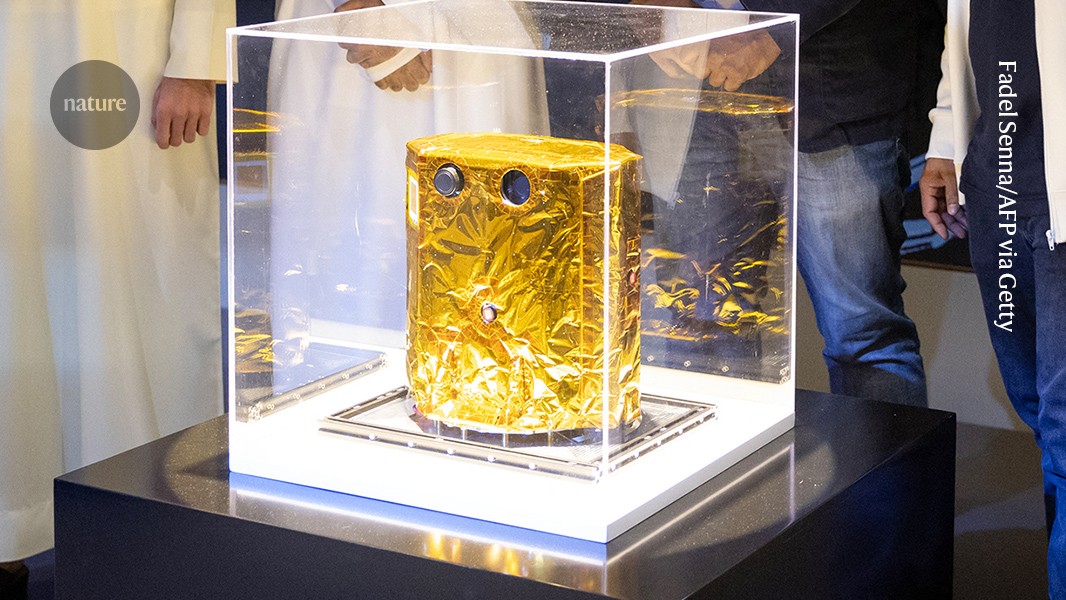
MBR Explorer, the UAE's asteroid-belt spacecraft, is set to launch in March 2028 and end its tour with a small probe touching the asteroid Justitia. Nature reported that the UAE built the 10 kg probe on its own, where every part of its Hope Mars orbiter was a collaboration.
The Scientist · Science desk
What happened
- The Technology Innovation Institute, a government-backed research agency in Abu Dhabi, designed and developed the probe and marked its completion at an event on 1 October.
- After launch the spacecraft flies past Venus in mid-2028 and Earth in spring 2029, then visits six main-belt asteroids, with a Mars flyby partway through, before reaching Justitia.
- Scientists and engineers on the programme say the UAE is on course to become the fourth space power to touch an asteroid, Nature reported.
- Defence minister Hamdan bin Mohammed Al Maktoum said on X that the UAE space sector is worth about $12 billion and aims to rank among the top 10 space economies by 2031.
Compiled by The ScientistSomething wrong?How this is made
Why it matters
- constraint Emirati independence currently stops at the probe, so any delay in the Colorado integration would keep the finished hardware on the ground however ready it is.
- contradiction Nature describes an impactor and Scientific American a lander, so what contact with Justitia can reveal about the rock's composition depends on which account is right.
- precedent Aaraj's prediction that the next mission will not need Colorado gives the UAE a public target, and its next spacecraft will show whether the programme met it.
The probe's next stop is the University of Colorado Boulder, where collaborators will fit it to the main MBR Explorer spacecraft before launch [1]. The UAE's space programme grew quickly by hiring international partners to help design and build its spacecraft while training Emirati researchers and engineers [14]. That approach produced Hope, which launched in 2020 and entered orbit around Mars in 2021 [15].
Najwa Aaraj, chief executive of the Technology Innovation Institute, expects to drop the Colorado stage next time. "I'm very confident that in the next mission, we don't need Colorado," she said. "Everything can be done end-to-end here." [13]
The two published accounts disagree about what happens at Justitia. Nature, which spells the name Justicia, describes a probe expected to career into the asteroid in 2035 [9]. Scientific American describes a lander. In its account the spacecraft arrives in 2034, orbits for seven months, then releases a probe that will attempt to touch down and analyse the rock's composition [5]. The timelines are consistent: a 2034 arrival plus seven months in orbit can put contact in 2035 [20]. A probe built to career into a rock and one built to set down on it are different machines, though either one touches the asteroid [9][5].
In Nature's account, the scientific case rests on colour. Justitia's red tint suggests it holds material more commonly found further out in the Solar System than its current orbit between Mars and Jupiter [6]. Elias Tsoutsanis, chief researcher at the institute's Propulsion and Space Research Center, said that if the asteroid formed in the outer reaches and migrated inward, it would be an ancient "traveller from the past" with clues to how the Solar System formed and where its water came from [7]. Scientific American states the origin more firmly, saying the asteroid is believed to have formed in the Kuiper Belt, beyond Neptune [8]. A composition measurement at Justitia itself is what would test Tsoutsanis's condition [5].
Before the spacecraft gets there, its cameras and spectrometers will analyse six other asteroids remotely [3]. It is designed to operate fully autonomously [16].
Ahmad Belhoul Al Falasi, chair of the UAE Space Agency, said enrollment in science, technology, engineering and mathematics has risen 30% since the country announced its Mars mission in 2014 [17]. He later told Nature that the number of UAE universities offering aerospace and space-related degrees roughly doubled between 2015 and 2025 [18]. The thing those figures don't tell you is whether the space programme caused either increase. As reported, they come without a baseline or a comparison group, so they show only that the rises followed the announcement.
What to watch
- Whether integration of the Emirati probe with the MBR Explorer at the University of Colorado Boulder keeps the March 2028 launch on schedule.
- A statement from the TII or the UAE Space Agency on whether the Justitia probe is designed to impact the asteroid or land on it.
- Whether the UAE's next deep-space mission is built end-to-end in the country, as Aaraj predicted.
Clarity's read
What the record supports and how the coverage leans. The claims behind it follow.
Reality
- Evidence60
- Adoption
- Insufficient
- Hype gap+20
- Incentives70
- Confidence62
Claim ledger
Ranked by verification strength, evidence, and original report placement.
- [1]
The probe was designed and built in the UAE and will be shipped to the University of Colorado Boulder, where collaborators will integrate it with the main MBR Explorer spacecraft before a launch scheduled for March 2028.
- [2]
The MBR Explorer is set to launch in March 2028 and will visit seven asteroids in the main asteroid belt between Mars and Jupiter.
ReportedSupportedSource: Scientific American2 sources— create a free account to open themView cited source - [3]
The Emirates Mission to the Asteroid belt will observe six asteroids using cameras and spectrometers that can analyse material composition remotely, and will observe Venus and Mars, before the MBR Explorer dispatches the 10 kilogram probe to Justicia.
- [4]
The spacecraft will fly by Venus in mid-2028 and Earth in spring 2029, then visit asteroids 10253 Westerwald, 623 Chimaera and 13294 Rockox, make a flyby of Mars, and visit 88055 Ghaf, 23871 Ousha and 59980 Moza before its final destination, 269 Justitia.
ReportedSupportedSource: Scientific American2 sources— create a free account to open themView cited source - [5]
The MBR Explorer is expected to reach 269 Justitia in 2034, orbit it for seven months, then release a lander that will attempt to touch down on the asteroid to analyse its composition.
ReportedSupportedSource: Scientific American2 sources— create a free account to open themView cited source - [6]
Justicia's unusual red colour suggests the asteroid contains materials more commonly found further out in the Solar System than its current orbit between Mars and Jupiter.
- [7]
If Justicia originated in the outer reaches and migrated inwards, it is an ancient "traveller from the past" that could give clues to how the Solar System formed and the origins of its water, said Elias Tsoutsanis, chief researcher for the Propulsion and Space Research Center at the TII.
ReportedSupportedSource: Elias Tsoutsanis, TII, via Nature2 sources— create a free account to open themView cited source - [8]
The asteroid is believed to have formed in the Kuiper Belt, beyond the orbit of Neptune, and could offer clues as to how water and other organic materials were distributed in the early solar system.
ReportedSupportedSource: Scientific American2 sources— create a free account to open themView cited source - [9]
On 1 October, scientists and engineers in the UAE space programme announced the completion of a probe that is expected to career into the asteroid Justicia in 2035.
- [10]
The Technology Innovation Institute (TII), a government-backed research agency in Abu Dhabi, designed and developed the probe; its completion was marked at an event in Abu Dhabi on 1 October.
- [11]
The UAE is on course to become the fourth space power to touch an asteroid, according to scientists and engineers involved in the country's space programme.
- [12]
Whereas every part of the Hope mission was a collaboration, the UAE built the probe component of the asteroid mission on its own.
ReportedSupportedSource: Nature, reporting remarks by TII chief executive Najwa AarajView cited source - [13]
"I'm very confident that in the next mission, we don't need Colorado," Najwa Aaraj, chief executive of the TII, said. "Everything can be done end-to-end here."
ReportedSupportedSource: Najwa Aaraj, TII chief executive, speaking at the 1 October event, via NatureView cited source - [14]
The UAE's ascent in space came through a programme of hiring international partners who helped design and build its spacecraft while also training Emirati researchers and engineers.
- [15]
In 2020 the UAE launched a probe that entered orbit around Mars in 2021.
- [16]
The MBR Explorer spacecraft is designed to be fully autonomous.
- [17]
Since the UAE announced its Mars mission plan in 2014, there has been a 30% rise in students enrolling in science, technology, engineering and mathematics, said Ahmad Belhoul Al Falasi, chair of the UAE Space Agency.
- [18]
Between 2015 and 2025, the number of UAE universities offering aerospace engineering and space-related degree programmes roughly doubled, Al Falasi told Nature.
- [19]
Hamdan bin Mohammed Al Maktoum, Defence Minister and Chairman of the UAE's Supreme Space Council, said on X that the country's space sector is valued at roughly $12 billion and that the UAE aims to become one of the world's top 10 space economies by 2031.
ReportedSupportedSource: Hamdan bin Mohammed Al Maktoum on X, via Scientific AmericanView cited source - [20]
A 2034 arrival at Justitia followed by seven months in orbit before the lander is released can place contact with the asteroid in 2035, consistent with Nature's expected 2035 impact date.
Sources
2 independent publishers whose own reporting we read for this story.
- nature.comUAE completes Arab world's first solo space probe <b>– </b>and sets course for an asteroid
1 article · October 7, 2026
- scientificamerican.comUnited Arab Emirates to launch spacecraft to probe seven asteroids in 2028
1 article · October 5, 2026
Topics and entities
Follow any of these and your For You feed starts watching them — no settings page required.