Science1 publisher3 min readPublished
Venus's slow spin drags simulated moons down into the planet
Stephen Kane let hypothetical moons evolve around a Venus that turns once every 243 Earth days, and in most runs they spiralled inward and hit the planet. He says Venus needed no catastrophe to end up moonless.
The Scientist · Science desk
What happened
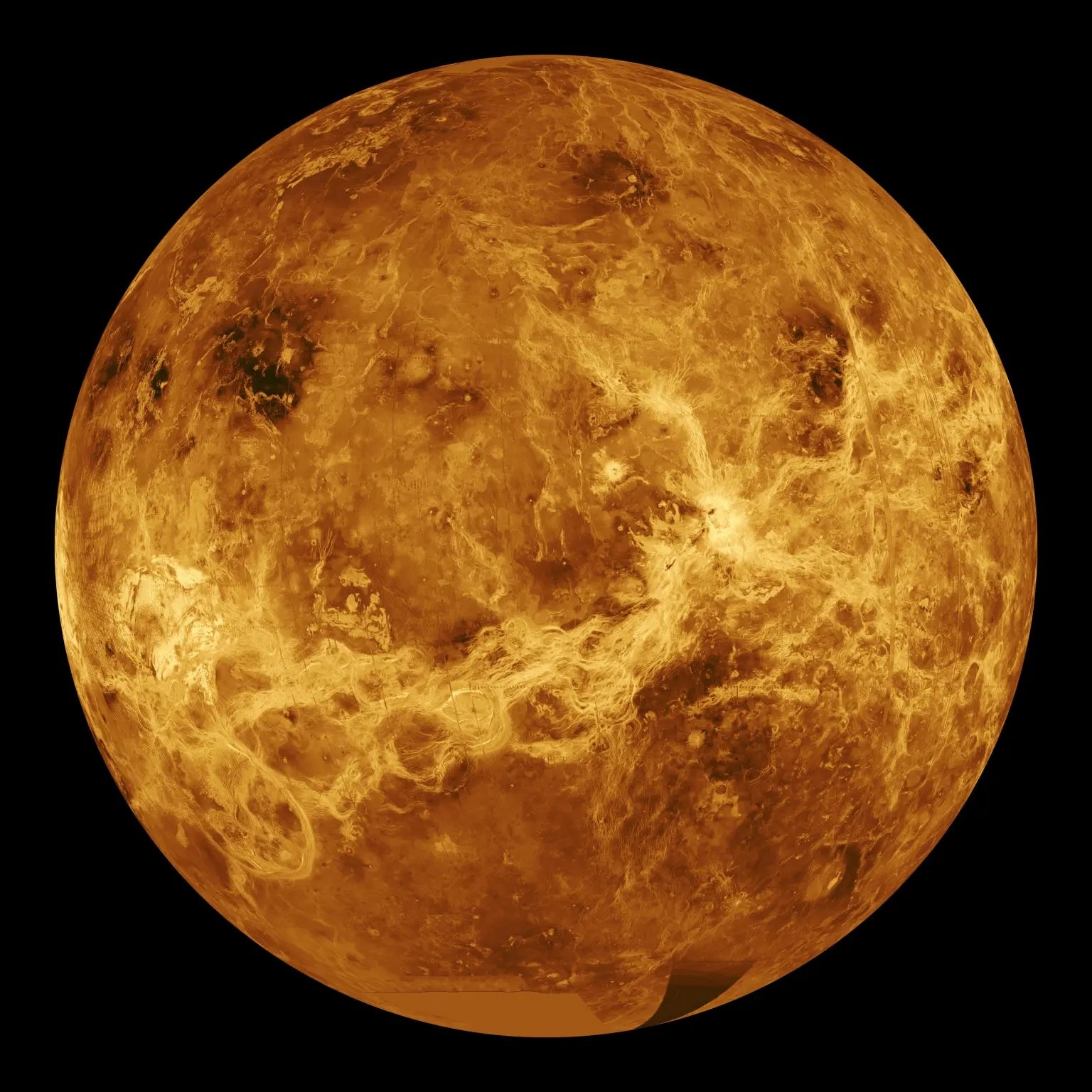
- A study in The Astrophysical Journal by UC Riverside astrophysicist Stephen Kane argues that Venus's very slow rotation could have dragged a former moon inward until it crashed into the planet.
- Kane ran his gravitational model on Earth and its Moon first, reproducing the system's known evolution, and only then applied the same code to Venus.
- In most of the Venus runs the moon eventually hit the planet, and the larger moons reached that end sooner.
- The two standing explanations had been that an impact destroyed a Venusian moon, or that no moon-forming collision ever happened at Venus at all.
- The simulations do not establish that Venus ever had a moon, and Kane says whether one formed remains unknown.
Compiled by The ScientistSomething wrong?How this is made
Why it matters
- constraint The resurfacing that covered most of Venus removes the surface as a place to test any account of a missing moon, including the two older ones, so the debate stays a modelling debate until someone measures the interior.
- contradiction Kane's runs speak to whether a moon could survive, while the impact and never-formed accounts speak to whether one existed, so the new work does not retire either and all three stay live.
- capability Because rotation rate is an input the model was first calibrated to reproduce for Earth, the same approach can be turned on other slowly rotating worlds to ask whether they could keep a satellite.
The physics turns on which way energy moves between a planet's spin and its satellite's orbit. Earth turns once in about 24 hours, and some of that rotational energy is passed to the Moon, which drifts outward. "We know that the moon is slowly moving away from the planet, at a rate of around four centimeters per year," Kane said [7]. That rate is measurable to high precision because Apollo 11 left mirrors on the lunar surface [8]. Venus turns once in about 243 Earth days [9], roughly 243 times Earth's rotation period [10]. Kane said the result for a Venusian moon follows from the planet itself: "It turns out the gravity of the planet itself combined with the rate at which it spins naturally caused the moon to collapse on top of it." [11]
He varied Venus's rotation rate as well as the satellite, so the sweep covered both the planet's spin and the moon's mass, running from half the mass of Earth's Moon to ten times it [4], a twenty-fold range [12].
The University of California, Riverside release describes the crash outcome as holding across most of those runs, but does not say how many runs there were or which combinations ended otherwise [13]. Kane described the uniformity as a surprise. "When I made this discovery, I was shocked," he said. "I thought surely the broad range of scenarios I was exploring would lead to a variety of results. But it all went pretty much in the same direction." [14][15]
The simulations stop short of showing that Venus ever had a moon [5]. The argument the simulations support is narrower, and Kane put it this way: "My study shows Venus didn't require a catastrophe to arrive at what we can see today." [16]
Direct evidence of an impact would be hard to find. About 80 percent of Venus's surface is similar in age, which scientists read as a large resurfacing event roughly a billion years ago that may have erased much of the older geological record [6]. On Earth, seismic studies have found unusual structures far below the surface that could contain remnants linked to the collision thought to have formed the Moon [17]. Comparable measurements of Venus might someday reveal whether the planet absorbed one of its own, according to the release [18].
The design is the part I would trust. Reproducing the Earth-Moon system before touching Venus is a genuine control [3], and without it an inward spiral in the Venus runs would be indistinguishable from a coding error. The control cannot test whether there was a moon there to begin with. Venus is close to Earth in size, mass and overall structure and has no moon [19]; whether it ever did is a question Kane leaves open [5].
What to watch
- Whether the published Astrophysical Journal paper gives a run count and lists the spin-rate and mass combinations in which the moon survived.
- Whether any proposed Venus mission carries instruments capable of resolving deep interior structure of the kind seismology found under Earth.
- Whether follow-up work tests spin histories in which Venus rotated much faster early on, since rotation rate was an input Kane varied.