Science1 publisherNot yet confirmed elsewhere3 min readPublished
Milky Way's fastest known star orbits close enough to Sgr A* to probe its spin
Astronomers reporting in Nature have found S301, the Milky Way's fastest known star, on a tight, eccentric orbit around the black hole Sgr A*. Its passes come close enough for the black hole's rotation to bend its path, so the team sees the star as a route to measuring that spin.
The Scientist · Science desk
What happened
- Even at its closest, the long-tracked star S2 stays too far from Sgr A* to reveal the black hole's spin without prohibitively long observation.
- The team spotted S301 in spring 2023 but initially could not tell whether it was a foreground or a background star.
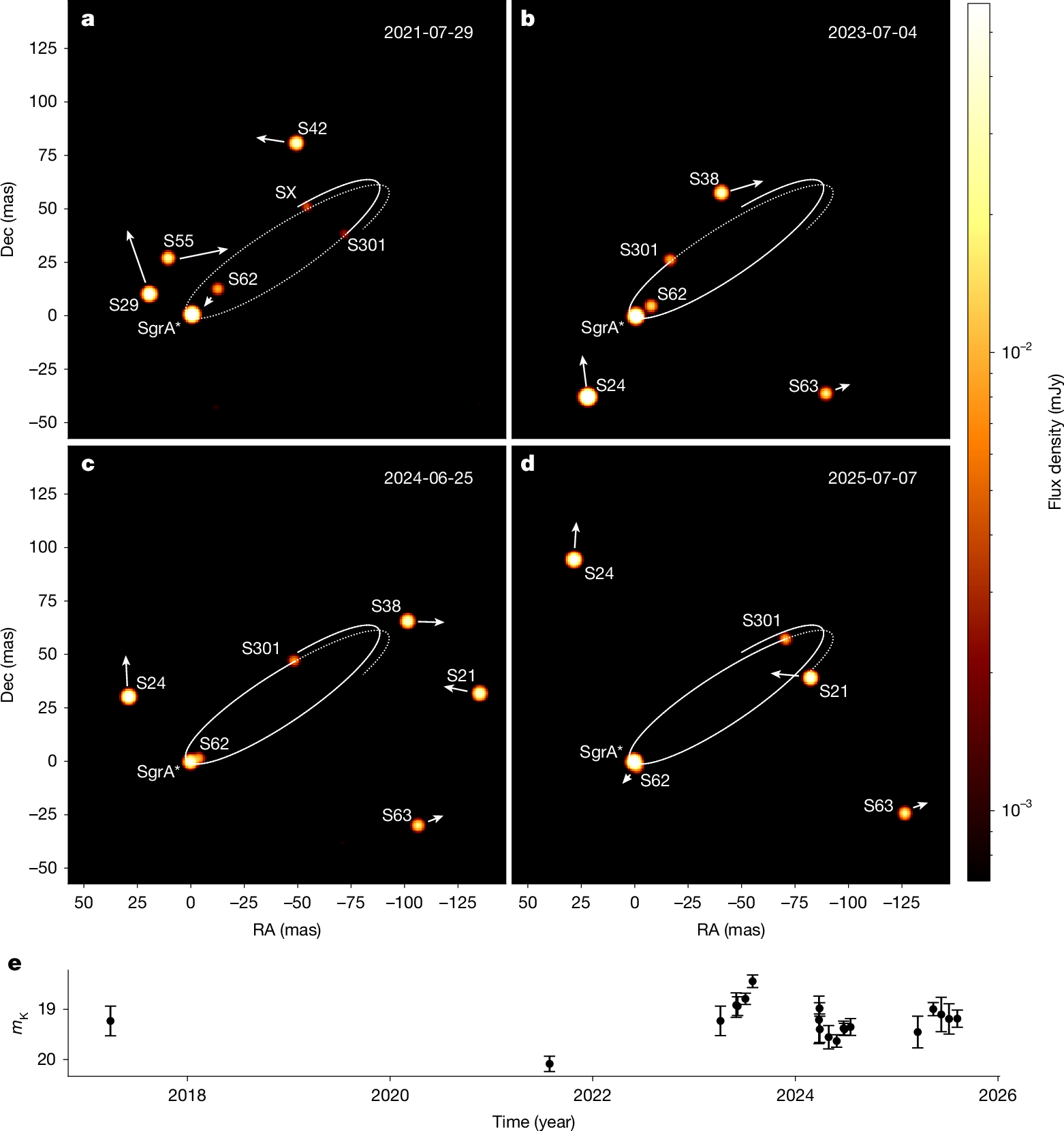
- Combining new and archival observations, the team assembled 19 distinct positions that trace a clear elliptical orbit around Sgr A*.
Compiled by The ScientistSomething wrong?How this is made
Why it matters
- constraint Frame dragging shows up only on very close passes, so any spin result has to wait for S301's future approaches and for continued tracking of a faint star.
- contradiction Physics World's headline says S301 "feels the rotation" of Sgr A*, while its text says observations "could shed new light" on spin; what the report supports is a candidate probe, and no detection is reported.
- capability A spin value would give Sgr A* a second of the three quantities Mang says fully describe a black hole, leaving electric charge as the one still open.
"Our group has determined the mass of the central black hole down to sub-percent precision," said Felix Mang, a PhD student at the Max Planck Institute for Extraterrestrial Physics and an author of the study, published in Nature [5]. That mass is more than four million times the Sun's [1]. "A black hole is characterized exclusively by its mass, spin, or angular momentum and electric charge; now that we've measured the mass really, really accurately, the next step is to measure the spin," he said [6].
Spin is the harder number. A rotating black hole drags space-time around with it, the Lense-Thirring effect, and that warps the orbits of nearby stars [4]. The effect is subtle and hard to measure unless a star gets very close [4]. Sgr A* has a few dozen stars on nearly Keplerian orbits, and the ones that come nearest reach deepest into its gravitational potential [8]. S2 is the best studied. The GRAVITY instrument on ESO's Very Large Telescope Interferometer followed its 16-year orbit and, during the 2018 close approach, measured a 12-arcminute orbital precession consistent with the Schwarzschild metric of general relativity [9].
The test that settled what S301 was came in 2024, when follow-up observations showed a pronounced acceleration in its proper motion [13]. "It was curving away from a linear trajectory, which gave us a hint that it may be bound to the black hole," Mang said [13]. Data from 2025 produced a robust initial orbit. Mang said it showed "indeed a very eccentric and tightly orbiting star, which was then later on confirmed" [14].
Then the team went back through the archive, looking for the star before its 2023 close approach so the orbit could be locked down [15]. Mang said finding the two pre-pericentre positions, from 2021 and 2017, was rather challenging and meant digging through the data [15]. The search turned up a strong trace in 2021 and a weaker one in 2017 [15]. With those, the dated observations run from 2017 to 2025, a span of eight years [19].
The star itself is ordinary. It is a main-sequence star under 1.5 solar masses, with a radius about 1.4 to 1.6 times the Sun's, too faint to be one of the galactic centre's giants [11]. Mang said it is "a bit heavier than the Sun, and it has a radius which is a bit bigger; but overall, it's not that special" [17]. What sets it apart is the extremely eccentric orbit and the very close approach to Sgr A* [11].
The thing this doesn't tell you is the size of the spin signal, or how many orbits it will take to see it. Physics World's account does not give S301's peak speed, its closest distance to Sgr A* or its orbital period.
Spin also has other routes: X-ray reflection spectra, thermal X-ray emission from the gas disks of stellar-mass black holes, and gravitational-wave signatures from merging binaries [7]. At Sgr A*, stellar orbits offer "another direct way," Physics World wrote [8]. I think S301 is a realistic route to the spin of Sgr A*, on two conditions. Its orbit has to keep being tracked, and the paper's distances have to bear out the "extremely close orbit" Physics World describes [2].
What to watch
- The Nature paper's figures for S301's closest approach and speed, which set how strong a frame-dragging signal the orbit can carry.
- A first spin estimate or upper limit for Sgr A* from S301's orbit, and how many passes the team says a detection needs.
- Further observations of S301 that test the elliptical orbit fitted from its 19 positions.