Science1 publisherNot yet confirmed elsewhere2 min readPublished
Eastern Sierra survey finds unhealthy pinyon stands where Paiute and Washoe members had flagged decline
UC Berkeley-led researchers found three Eastern Sierra areas with a high share of unhealthy pinyon-juniper trees, all where tribal members had seen decline. The match shows tribal reports pointed to the right stands, a guide for managers deciding where to monitor and thin.
The Scientist · Science desk
Drafted by a language model from the sources cited here and checked against its claim ledger before publication. How we use AISend a correction
What happened
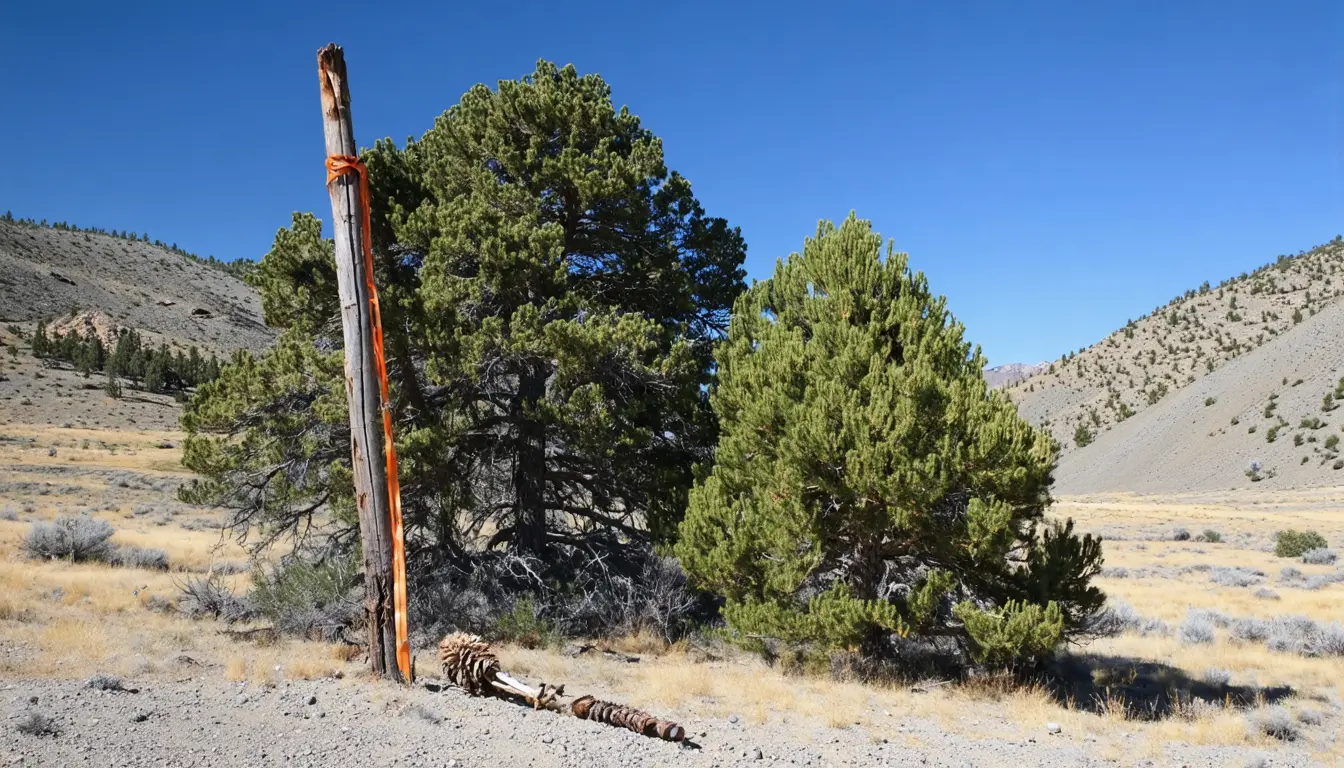
- A Big Pine Paiute member said a stand at Westgard Pass looked as if fire had passed through, with thin, browning needles, though there had been no fire.
- Miranda Redmond of UC Berkeley has led the PiCCA Network for three years, joining federal agencies, tribal nations, NGOs and Stanford researchers.
- The network's first study appeared in People and Nature, with more than 20 co-authors from 17 organizations and postdoctoral fellow Diana Macias as lead author.
- In some regions, land managers restoring sagebrush for bi-state sage-grouse have removed pinyon and juniper from woodlands of strong cultural importance to tribes.
Compiled by The ScientistSomething wrong?How this is made
Why it matters
- decision Managers planning to clear pinyon and juniper for sage-grouse habitat in the Eastern Sierra now have site-level evidence of which stands are already stressed.
- exposure Decline concentrated in particular stands falls hardest on tribal communities for whom pine nuts are a central food and, in many areas, a critical income stream.
- constraint A three-area result from one region cannot support a claim of die-off across the West; a regional estimate would need surveys well beyond the Eastern Sierra.
The tree data came from woodland monitoring led by Indigenous partners, paired with a household survey of Eastern Sierra residents [7]. The comparison therefore runs between two kinds of tribal knowledge: a decade of informal observation by Bishop Paiute, Big Pine Paiute and Washoe members [3], and a structured survey. That design tests whether the observations were accurate, and at the stands in question they were [1]. Whether tribal observers caught the decline earlier than agency monitoring would have is a separate question. The reported results do not address it.
Most trees in the survey appeared healthy [1]. The article does not give the number of areas surveyed, how they were chosen, or what proportion of unhealthy trees counted as high. Pinyon-juniper woodland covers more than 100 million acres across 10 Western states [2]. California holds more than 3 million of those acres [9], roughly 3 percent of the total on the article's lower-bound figures [18], and the Eastern Sierra is one part of California's share [9].
Redmond's argument for the woodlands starts with where they grow. "Pinyon and juniper trees tend to occur at lower elevations than other types of forests," she said. "They occupy some of the hottest and driest environments where trees can survive, so without these woodlands, our forested landscapes would be much smaller." [8] Water is scarce across that range, so the trees grow slowly [17]. Redmond also said that no other landscape in the United States retains as much mature and old-growth forest as these do [11].
Macias allows for some thinning. "In theory, some thinning may be warranted to promote woodland health," she said, "but in practice that removal may have unintended consequences." [13] In some cleared areas, cheatgrass and other invasive grasses can spread and change the fire cycle, and pinyon jays and other wildlife can lose habitat [14]. "When you pair that with the loss of seed sources, death of older pinyon trees and the declines in regeneration, you end up with woodlands that may not be able to replace themselves," she said [15].
The household survey produced a finding about people. It points to more than one route into stewardship: formal education and climate knowledge, and also a personal connection to the land [16].
What to watch
- Release of the survey's site count and selection method, so the unhealthy share can be read against the healthy majority.
- Whether Forest Service tree-mortality data for the Inyo National Forest line up with the three areas tribal partners flagged.
- Any change by land managers to sage-grouse-driven removal of pinyon and juniper in woodlands tribes consider culturally important.