Science2 publishersIndependently confirmed3 min readPublished
Cold ammonia collisions show dipole-dipole interactions switching off at low energy
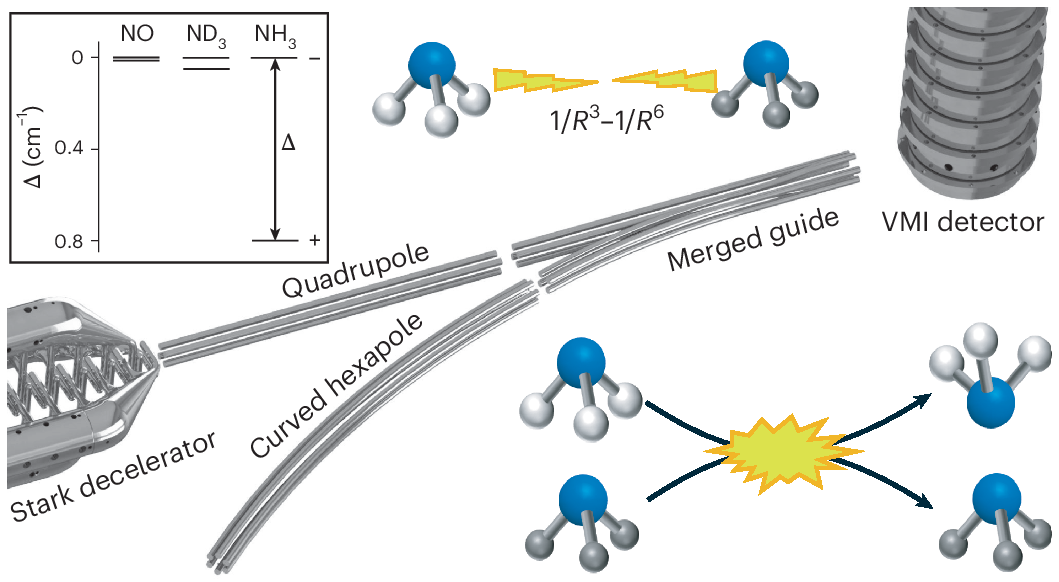
Physicists merging two ammonia beams measured state-to-state collisions down to 0.3 cm-1 and found dipole-dipole interactions switching off at low energy. The classical capture model the field uses predicts steady growth as energy falls, so the measured peak gives low-energy theory a concrete test.
The Scientist · Science desk
Drafted by a language model from the sources cited here and checked against its claim ledger before publication. How we use AISend a correction
What happened
- The cross-sections pass through a local maximum inside the measured window, so below a certain energy they get smaller as collision energy drops.
- Scattering calculations reproduced the maximum and explained how the observed behaviour scales with the molecules' parity splitting energies.
- Measuring correlated energy transfer in both collision partners gave what the authors call direct evidence that the dipole-dipole interaction is suppressed at low energies.
Compiled by The ScientistSomething wrong?How this is made
Why it matters
- contradiction Langevin scaling, the field's standard tool for cold polar molecules, predicts about 48-fold growth across this window, yet ammonia shows a peak inside it.
- capability Low-energy theory, where ab initio methods lack quantitative predictive power, now has state-to-state data with a matching calculation to calibrate against.
- constraint Statements about truly ultracold behaviour from these data remain extrapolations, since the floor is 0.3 cm-1 and the authors describe collisions heading towards that regime.
- precedent The authors' proposal to steer cold collisions with external fields becomes the obvious next experiment, and for now it is still only a proposal.
For two polar molecules, the classical expectation is simple. In the Langevin capture model, the cross-section depends only on the dipole moments and grows as the collision energy falls, scaling with energy to the power -2/3 [7]. The authors note that the model is used throughout the field to predict cross-sections for cold polar molecules [7]. This experiment's window spans a factor of about 330 in energy, from 100 down to 0.3 cm-1 [13]. Carried across that window, Langevin scaling predicts a cross-section roughly 48 times larger at the bottom than at the top [14].
The ammonia data show a local maximum instead [2]. Somewhere inside the window, slowing the collision further makes the cross-section smaller [2]. The 48-fold figure is only a rough yardstick, because Langevin describes capture and the experiment resolved specific state-to-state channels [14][1][7].
Reaching the low end took some engineering. The authors write that getting to sufficiently low energies by merging two beams of strongly polar molecules had seemed fundamentally impossible [6]. They used what they describe as an advanced beam-merging protocol [1].
A peak by itself could have more than one cause, so the paper adds two checks. Scattering calculations reproduced the maximum in good agreement and accounted for how the behaviour scales with the molecules' parity splitting energies [3]. Parity is a quantum property of the molecular wavefunction, even or odd, with no classical analogue [10]. A classical capture model has no term for it [7][10]. The second check is the one I find most persuasive. By measuring the correlated energy transfer in both collision partners, the team obtained what the authors call direct evidence that the dipole-dipole interaction is suppressed at low energies [4].
The thing this doesn't tell you is the size of the effect. The available text does not give the energy at which the maximum sits or how far the cross-section falls below it. The authors frame the result as a trajectory, writing that collisions between this class of polar molecules "evolve from high temperatures towards the ultracold regime in a counterintuitive way" [11]. The lowest energy measured is 0.3 cm-1 [1].
Control of chemistry is the further claim. The authors say the results offer distinctive opportunities to control cold molecular collisions with external fields [5], and they motivate the work with the prospect of ultracold chemistry [12]. What the paper measured is how energy moves between quantum states during a collision [1][4]. Steering those collisions with a field is a proposal for later experiments [5]. In my view the nearer use is as a benchmark. Ab initio methods generally lack quantitative predictive power at low energies [8], and precise collision data to test dipolar predictions are scarce at every energy [9]. A measured peak that a scattering calculation reproduces gives those methods something concrete to match [3].
What to watch
- An experiment that applies an external electric field and shows the low-energy ammonia cross-section changing, the control the authors propose.
- Measurements on other polar molecules with different parity splittings, testing whether the maximum moves as the scattering calculations predict.
- Merged-beam measurements pushed below 0.3 cm-1, closer to the ultracold regime the authors say these collisions are heading towards.