Science1 publisher3 min readPublished
Argon dating of Vesuvius sanidine lands within eight years of the eruption Pliny recorded
Berkeley and Padua researchers dated eight Vesuvius sanidine samples to 1,938 years, give or take 13, against the 1,946 years that Pliny's account implies. The same historical date helped make potassium-40's half-life, the constant under every argon-argon age, twice as precise.
The Scientist · Science desk
What happened
- The team's revised half-life for potassium-40 decaying to argon-40 is 12.044 billion years, give or take 0.088 billion.
- About a decade ago, study leader Paul Renne used the same method to place an impact, Indian eruptions and the dinosaur extinction within a few tens of thousands of years, about 66 million years ago.
- The researchers say the calibration could also help verify carbon-14 dates on organic material and uranium-lead dates on very old rocks.
Compiled by The ScientistSomething wrong?How this is made
Why it matters
- capability Teams reconstructing recent eruptions at volcanoes near Mexico City, Naples and Yogyakarta can now point to a measured accuracy for argon-argon ages at historical timescales.
- constraint The 0.7 percent figure cannot be carried to 66-million-year events, where it would equal about 460,000 years, so any sharper deep-time timeline has to come through the half-life revision.
- precedent Tuning a decay constant against a historically dated eruption opens the way for the cross-checks against carbon-14 and uranium-lead clocks that the team proposes next.
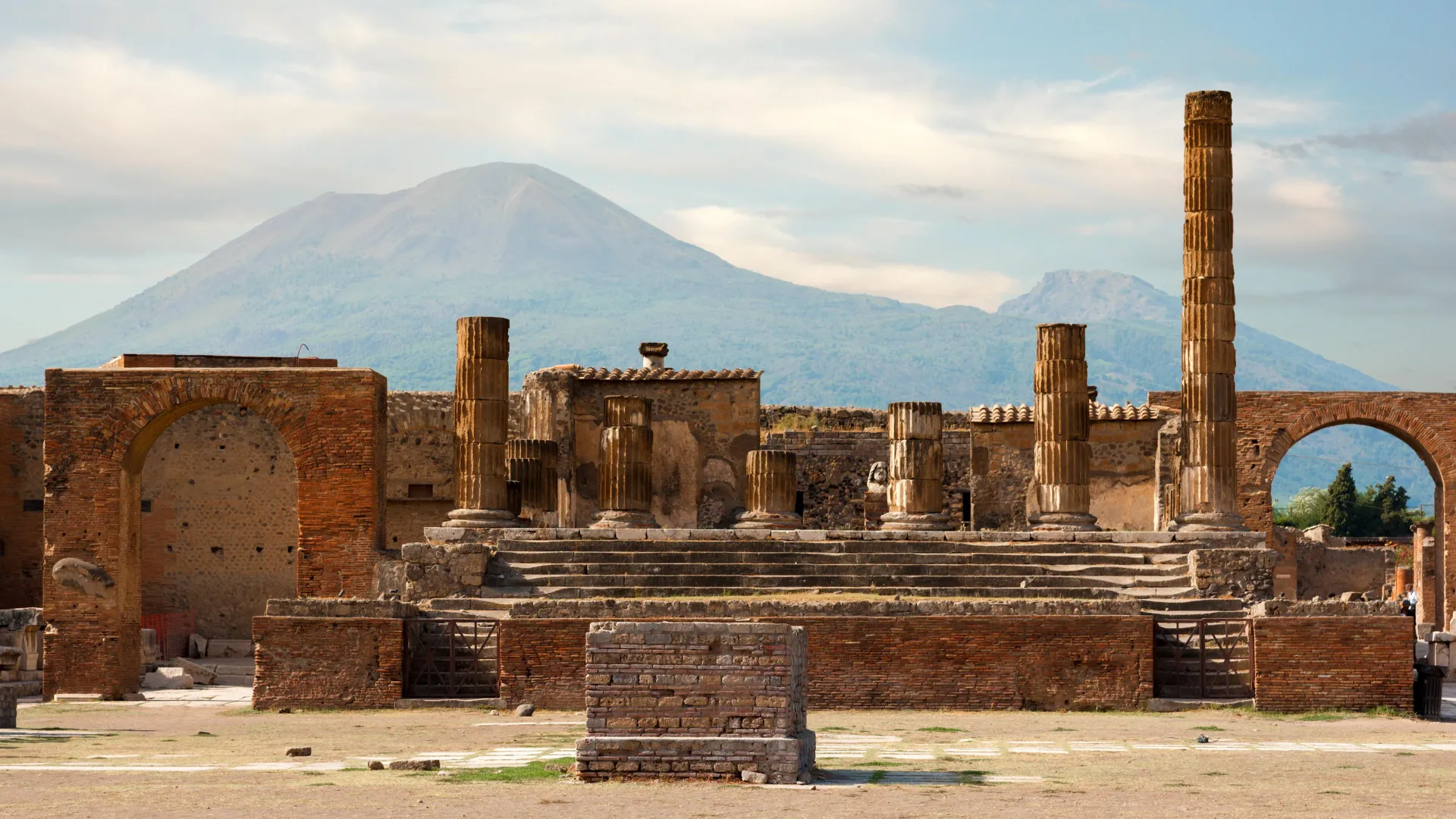
The control in this experiment is Pliny the Younger's writing. He saw the eruption that buried Pompeii and killed his uncle, Pliny the Elder, and recorded enough to date it [17]. Graduate student Caroline Hasler's review of the historical record confirms that date, Aug. 24, 79 CE, to within two months [6]. Two months is about a sixth of a year. Against the 13-year error bar on the argon measurement, that is roughly one-eightieth of the bar [4].
The lab did well. The team, from the Berkeley Geochronology Center, UC Berkeley and the University of Padua, reported the work in Science Advances [1]. They measured eight samples of sanidine, a potassium-containing volcanic mineral from Vesuvius, in 2025 and got an age of 1,938 years, give or take 13. The historical age is 1,946 [2][3][4]. That result is eight years young and falls inside its own stated uncertainty [1][2]. The release's figures of 0.7 percent precision and 0.4 percent accuracy follow directly from those numbers [5][3]. Accuracy here means distance from the right answer, and precision means how reproducible the measurement is [16]. The same group first tested the method on sanidine from 79 CE pumice in 1997 [15]. The accuracy check is still one volcano and one mineral [2].
The 0.7 percent figure comes from a very young sample. About a decade ago, Paul Renne, who led the study, used argon-argon dating on a meteor impact, major eruptions in India and the extinction of the non-avian dinosaurs [10]. All three fell within a span of a few tens of thousands of years, about 66 million years ago [10]. At 66 million years, 0.7 percent would be about 460,000 years, many times wider than that span [7].
The result that reaches deep time is the half-life. The decay of potassium-40 into argon-40 underlies argon-argon dating [8]. The historical constraint helped the team revise that half-life to 12.044 billion years, give or take 0.088 billion [8][7]. That uncertainty is about 0.73 percent. The release calls the new value twice as precise as the earlier one derived from nuclear physics [5][7]. I think the half-life revision will matter more than anything else the team reported. The release does not explain how a sample under 2,000 years old constrains a constant measured in billions of years.
Renne describes the payoff in terms of causation. "This lets us more precisely infer causality between events in the geologic record, for example a meteor impact structure and a mass extinction," he said [9]. His earlier dates supported the idea that the impact intensified the Indian volcanism, and that the combination contributed to the dinosaurs' extinction [10]. The release says the improved technique could sharpen the timelines of eruptions, impacts and extinctions [19]. The test itself covers one eruption, 1,946 years old [2][4]. The team also expects the calibration to help check carbon-14 dates on organic material and uranium-lead dates on rocks billions of years old [14].
The use closest to hand is at young volcanoes. The release names the risks posed by volcanoes near Mexico City, Naples and Yogyakarta [13]. "If you want to put together the eruptive history of a volcano in relatively recent time, precision and accuracy really count," said Renne, who directs the Berkeley Geochronology Center [11][18]. "The study shows that you can achieve that kind of highly useful precision and accuracy into the historical realm." [12]
What to watch
- The Science Advances paper's account of how a 79 CE sample constrains a half-life of about 12 billion years.
- Whether the revised potassium-40 half-life is applied to the 66-million-year impact, Indian eruption and extinction dates, and whether their spacing changes.
- Independent labs reproducing the Vesuvius sanidine result on their own samples.