Ultrasound makes a biodegradable spinal patch release six times more urokinase in lab tests
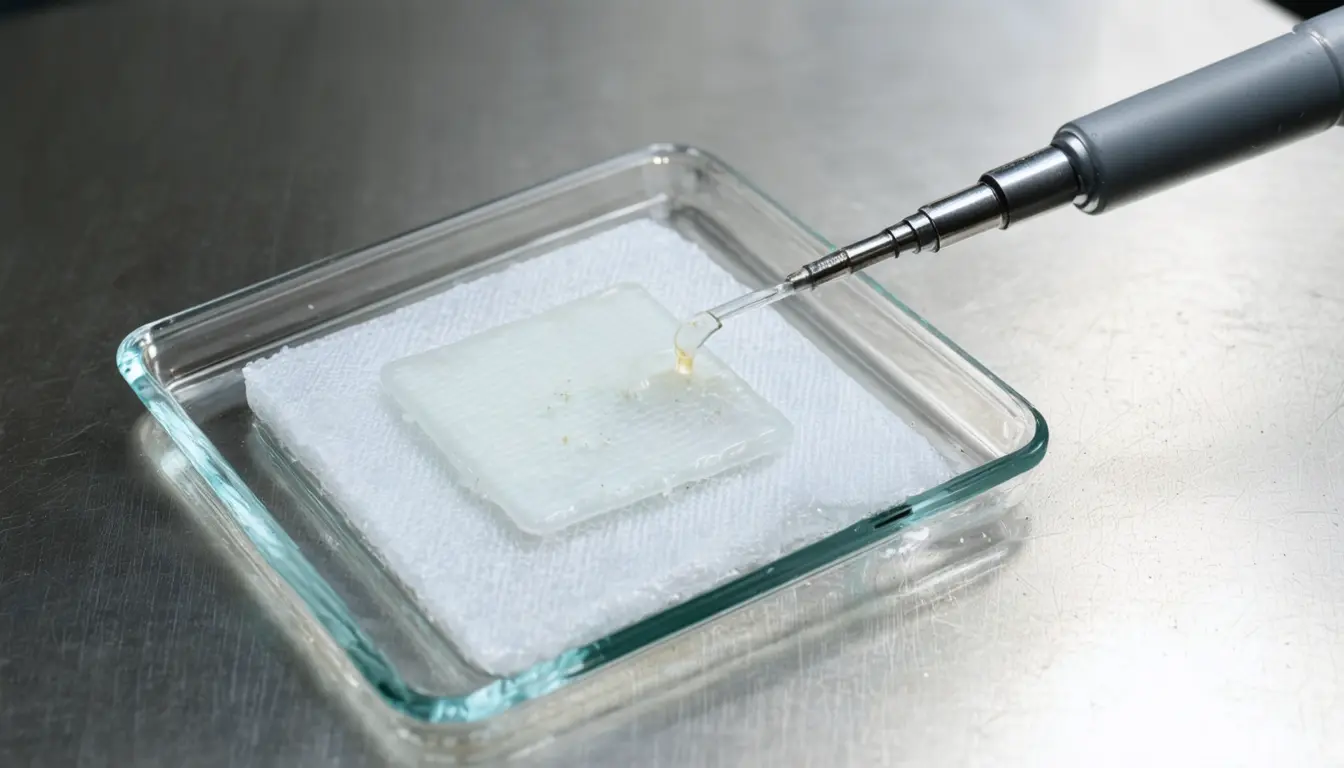
National Taiwan University researchers built a biodegradable patch that released about six times more urokinase under ultrasound than without it in laboratory tests. The same fibers sense pressure, and every reported result comes from the lab.
The Scientist · Science desk
Three lab figures: unstimulated release is about 17% of stimulated release; the system achieved approximately 70% clot degradation in lab blood clot experiments; the patch produced electrical signals of approximately 8 volts under an applied pressure of 80 pascals.
| Figure | Value | Note | Claim |
|---|---|---|---|
| Unstimulated release as share of stimulated, about | 17% | worked out from the reported ratio | 11 |
| Clot degradation, about | 70% | 6 | |
| Electrical signal, approximately | 8 volts | at 80 pascals of applied pressure | 3 |
What happened
- The fibers are made of a biodegradable polymer and glycine, an amino acid, and they generate electrical signals when pressed, so sensing needs no external power source.
- Urokinase, a clot-dissolving drug, sits in the inner structure of the fibers and is released when ultrasound is applied from outside the body.
- Professor Zong-Hong Lin led the international team, and the work is published in the journal Nano Energy.
Why it matters
- constraint The repeat-surgery benefit is a goal for later. The authors say further animal studies and clinical evaluations are necessary before any patient is involved.
- exposure A ratio of six leaves the unstimulated patch releasing about one-sixth as much, so a clot-dissolving drug sits near a fresh surgical wound at some dose that has not been reported.
- capability If the design holds up in the body, one biodegradable material would sense pressure without an external power source and also carry the drug, so a monitoring device and a treatment device would be one object.
The sixfold figure is a comparison inside one experiment: the same patch, with and without ultrasound [5]. The with/without comparison is the right control for the claim that ultrasound triggers release. If stimulated release is six times the unstimulated release, the idle patch still lets out roughly one-sixth as much, or about 17% [11]. Urokinase dissolves clots [4], and this patch is meant to sit beside a fresh surgical site. In our view, the absolute dose at rest is the first figure to want.
The clot result has a similar limit. The 70% degradation came from laboratory blood clot experiments [6]. A clot in a dish shows that released urokinase works on a clot. Whether enough drug reaches a clot through tissue, and how fast, cannot be tested there.
The sensing result is the same kind of measurement. The fibers produced approximately 8 volts at 80 pascals in the laboratory [3]. That makes the material a sensitive transducer. The lab test cannot show whether a clot's pressure can be told apart from the other loads on a living spine.
The clinical problem is real. Blood accumulating around the spinal cord can press on nerves and cause severe pain, muscle weakness or paralysis [9], and conventional treatment may require additional surgery [10]. Lin, co-corresponding author and chair of the Department of Biomedical Engineering at National Taiwan University, framed the aim in those terms. "This technology could eventually help improve patient safety and reduce the need for additional invasive procedures," Lin said [8].
What to watch
- Animal-study results that report the absolute urokinase dose released with and without ultrasound at the implant site.
- Whether the pressure signal in a living spine separates clot-related pressure from other loads on the spine.
- A 70% degradation figure reported alongside a control, such as urokinase alone, and a time frame.
Clarity's read
What the record supports and how the coverage leans. The claims behind it follow.
Reality
- Evidence40
- Adoption
- Insufficient
- Hype gap+15
- Incentives
- Insufficient
- Confidence60
Claim ledger
Ranked by verification strength, evidence, and original report placement.
- [1]
An international research team led by professor Zong-Hong Lin at National Taiwan University developed a biodegradable smart patch combining pressure monitoring with ultrasound-triggered drug delivery, published in the journal Nano Energy.
- [2]
The patch is made from extremely thin fibers of a biodegradable polymer and glycine, a naturally occurring amino acid; the fibers are piezoelectric, generating electrical signals under mechanical pressure, so the patch can detect pressure changes without an external power source for sensing.
- [3]
In laboratory experiments the patch produced electrical signals of approximately 8 volts under an applied pressure of 80 pascals.
- [4]
The researchers incorporated urokinase, a medication that helps dissolve blood clots, into the inner structure of the fibers; when ultrasound is applied from outside the body, the fibers release the medication in a controlled manner.
- [5]
Under ultrasound stimulation, the patch released approximately six times more urokinase than under unstimulated conditions.
- [6]
In laboratory blood clot experiments, the system achieved approximately 70% clot degradation.
- [7]
Further animal studies and clinical evaluations are necessary.
- [8]
"This technology could eventually help improve patient safety and reduce the need for additional invasive procedures," said co-corresponding author Lin, distinguished professor and chair of the Department of Biomedical Engineering at National Taiwan University.
- [9]
When blood accumulates around the spinal cord after surgery, it may increase pressure on surrounding nerves, potentially causing severe pain, muscle weakness or even paralysis.
- [10]
Conventional treatments for blood clots after spinal surgery may require additional surgery.
- [11]
If stimulated release is about six times unstimulated release, unstimulated release is roughly one-sixth of stimulated release, about 17%.
Get this ledger inside ChatGPT. Ask about any of our stories and the answer brings its figure, each claim’s verdict and the sources. Free, no account.
Sources
1 independent publisher whose own reporting we read for this story.
- phys.orgNew smart patch could help detect and treat blood clots after spinal surgery
1 article · October 15, 2026
Topics and entities
Follow any of these and your For You feed starts watching them — no settings page required.