Shanidar A's shoulder-blade hole fits a wooden spear, Cambridge researchers say
Cambridge archaeologists attribute a 15 mm hole in the Shanidar A Neanderthal's shoulder blade to a wooden spear about 75,000 years ago. Whether the thrust was a hunting accident or violence between people cannot be known, the authors write.
The Scientist · Science desk
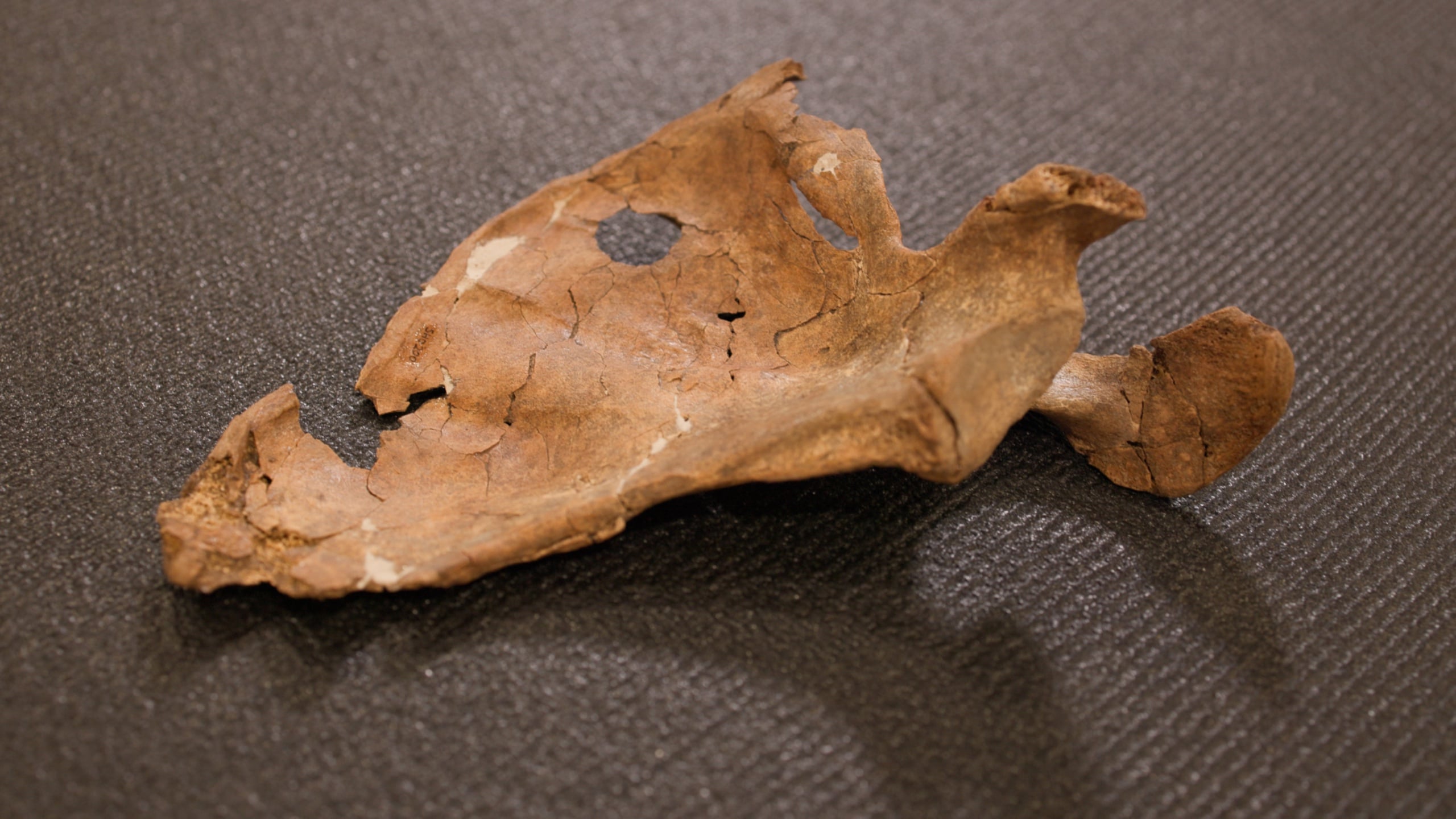
Key figures: Shanidar A, an adult Neanderthal, died roughly 75,000 years ago. The earliest known rounded wooden spear is over 400,000 years old; only its pointed end survived. The circular hole in Shanidar A's left scapula is 15 mm wide.
| Figure | Value | Note | Claim |
|---|---|---|---|
| Shanidar A died, roughly | 75,000 years ago | 6 | |
| Earliest known rounded wooden spear, over | 400,000 years old | only its pointed end survived | 10 |
| Width of scapula hole | 15 mm | 1 |
What happened
- The team excluded post-mortem damage such as animal gnawing and insect burrowing before treating the hole as a wound.
- Beveling around the hole is typical of an exit wound, and displaced bone shards suggest a downward path, Phys.org reported.
- Rebecca Wragg Sykes, who was not part of the study, suggested comparing the hole with one made by a wild goat horn.
Why it matters
- contradiction The paper's wording leaves hunting accident and violence between people open, while the lead author's statement calls the thrust an intended kill shot.
- constraint No spear survives and there is one individual, so the weapon identification rests on matching the hole to recreated spears, and the accounts report no horn comparison.
- capability If the spear reading holds, the scapula would be the first evidence of sharpened wooden spears in the prehistoric Middle East, taken from a wound because no weapon survives.
The team worked by elimination. It first excluded the usual ways a cave bone gets a hole after death, which are animal gnawing and insect burrowing [2]. It then compared the hole with experimental evidence of wounds from wooden spears and from stone-tipped weapons, and the shape matched wood [3]. A tip of flint or stone, the Cambridge archaeologists say, would leave a flat or angular hole [4]. Lead author Emma Pomeroy said: "Holes left by recreations of spears from this time are an excellent fit for the one we found in the Neanderthal scapula" [5].
Rebecca Wragg Sykes, an archaeologist who was not involved in the study, called a wooden spear plausible and then raised another pointed object. She said "it would be interesting to also compare whether a wild goat horn, the most intensely hunted species at Shanidar, might have been responsible" [13]. No trace of a spear survives in the cave, which is unremarkable given how easily wood decomposes [9].
Intent is a separate question, and the paper answers it more cautiously than the press statement does. The researchers wrote: "Whether the traumatic lesion on the scapula resulted from something like a hunting accident or from interpersonal violence cannot be known" [16]. Pomeroy, in the statement, said: "The position of the wound and the force required to push it right through the Neanderthal's body bear the hallmarks of an intended kill shot directed towards the heart" [15]. She also allowed the other reading: "Animals such as mammoths may have been hunted up close with thrusting spears, so it's easy to imagine lethal injuries" [17]. Co-author Graeme Barker said: "All we can ever know about the end of this Neanderthal's life is that it was violent, and came at the end of a wooden spear" [18]. Phys.org reported that archaeologists believe the most straightforward interpretation is interpersonal violence between Neanderthals [19].
The bone cannot identify who held the spear. The sample is one individual. The entry path adds a wrinkle: the researchers wrote that the spear entered the left side while the person faced forward [8], while Phys.org described bone fragments that suggest a downward trajectory from above [7]. The accounts leave open whether that geometry bears on intent.
The "earliest" label depends on the intent reading. The oldest known rounded wooden spear, a pointed end pulled from the shoreline at Clacton-on-Sea in 1911, is over 400,000 years old [10]. That is at least 325,000 years before Shanidar A died [14]. What Shanidar A may be, according to Phys.org, is the earliest known lethal interpersonal violence with a wooden spear in the hominin fossil record [11], and the wound could be the first evidence of sharpened wooden spears in the prehistoric Middle East [12]. We think the first label needs the intent reading and the second needs only the spear.
What to watch
- Whether the hole is compared with experimental punctures from a wild goat horn, as Wragg Sykes suggests.
- Further perimortem puncture wounds in other Neanderthal remains. Shanidar A is one case; more would make a pattern.
- Whether the reported downward trajectory is read as bearing on intent in later commentary on the paper.
Clarity's read
What the record supports and how the coverage leans. The claims behind it follow.
Reality
- Evidence72
- Adoption
- Insufficient
- Hype gap+20
- Incentives
- Insufficient
- Confidence70
Perspective Coverage
6 publishers- Builder
- Builder 55%
- Operator
- Operator 40%
- Investor
- Investor 5%
Claim ledger
Ranked by verification strength, evidence, and original report placement.
- [1]
The perforation in the left scapula of Shanidar A is a circular hole 15 mm wide.
- [2]
The researchers ruled out post-mortem damage to the bone, including animal gnawing and insect burrowing.
- [3]
The shape of the wound in the shoulder blade appears to match experimental evidence of injuries made by wooden spears rather than stone-tipped weapons, the researchers wrote.
- [4]
Cambridge archaeologists who led the excavation say the hole was made by a spear of sharpened wood, because a spear tip of flint or stone would leave a flat or angular hole.
- [5]
"Holes left by recreations of spears from this time are an excellent fit for the one we found in the Neanderthal scapula," said Emma Pomeroy, study lead author.
- [6]
Shanidar A was an adult Neanderthal estimated to be about 45 years old, who died roughly 75,000 years ago.
- [7]
Phys.org reported that beveling around the hole is typical of an exit wound, and that the position of tiny displaced bone shards suggests the spear entered from above at a downward trajectory.
- [8]
The researchers wrote that the spear would have entered the individual's body on the left-hand side while they were facing forward, penetrating all the way through the chest, including the lungs and potentially major blood vessels, likely leading to a rapid death.
- [9]
There is no surviving sign of the spear or weapon in Shanidar Cave, which is not unusual given how easily wood can decompose over long periods.
- [10]
The earliest known rounded wooden spear is over 400,000 years old; only the pointed end survived, pulled from the UK shoreline at Clacton-on-Sea in 1911.
- [11]
Phys.org reported that the wound may be the earliest known example of lethal interpersonal violence with a wooden spear in the hominin fossil record.
- [12]
Phys.org reported that the researchers say the wound could be the first evidence for use of sharpened wooden spears in the prehistoric Middle East.
- [13]
Rebecca Wragg Sykes, an archaeologist not involved in the study, said a wooden spear stab is plausible but "it would be interesting to also compare whether a wild goat horn, the most intensely hunted species at Shanidar, might have been responsible."
- [14]
The earliest known rounded wooden spear is at least 325,000 years older than the death of Shanidar A.
- [15]
"The position of the wound and the force required to push it right through the Neanderthal's body bear the hallmarks of an intended kill shot directed towards the heart," said study first author Emma Pomeroy in a statement.
- [16]
"Whether the traumatic lesion on the scapula resulted from something like a hunting accident or from interpersonal violence cannot be known," the researchers wrote in the study.
- [17]
Pomeroy said: "Animals such as mammoths may have been hunted up close with thrusting spears, so it's easy to imagine lethal injuries."
- [18]
"All we can ever know about the end of this Neanderthal's life is that it was violent, and came at the end of a wooden spear," said Graeme Barker, who leads the Shanidar Cave excavations.
- [19]
Phys.org reported that there is no way of knowing the context for the violence, or whether modern humans could have been involved, although archaeologists believe the most straightforward interpretation is interpersonal violence between Neanderthals.
Get this ledger inside ChatGPT. Ask about any of our stories and the answer brings its figure, each claim’s verdict and the sources. Free, no account.
Sources
9 independent publishers whose own reporting we read for this story.
- bbc.co.ukWas Neanderthal life violent? This wound suggests lethal fighting was more common
1 article · October 15, 2026
- channelnewsasia.comBones from Iraqi cave hint at violence and compassion in Neanderthals
1 article · October 15, 2026
- gizmodo.comA Spear Wound Likely Killed This Neanderthal, but It Tells a Very Human Story
1 article · October 15, 2026
- livescience.comMysterious hole in Neanderthal shoulder blade may have been a 'kill shot' from a wooden spear, according to archaeologists
1 article · October 15, 2026
- newscientist.comNeanderthal skeleton found with horrific injuries
1 article · October 15, 2026
- phys.orgFatal Neanderthal wound may be earliest evidence of a wooden spear attack on a human ancestor
1 article · October 15, 2026
- popsci.com75,000 years ago, this Neanderthal was stabbed with a spear
1 article · October 15, 2026
- sciencealert.comAncient Hole in Neanderthal Shoulder Blade May Be The Oldest Spear Attack Ever Discovered
1 article · October 15, 2026
- sciencenews.orgA telling hole in a Neandertal bone hints at a bitter end
1 article · October 15, 2026
Topics and entities
Follow any of these and your For You feed starts watching them — no settings page required.
Entities
- Shanidar CaveFollow
- Emma PomeroyFollow
- Graeme BarkerFollow
- University of CambridgeFollow
- Scientific ReportsFollow
- Rebecca Wragg SykesFollow