Osaka chemists insert a single carbon into biphenylene C-C bonds to build spirocycles
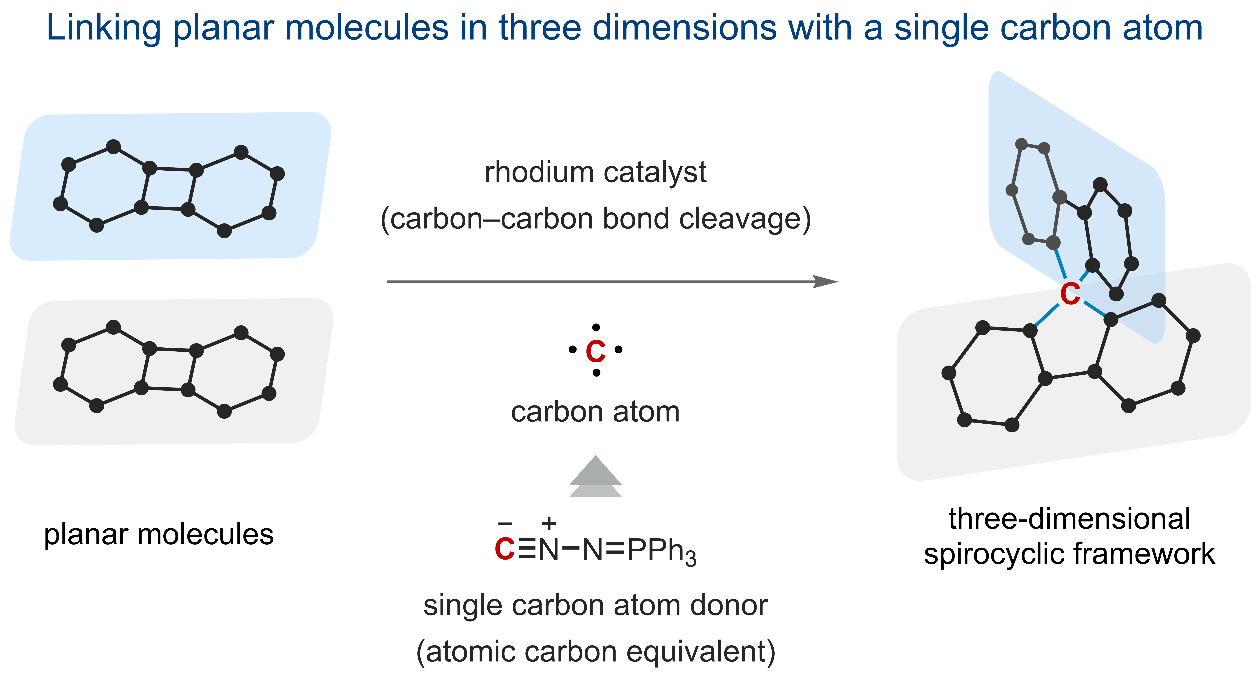
University of Osaka chemists report in Nature a rhodium-catalysed reaction that inserts one carbon atom into biphenylene single bonds to form spirocycles. Earlier carbon-transfer methods worked largely through double bonds, so single-bond insertion is the new part.
The Scientist · Science desk
Supported: rhodium catalysis turns biphenylenes into spirocycles; PINC forms four new C-C bonds at a spiro centre; labeled PINC carbon ended up at the molecule's heart; earlier methods largely used pi bonds, per Nature. Insufficient: phys.org's electronics and solar-cell outlook.
- Supported The paper reports a rhodium-catalysed spiro-carbon-atom insertion reaction that converts biphenylene substrates into spirocyclic structures through sequential C-C bond activation., claim 1
- Supported Using N-isocyanoiminophosphorane (PINC) as an atomic carbon equivalent, the reaction forms four new C-C bonds at a spiro centre., claim 2
- Supported The researchers labeled PINC with a traceable form of carbon, which ended up exclusively at the heart of the new molecule, confirming the origin of the central carbon., claim 13
- Supported According to the Nature abstract, previous carbon-atom-transfer approaches have largely relied on pi-bond reactivity, whereas controlled insertion of a carbon atom into C-C sigma bonds remains challenging., claim 4
- Insufficient evidence Phys.org writes that by turning simple flat starting materials into complex 3D architectures in a single step, the approach is expected to facilitate the design and synthesis of new functional molecules, with potential applications in electronic materials and solar cells., claim 17
| Claim | State | Claim number |
|---|---|---|
| The paper reports a rhodium-catalysed spiro-carbon-atom insertion reaction that converts biphenylene substrates into spirocyclic structures through sequential C-C bond activation. | Supported | 1 |
| Using N-isocyanoiminophosphorane (PINC) as an atomic carbon equivalent, the reaction forms four new C-C bonds at a spiro centre. | Supported | 2 |
| The researchers labeled PINC with a traceable form of carbon, which ended up exclusively at the heart of the new molecule, confirming the origin of the central carbon. | Supported | 13 |
| According to the Nature abstract, previous carbon-atom-transfer approaches have largely relied on pi-bond reactivity, whereas controlled insertion of a carbon atom into C-C sigma bonds remains challenging. | Supported | 4 |
| Phys.org writes that by turning simple flat starting materials into complex 3D architectures in a single step, the approach is expected to facilitate the design and synthesis of new functional molecules, with potential applications in electronic materials and solar cells. | Insufficient evidence | 17 |
What happened
- A rhodium catalyst cleaves single bonds in flat biphenylenes, and a stable reagent called PINC, a packaged carbon atom, delivers one carbon into the gap.
- The reaction forms four new carbon-carbon bonds around that one central carbon, which becomes the spiro centre.
- The team labeled PINC with a traceable form of carbon, and the label ended up exclusively at the heart of the new molecule.
- The reaction also ran on a gram scale in a standard benchtop setup.
Why it matters
- capability Cross-spirofusion joins two different biphenylenes at one carbon, so spiro cores with unlike halves can be made catalytically.
- constraint The reported starting materials are biphenylenes, with a double-bond pairing as an extension, so a target spirocycle has to be assembled from those pieces.
- contradiction Lead author Fujimoto says earlier substitutes could only use double bonds; the abstract's wording is weaker, so the narrower claim is the one to repeat.
A spiro centre is hard to build because the central carbon has to form four separate bonds [8]. Hayato Fujimoto, the lead author, said: "A lone carbon atom would be the ideal 'glue' for this job, because it can form four bonds at a single point." [16]
Mamoru Tobisu, the senior author, described what the Osaka reaction adds. "By controlling the temperature, we can join either two identical molecules or two different ones, giving us access to a diverse range of 3D structures that are otherwise difficult to make," he said [6].
The Nature abstract says controlled insertion of a carbon atom into carbon-carbon sigma bonds "remains challenging" [4]. Neither the abstract nor the phys.org summary says these spirocycles were out of reach before. The claim the evidence supports is narrower: a catalytic way to put one carbon into carbon-carbon single bonds [1].
The labelling test answers one question, where the central carbon comes from [13]. The abstract and the phys.org summary do not report yields or a count of substrates tried. The summary says only that the method tolerates a variety of chemical groups [7], and the full article sits behind a subscription or rental fee on Nature's site [15].
The application case is a forecast. Phys.org writes that the approach is expected to facilitate the design and synthesis of new functional molecules, with potential applications in electronic materials and solar cells [17]. Spiro frameworks already appear in optoelectronic and hole-transporting materials, in ligands and in natural products [9]. We'd treat the work as a synthesis result until someone builds a device from the products.
What to watch
- The full paper's yield table, especially how selectively two different biphenylenes give the cross product instead of the two symmetric ones.
- Device tests of spiro products made by this route, such as hole-transport layers or solar cells, against the spiro materials already in use.
- A second lab reproducing the gram-scale benchtop run with its own biphenylene substrates.
Clarity's read
What the record supports and how the coverage leans. The claims behind it follow.
Reality
- Evidence68
- Adoption
- Insufficient
- Hype gap+15
- Incentives
- Insufficient
- Confidence66
Claim ledger
Ranked by verification strength, evidence, and original report placement.
- [1]
The paper reports a rhodium-catalysed spiro-carbon-atom insertion reaction that converts biphenylene substrates into spirocyclic structures through sequential C-C bond activation.
- [2]
Using N-isocyanoiminophosphorane (PINC) as an atomic carbon equivalent, the reaction forms four new C-C bonds at a spiro centre.
- [3]
The transformation enables both homo- and cross-spirofusion of biphenylenes and can be extended to reactions combining sigma- and pi-bond activation.
- [4]
According to the Nature abstract, previous carbon-atom-transfer approaches have largely relied on pi-bond reactivity, whereas controlled insertion of a carbon atom into C-C sigma bonds remains challenging.
- [5]
Lead author Hayato Fujimoto said that free carbon atoms are extremely unstable and that previous substitutes could only join molecules through their double bonds.
- [6]
Senior author Mamoru Tobisu said: "By controlling the temperature, we can join either two identical molecules or two different ones, giving us access to a diverse range of 3D structures that are otherwise difficult to make."
- [7]
The team also showed that the method tolerates a variety of chemical groups.
- [8]
In spirocycles two rings share just one carbon atom and the two halves sit at right angles; building them is challenging because the central carbon atom must form four separate bonds.
- [9]
Spirocyclic frameworks are key structural motifs in optoelectronic and hole-transporting materials, ligand design for coordination complexes, and numerous natural products.
- [10]
The rhodium catalyst cleaves carbon-carbon single bonds in flat molecules called biphenylenes, and PINC, a stable reagent that acts as a 'packaged' carbon atom, delivers a single carbon atom into the gap.
- [11]
Researchers from the University of Osaka published the study in Nature.
- [12]
The method can pair a biphenylene with a carbon-carbon double bond, expanding the types of structures it can produce.
- [13]
The researchers labeled PINC with a traceable form of carbon, which ended up exclusively at the heart of the new molecule, confirming the origin of the central carbon.
- [14]
The reaction also worked on a gram scale using a standard benchtop setup.
- [15]
Nature's article page offers access through a Nature+ subscription, a journal subscription, or a rental or purchase fee.
- [16]
Fujimoto said: "A lone carbon atom would be the ideal 'glue' for this job, because it can form four bonds at a single point."
- [17]
Phys.org writes that by turning simple flat starting materials into complex 3D architectures in a single step, the approach is expected to facilitate the design and synthesis of new functional molecules, with potential applications in electronic materials and solar cells.
Get this ledger inside ChatGPT. Ask about any of our stories and the answer brings its figure, each claim’s verdict and the sources. Free, no account.
Sources
2 independent publishers whose own reporting we read for this story.
- nature.comCatalytic transfer of carbon atoms enables spirofusion of C–C σ-bonds
1 article · October 13, 2026
- phys.orgA single carbon atom stitches flat molecules into 3D structures
1 article · October 14, 2026
Topics and entities
Follow any of these and your For You feed starts watching them — no settings page required.