Genomes put North America's giant tiger beetles in a lineage older than the South America-Africa split
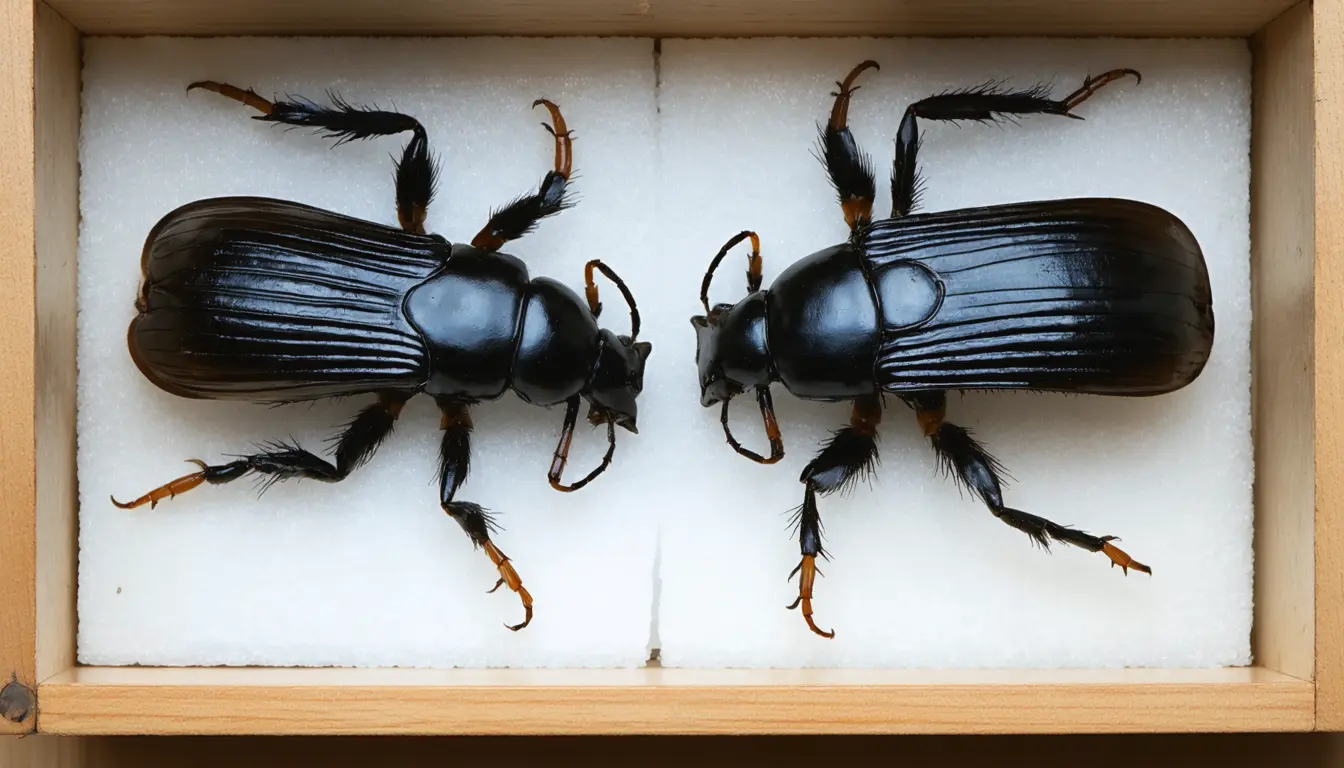
Grey Gustafson's team reports that the tiger beetle tribe Manticorini is older than the split of South America from Africa. If the dating holds, the large flightless beetles on both continents were carried apart when the continents separated.
The Scientist · Science desk
What happened
- An earlier hypothesis put two western US genera, Amblycheila and Omus, in Manticorini alongside large flightless beetles of the Southern Hemisphere.
- Most Manticorini species live in sub-Saharan Africa and the only other close relative is in South America, which made a North American presence look like a puzzle.
- Gustafson spent three years generating data, comparing DNA sequences from across entire genomes with help from colleagues.
- The team built a family tree of most recent common ancestors and used it to trace when the lineages diverged from one another.
Why it matters
- precedent The write-up sets the beetles beside South America's rheas and Africa's ostriches and calls only the beetles well supported. In our view, other flightless pairs across the Atlantic will now be held to a branching order and a divergence date.
- constraint A split between South America and Africa accounts for a pairing across the Atlantic. In our view it does not by itself put beetles in the western US, so that step needs its own explanation.
- exposure The conclusion depends on the age of the lineage. The write-up does not include divergence dates, species counts, branch support or any genus leaving Manticorini.
The inference needs a branching order and a clock. The order comes from the family tree: North America's giant tiger beetles sit closest to the South American tiger beetle, and that pair sits closest to the tiger beetles of southern Africa [10]. The clock comes from the divergence timing. Gustafson said, "The exciting thing we found was that the group is actually older than when the continents were separated, so they didn't actually get across the oceans." [9]
Sampling was deliberately mixed. "We assembled genomic sequences from freshly collected material in the western U.S., ethanol-preserved frozen material from colleagues and specimens held in natural history collections in the U.S. and Europe," Gustafson said [7]. Scientists have studied the biology, classification, life history and conservation of tiger beetles in substantial depth, but they have done comparatively little on the evolutionary history of these insects [12].
The write-up still speaks of the North American beetles as manticorine [14] and says the Manticorini tribe evolved while South America and Africa were part of Gondwana [15]. The tree does away with the assumed route across the ocean. Gustafson put the starting question this way: "We wanted to know how a large-bodied, flightless beetle could get across the ocean to South America and then, better yet, how our North American beetles fit into this tribe." [13]
His answer: "The answer to our question of how these giant beetles got across the ocean was that they actually didn't." [11] He added: "As the continents separated, they took their giant tiger beetles with them." [11]
Vicariance is the name for that pattern. A barrier forms and splits populations of a species between the land on either side [16]. Gustafson said many biologists had hypothesized that lineages with a lot of closely related modern diversity in Africa and South America likely originated while the continents were still joined [17].
Everything here comes from phys.org's write-up of a paper in Proceedings of the Royal Society B [2], and the quotations are Gustafson's own summary of it.
What to watch
- The paper's divergence-date estimates and branch support for the African, South American and North American nodes.
- Where Omus falls in the tree, since the write-up reports the close South American and African relationships for the giant tiger beetles.
- Whether other large flightless groups with kin on both sides of the Atlantic get the same genome-wide, dated treatment.
Clarity's read
What the record supports and how the coverage leans. The claims behind it follow.
Reality
- Evidence58
- Adoption
- Insufficient
- Hype gap+15
- Incentives
- Insufficient
- Confidence50
Claim ledger
Ranked by verification strength, evidence, and original report placement.
- [1]
Grey Gustafson, an associate professor in the Department of Biological Sciences, found through DNA sequencing that the ancestors of some of today's tiger beetles existed in South America and Africa before the two continents separated.
- [2]
Gustafson and colleagues published their findings in Proceedings of the Royal Society B.
- [3]
Gustafson's research began with two groups of tiger beetles found in the western U.S.: the genus Amblycheila, called the giant tiger beetles, and the genus Omus, the night-stalking tiger beetles.
- [4]
The previous hypothesis was that both Amblycheila and Omus belong to the tribe Manticorini, which also contains large-bodied, flightless tiger beetles found in the Southern Hemisphere.
- [5]
Most species of the tribe Manticorini live in sub-Saharan Africa, with the only other close relative found in South America, which would raise the question of how and why tiger beetles ended up in North America.
- [6]
Gustafson spent three years generating data, and with help from colleagues collected and compared DNA sequences from across the beetles' entire genomes.
- [7]
Gustafson said: "We assembled genomic sequences from freshly collected material in the western U.S., ethanol-preserved frozen material from colleagues and specimens held in natural history collections in the U.S. and Europe."
- [8]
The research team used the data to produce a family tree to understand the most recent common ancestors, and with this information traced when the lineages diverged from one another.
- [9]
Gustafson said: "The exciting thing we found was that the group is actually older than when the continents were separated, so they didn't actually get across the oceans." He added that they originated before an ocean separated South America from Africa on the supercontinent Gondwana.
- [10]
Gustafson and colleagues found that the giant tiger beetles of North America are most closely related to the South American tiger beetle, and that together these beetles are most closely related to those found in southern Africa.
- [11]
Gustafson said: "The answer to our question of how these giant beetles got across the ocean was that they actually didn't," and "As the continents separated, they took their giant tiger beetles with them."
- [12]
Scientists have done substantial research on the biology, classification, life history and conservation of tiger beetles, but comparatively little to understand the evolutionary history of these insects.
- [13]
Gustafson said: "We wanted to know how a large-bodied, flightless beetle could get across the ocean to South America and then, better yet, how our North American beetles fit into this tribe."
- [14]
Gustafson's three years of data generation was aimed at revealing more about the evolutionary history of North American manticorine tiger beetles.
- [15]
The family tree produced by DNA sequencing revealed that the Manticorini tribe evolved at a time when South America and Africa were part of the landmass Gondwana, which later separated into distinct continents.
- [16]
Vicariance is the phenomenon that occurs when a barrier forms, splitting different populations of the same species between the land on either side.
- [17]
Gustafson said many biologists hypothesized that lineages with lots of closely related modern diversity in Africa and South America likely originated when the continents were still part of Gondwana.
- [18]
The write-up says that, like the rheas of South America and the ostriches of Africa, these tiger beetles are large, flightless and separated by an ocean, but that unlike those birds the ancient manticorine tiger beetles now serve as a well-supported example of Gondwanan vicariance.
Get this ledger inside ChatGPT. Ask about any of our stories and the answer brings its figure, each claim’s verdict and the sources. Free, no account.
Sources
1 independent publisher whose own reporting we read for this story.
- phys.orgSolving the mystery behind a flightless beetle's transatlantic journey
1 article · October 15, 2026
Topics and entities
Follow any of these and your For You feed starts watching them — no settings page required.
Topics
- PhylogenomicsFollow
- EntomologyFollow
- BiogeographyFollow