Drowned peat platforms off Mozambique shelter reef-like marine life with no living coral
Researchers report that three drowned peat reefs off Mozambique, with peat up to 5,000 years old, host marine life comparable to a nearby coral reef. The paper says the peat's present-day carbon role is unresolved, and three sites in one archipelago cannot show how many such reefs exist.
The Scientist · Science desk
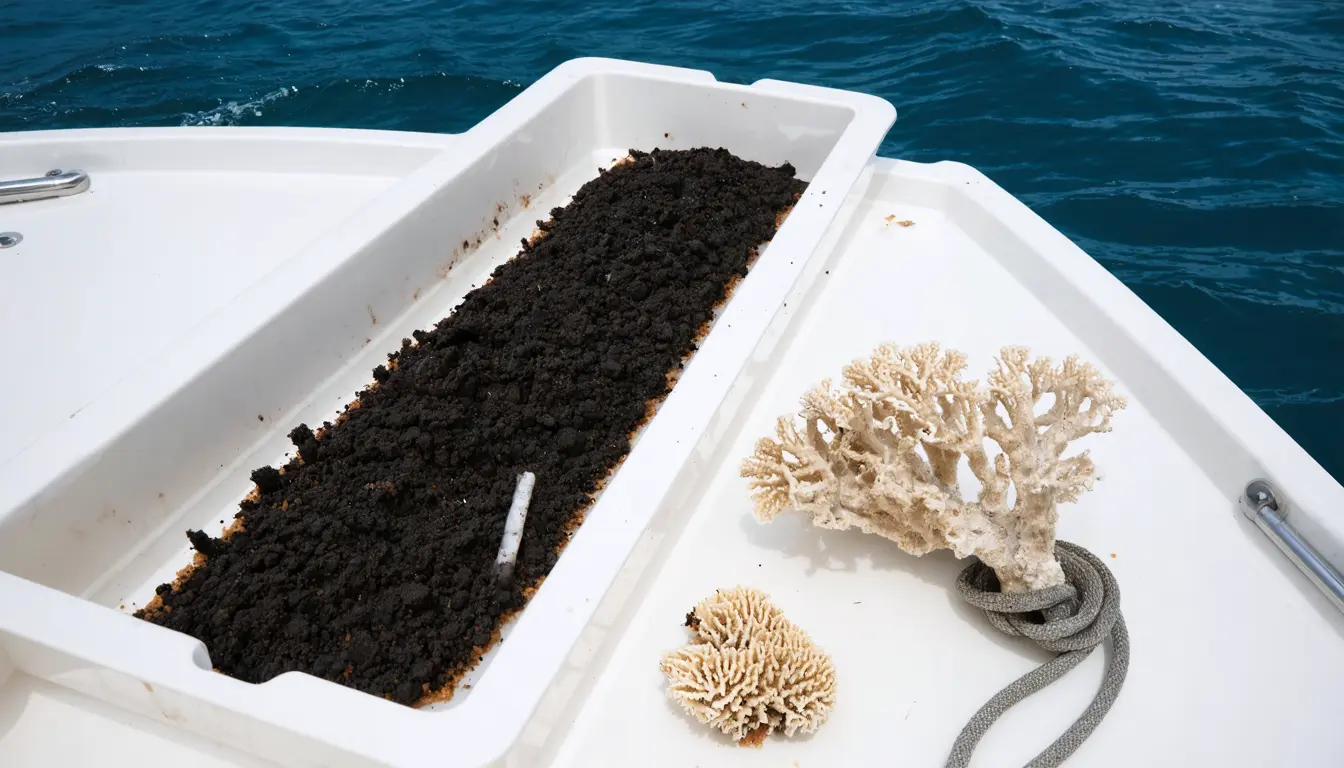
Some peat samples contain up to 40% organic carbon by dry weight. On land, peat swamps can hold 1,000 to 2,000 tons of carbon per hectare below ground, but no one yet knows how much the peat reefs hold. Radiocarbon dating shows the peat formed between roughly 300 and 5,000 years ago.
| Figure | Value | Note | Claim |
|---|---|---|---|
| Organic carbon in some peat samples, up to, by dry weight | 40% | 9 | |
| Carbon below ground in land peat swamps, at least | 1,000 tons/hectare | up to 2,000; reef peat amount unknown | 11 |
| Peat formed up to roughly this long ago, by radiocarbon | 5,000 years ago | youngest roughly 300 years ago | 7 |
What happened
- Rising seas flooded coastal swamps and forests, and waves later stripped the sand above them, leaving firm peat platforms that marine life then colonized.
- The peat reefs host no living coral, yet seagrass and seaweeds grow on the peat and its crevices shelter spiny lobsters, oysters, barnacles and juvenile snappers and grunts.
- The work draws on the BCSS Ocean Observatory, set up in 2017, which has logged more than 22 million measurements at 14 long-term monitoring stations.
Why it matters
- constraint Whether the peat is storing or releasing carbon today depends on burial or erosion rates and greenhouse gas fluxes, so no sign can be put on the reefs' climate role yet.
- decision Protection arguments for the reefs rest on biodiversity alone for now, because their status as a blue-carbon habitat like mangroves or seagrass is still to be explored.
- exposure Sea levels are still rising. The source asks what becomes of the stored carbon if these reefs are lost, eroded or disturbed, and that outcome has yet to be measured.
The design has a comparator built in. Alongside three peat reefs, the team surveyed a nearby true coral reef [3]. They compared seabed cover, invertebrates, small fish and larger animals such as sharks, rays and turtles [3]. That makes four sites [15], all in one archipelago [1].
The published summary does not list species counts or abundances, so the authors' description of the peat reefs' biodiversity as "comparable" to neighboring coral reefs [5] cannot be turned into a ratio.
The 5,000-year figure is the oldest end of a range. Radiocarbon dating puts the peat's formation between roughly 300 and 5,000 years ago [7], a spread of about 4,700 years [16]. Chemical analysis shows it came mostly from coastal land plants and trees [8].
The carbon evidence is weaker. Some samples hold up to 40% organic carbon by dry weight [9], and "up to" makes that a ceiling. A percentage describes the material. A stock per hectare also needs peat thickness and bulk density, both on the list of measurements the paper says are still required [12]. On land, peat swamps can hold 1,000 to 2,000 tons of carbon per hectare below ground, but the source says no one yet knows how much the reefs hold [11].
The survey does not show how many peat reefs exist elsewhere. The discovery raises that question [17], and the study is believed to be the first ecological look at peat reefs anywhere in the tropics [2].
In our view the biodiversity result is the firm finding. The carbon role is a hypothesis with a measurement plan attached. The authors want to know whether the peat works mainly as a long-term legacy store [10] and whether living communities add new carbon burial [14].
What to watch
- Peat thickness, bulk density, burial or erosion rates and greenhouse gas flux measurements from Bazaruto, which would give the first stock figure and show whether the peat is storing or releasing carbon.
- Results on whether living communities on the peat add new carbon burial or the platforms act only as a legacy store.
- Surveys of other coastlines with drowned swamps that use a nearby coral reef as a comparison, as this one did.
Clarity's read
What the record supports and how the coverage leans. The claims behind it follow.
Reality
- Evidence55
- Adoption
- Insufficient
- Hype gap+20
- Incentives
- Insufficient
- Confidence50
Claim ledger
Ranked by verification strength, evidence, and original report placement.
- [1]
Researchers from the BCSS Ocean Observatory, working with U.K., U.S. and Canadian universities and institutions, documented submerged peat reefs in the shallow waters of the Bazaruto Archipelago in the western Indian Ocean, in a paper in Scientific Reports.
- [2]
The study is believed to be the first ecological study of peat reefs anywhere in the tropics and the first globally from a biodiversity angle.
- [3]
The team surveyed three peat reefs and a nearby true coral reef, comparing seabed cover, invertebrates, small fish and larger animals such as sharks, rays and turtles.
- [4]
The peat reefs host no living coral; seagrass and seaweeds grow directly on the peat, and crevices and ledges shelter spiny lobsters, oysters, barnacles and juvenile fish, including young snappers and grunts usually linked to coral reefs.
- [5]
The peat substrate was colonized by marine life whose biodiversity is comparable to neighboring coral reefs.
- [6]
As sea levels rose over the past few thousand years, and continue to rise, the sea flooded coastal swamps and forests; waves later stripped away the sand above them, leaving firm peat platforms exposed on the seabed, which marine life then colonized.
- [7]
Radiocarbon dating (14C) shows the peat formed between roughly 300 and 5,000 years ago.
- [8]
Chemical analysis confirms the peat mostly came from coastal land plants and trees.
- [9]
Some peat samples contain up to 40% organic carbon by dry weight.
- [10]
More work is needed to determine whether the peat reef systems can function as a long-term legacy carbon store and what their role is in blue-carbon storage; whether they can be classified as blue-carbon habitats like mangroves or seagrass remains to be explored.
- [11]
On land, peat swamps can hold 1,000-2,000 tons of carbon per hectare below ground, but no one yet knows how much the peat reefs hold or whether they are storing or releasing carbon today.
- [12]
The paper says the peat reefs' present-day role in carbon cycling remains unresolved and requires dedicated measurements of peat thickness, bulk density, areal carbon stocks, burial or erosion rates and greenhouse gas fluxes.
- [13]
BCSS, established in Mozambique's Bazaruto Archipelago in 2017, is Africa's first permanent Ocean Observatory and has generated more than 22 million measurements across 14 long-term monitoring stations in an approximately 6,850 square kilometer monitoring area.
- [14]
The authors call for research to establish whether the peat reefs primarily function as long-term legacy carbon stores and whether living communities contribute to new carbon burial.
- [15]
The survey covered four sites: three peat reefs and one coral reef.
- [16]
The peat's dated formation window spans about 4,700 years.
- [17]
The discovery raises the question of how many more peat reefs exist around the world's coastlines and how to evaluate them as a carbon store and develop policies to protect them and their biodiversity.
- [18]
The source asks what is stored in the peat reefs, how stable it is, and what happens if these newly recognized ecosystems are lost, eroded or disturbed.
Get this ledger inside ChatGPT. Ask about any of our stories and the answer brings its figure, each claim’s verdict and the sources. Free, no account.
Sources
1 independent publisher whose own reporting we read for this story.
- phys.orgDrowned 5,000-year-old forests reborn as thriving peat reefs and biodiversity hotspots off Mozambique
1 article · October 15, 2026
Topics and entities
Follow any of these and your For You feed starts watching them — no settings page required.
Topics
- Marine biodiversityFollow
- Coral reef ecologyFollow
- Blue Carbon EcosystemsFollow