Ulsan firms say Korean offshore wind sea fees differ dozens of times depending on nearby islands
Korea's chamber of commerce sent the reform task force 75 company proposals on the 15th, with offshore wind occupancy fees the most prominent. Ulsan firms say fees tied to nearby land prices differ by more than several dozen times.
The Investor · Invest desk
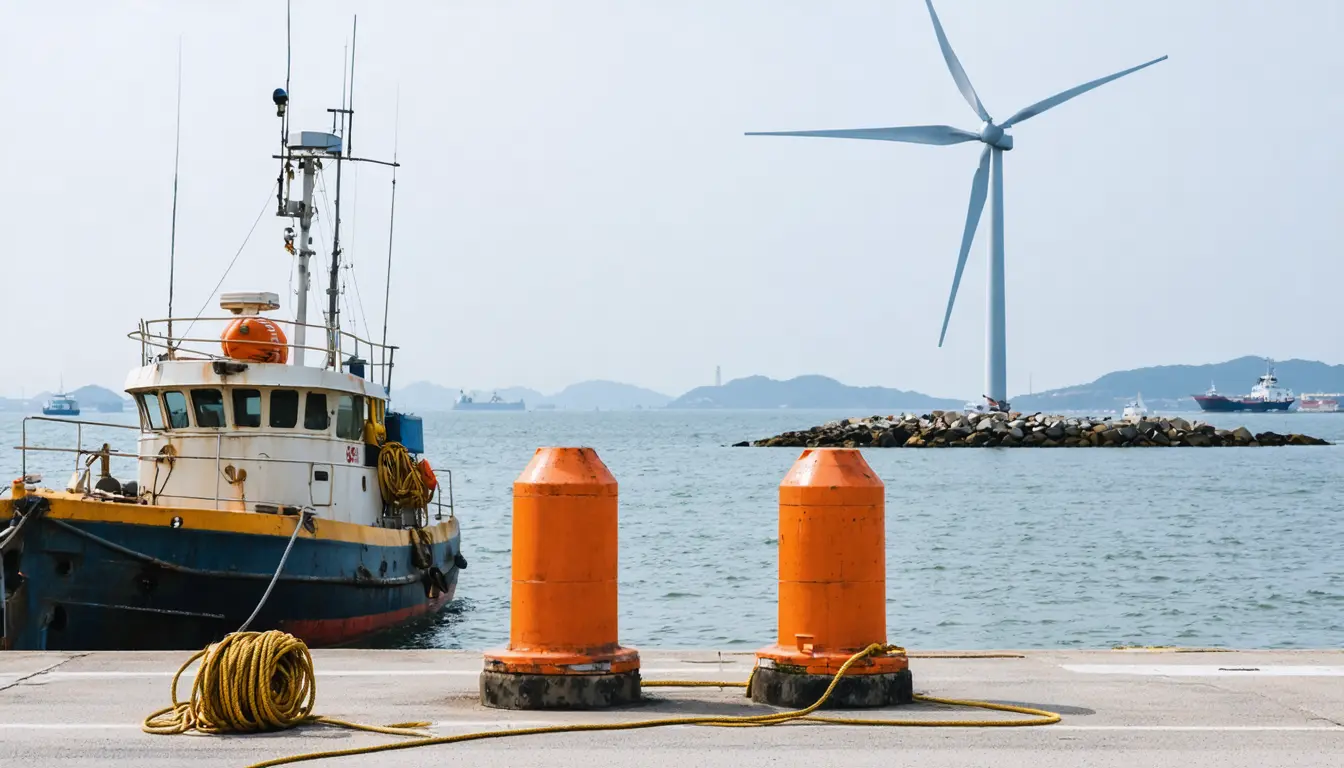
East Coast offshore wind pays fees on higher mainland land prices; West and South coast projects on low island prices. Ulsan firms cite gaps of more than several dozen times. Petrochemical plants hire separate safety managers; shipbuilders seek the E-7-3 quota; firms replace tarpaulin.
- cost East Coast offshore wind Few islands, so fees follow higher mainland land prices nearest the waters, claim 11
- exposure West and South coast wind Island-dotted coasts, so fees follow low island land prices, claim 11
- contradiction Ulsan companies Say fee differences of more than several dozen times arise depending on whether islands are nearby, claim 12
- cost Petrochemical plants Separate safety managers and deputies required, as different laws cover each piece of equipment, claim 2
- constraint Shipbuilders Ask to keep the E-7-3 foreign skilled-worker quota temporarily raised in 2023, claim 5
- cost Firms without steel ordinances Spend hundreds of millions of won every three to four years replacing tarpaulin, claim 7
| Who | How | Kind | Claim |
|---|---|---|---|
| East Coast offshore wind | Few islands, so fees follow higher mainland land prices nearest the waters | cost | 11 |
| West and South coast wind | Island-dotted coasts, so fees follow low island land prices | exposure | 11 |
| Ulsan companies | Say fee differences of more than several dozen times arise depending on whether islands are nearby | contradiction | 12 |
| Petrochemical plants | Separate safety managers and deputies required, as different laws cover each piece of equipment | cost | 2 |
| Shipbuilders | Ask to keep the E-7-3 foreign skilled-worker quota temporarily raised in 2023 | constraint | 5 |
| Firms without steel ordinances | Spend hundreds of millions of won every three to four years replacing tarpaulin | cost | 7 |
What happened
- Fees for offshore wind use of public waters follow the price of the nearest land, so island-dotted West and South coasts get low island prices while the East Coast pays on higher mainland prices.
- Ulsan companies asked for a separate calculation standard based on the characteristics of offshore wind projects and the use value of the sea instead of nearby land prices.
- Petrochemical firms must hire separate safety managers and deputies because different laws cover hazardous-material tanks, high-pressure gas facilities and boilers.
- The Building Act decree allows only tarpaulin and synthetic resin for simple factory warehouses, and steel plate is left to local ordinances that only some regions have revised.
- Shipbuilders asked to keep the E-7-3 foreign skilled-worker quota, temporarily raised in 2023, and to widen the jobs open to those workers' spouses.
Why it matters
- decision The task force must choose between keeping the nearest-land rule and writing a separate offshore wind standard based on the use value of the sea.
- cost Plants staff every shift around the clock, so each separate safety manager and deputy post is repeated across shifts and the cost recurs in payroll.
- constraint The several-dozen-times gap is the Ulsan companies' own estimate as relayed by the chamber, and the account gives no per-project charges, so the size of the problem cannot be checked from this submission.
Because the fee follows the land price nearest the water, projects using the same sea can carry very different charges depending on what stands on the closest shore [11]. Ulsan companies put the gap, or rather their estimate of it, at more than several dozen times [12]. If the fee moves in proportion to that land price (an assumption on our part), the reference parcels differ by about the same multiple.
We think the complaint is right on its logic: whether an island happens to be nearby has no evident bearing on what use of the seabed is worth. The counter-thesis has some force. A nearest-land rule is at least a single rule, and the request comes from the companies that pay the fee. A separate standard built on the use value of the sea [13] could also raise charges on the West and South coasts, where nearby islands now hold fees down [11]. We would call our view wrong if charges for comparable projects on the two coasts, set side by side, fall within a narrow band.
The other proposals share the shape of a fixed rule that forces repeat spending. One plant manager who attended a roundtable said staff with five or six certificates still cannot take on concurrent posts, and asked the government to create a basis for letting them serve concurrently as deputy where safety is not compromised [4]. For warehouses, companies in regions with no steel-plate ordinance carry the risk that typhoons damage the buildings and pay hundreds of millions of won for new tarpaulin every three to four years, and they asked that the decree be revised so steel plate is allowed anywhere in the country [7].
Lee Jong-myung, head of the KCCI's industrial growth division, said reform should correct the system itself where the same problem comes up in several regions, and handle the remaining issues in ways that fit local conditions [8]. The 75 proposals came from roundtables at five regional chambers [1]. The chamber plans to visit the Mokpo and Gwangju chambers in the fourth quarter [9], which would make seven chambers in all [10].
What to watch
- Whether the regulatory reform task force takes up a separate offshore wind fee standard, and what it would use in place of nearby land prices.
- Actual occupancy charges for named projects on the East Coast and on the island-rich West and South coasts, which would test the several-dozen-times claim.
- Whether the Building Act decree is revised to allow steel plate for simple warehouses nationwide.
Clarity's read
What the record supports and how the coverage leans. The claims behind it follow.
Reality
- Evidence35
- Adoption
- Insufficient
- Hype gap+20
- Incentives70
- Confidence55
Claim ledger
Ranked by verification strength, evidence, and original report placement.
- [1]
The Korea Chamber of Commerce and Industry said on the 15th that it had gathered 75 proposals from companies through regulatory roundtables held at five regional chambers of commerce (northern Chungcheongnam-do, Hwaseong, Ulsan, Yeosu and Daejeon) and submitted them to the public-private regulatory reform task force.
- [2]
The petrochemical industry must secure separate safety managers and deputies because different laws apply to each piece of equipment, including hazardous-material tanks, high-pressure gas facilities and boilers.
- [3]
Companies assign safety personnel to each shift because operations run around the clock, and the legal basis for letting an employee with multiple certifications serve concurrently as safety manager and deputy under different laws is unclear, making additional hiring unavoidable.
- [4]
One plant manager who attended a roundtable said that even when the company hires employees holding five or six certificates, they cannot hold concurrent posts, and urged the government to establish grounds for allowing concurrent service as a deputy where safety is not compromised.
- [5]
The shipbuilding industry, which relies heavily on foreign labor, asked that the quota for hiring foreign general skilled workers (E-7-3), temporarily raised in 2023, be maintained, and proposed broadening the jobs open to those workers' spouses to include manufacturing and other key regional industries.
- [6]
For simple warehouses on factory grounds, the enforcement decree of the Building Act currently permits only tarpaulin and synthetic resin, leaving more durable steel plate to local ordinances, and only some regions that have revised their ordinances allow steel plate.
- [7]
Companies in areas without such ordinances bear the risk of typhoon damage and spend hundreds of millions of won every three to four years replacing tarpaulin; they asked that the enforcement decree be revised so steel plate can be used for simple warehouses anywhere in the country.
- [8]
Lee Jong-myung, head of the KCCI's industrial growth division, stressed that regulatory reform should fix the system where problems are raised repeatedly across multiple regions, while resolving other issues in ways suited to local conditions.
- [9]
The chamber plans to continue the roundtables in the fourth quarter with its regulatory reform committee, visiting the Mokpo and Gwangju chambers to collect further proposals from the field.
- [10]
Five chambers have held roundtables and two more (Mokpo and Gwangju) are planned, making seven chambers in all.
- [11]
Occupancy and usage fees for public waters used by offshore wind facilities are currently set based on the price of the land closest to the waters, so projects using the same sea can face sharply different charges: the island-dotted West and South coasts benefit from low island land prices, while the East Coast, where islands are scarce, is subject to higher mainland land prices.
- [12]
Companies in Ulsan said fee differences of more than several dozen times arise depending on whether islands are nearby.
- [13]
The Ulsan companies asked the government to create a separate calculation standard that reflects the characteristics of offshore wind projects and the use value of the sea rather than nearby land prices.
Get this ledger inside ChatGPT. Ask about any of our stories and the answer brings its figure, each claim’s verdict and the sources. Free, no account.
Sources
1 independent publisher whose own reporting we read for this story.
- en.sedaily.comWhy Price Offshore Wind Fees by Land Value? Chambers Submit 75 Complaints
1 article · October 14, 2026
Topics and entities
Follow any of these and your For You feed starts watching them — no settings page required.
Topics
- South Korean industrial policyFollow
- Offshore wind policyFollow
- Regulatory reformFollow