ScienceNot yet confirmed elsewhere1 publisher2 min readPublished
Deep-sea sulfide rocks combusted on their own after USGS scientists dried and crushed them
USGS researchers say two of 57 seafloor sulfide rocks from the Escanaba Trough heated past 100 C on their own in the lab. The agency says the hazard deserves attention before anyone mines these deposits, on evidence so far limited to processed samples from a single trough.
The Scientist · Science desk
What happened
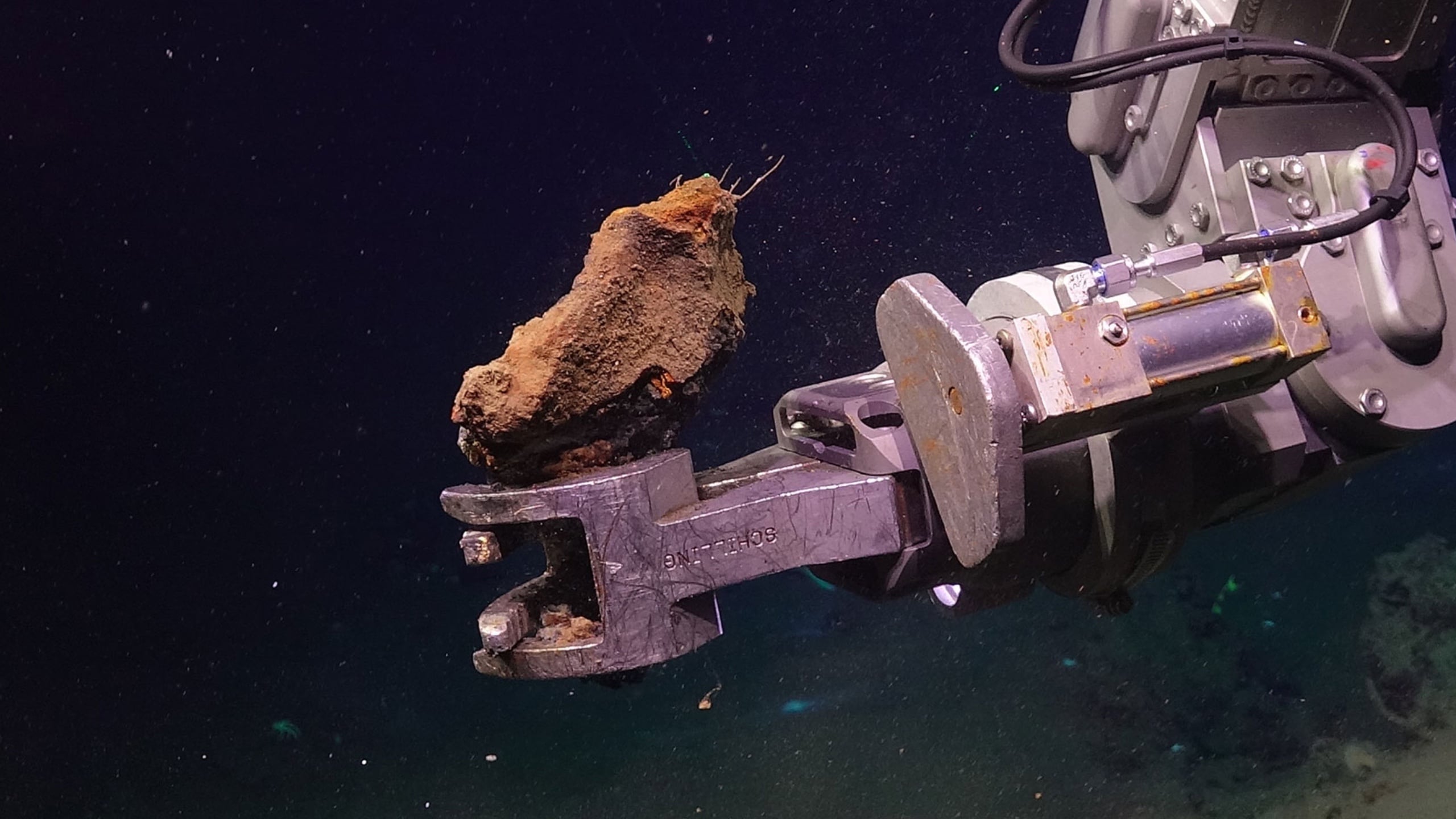
- The USGS collected the rocks in 2022 on a survey of the Escanaba Trough, run with the Bureau of Ocean Energy Management and NOAA.
- Researchers freeze-dried and crushed the samples in the laboratory, and two of them spontaneously combusted.
- Both rocks that burned were made mostly of nanocrystalline marcasite, a form of iron sulfide.
- The International Seabed Authority has granted sulfide exploration contracts on the Northern Mid-Atlantic Ridge and the Southwest Indian Ridge.
Why it matters
- exposure The paper's authors put the fire risk on ships, saying heat from these reactions has not been studied in seafloor sulfide deposits and could start fires quickly.
- constraint Handling practice carried over from land mining may not fit, since the USGS says some seafloor sulfides could behave very differently from comparable land deposits.
- decision Marcasite content gives operators and regulators a specific property to screen ore for, though ScienceAlert notes that not every marcasite-bearing rock is a hazard.
Two of 57 is about 3.5 percent of the haul [21]. Most of the 57 rocks had metal sulfides as a major mineral [8], so the other 55 [22] are a useful comparison set: sulfide-rich rock from the same four regions of the same trough [7] that did not ignite. The reaction completely oxidized the two that did [2].
That contrast let the team look for what set the pair apart. They compared mineralogy, chemical composition and thermal behavior across the samples [20]. Petroleum is one known route to self-heating. Heavy sedimentation on the deep seafloor can produce hydrothermal petroleum that ends up hidden inside sulfide minerals, and on land that material can heat itself [12]. Tar and petroleum did not appear to be the cause here [13]. Marcasite appears to be especially unstable in the presence of oxygen [15]. Heat and mechanical forces such as crushing, breaking and grinding can supply the energy to start it oxidizing, and the oxidation can then heat the rock [16].
With only two reactive samples, the marcasite result is an association across a small set, supported by a plausible chemical route. The thing this doesn't tell you is how ore behaves on its way up from the seafloor, wet and whole. The reported tests were on rock that had been freeze-dried and crushed [9]. The USGS said mined rock "would experience conditions dramatically different from those on the seafloor, including exposure to oxygen and changes in temperature, pressure, and moisture," and that "Such changes could affect how sulfide minerals react and how much heat they generate" [19].
The agency's own wording is measured. It calls this a "potential hazard that could merit special consideration if deep-sea mining of seafloor massive sulfide deposits moves forward" [4]. We think that is the strength the evidence earns. Two samples from one site show that some seafloor sulfide rock can heat itself past 100 C once it has been processed [2][9]. A rate that ship designers or regulators could apply to other deposits would need samples from those deposits, and there is time to collect them: no seafloor sulfide mining has taken place [11]. The paper itself is an early Scientific Reports release, posted before full editing [3].
What to watch
- Thermal tests on sulfide samples from the ISA contract areas on the Northern Mid-Atlantic Ridge and Southwest Indian Ridge, to see whether the self-heating shows up outside the Escanaba Trough.
- Any test of wet, uncrushed sulfide rock under shipboard conditions, which would show whether the ship-fire risk the paper describes holds before processing.
- The final edited version of the Scientific Reports paper, and whether its findings change from the early release.
Clarity's read
What the record supports and how the coverage leans. The claims behind it follow.
Reality
- Evidence40
- Adoption
- Insufficient
- Hype gap+25
- Incentives
- Insufficient
- Confidence45
Claim ledger
Ranked by verification strength, evidence, and original report placement.
- [1]
In 2022, two samples of metal-sulfide rocks collected from the deep seafloor spontaneously combusted.
- [2]
The combustion event caused temperatures above 100 C in the lab and completely oxidized the original samples.
- [3]
The article on the discovery, published in Scientific Reports, is being shared early, before full editing.
- [4]
"potential hazard that could merit special consideration if deep-sea mining of seafloor massive sulfide deposits moves forward"
- [5]
The rocks were collected by the USGS in 2022 during a deep-sea investigation of the Escanaba Trough, in collaboration with the Bureau of Ocean Energy Management and NOAA.
- [6]
The Escanaba Trough sits in the US Exclusive Economic Zone off the Oregon-California border, where hydrothermal activity has created deposits rich in copper, zinc and iron.
- [7]
Using a remotely operated vehicle, researchers collected 57 hydrothermal rock samples from four regions in the trough.
- [8]
Most of the samples contained metal sulfides as a major mineral.
- [9]
When researchers freeze-dried and crushed the samples in the laboratory, two of them spontaneously combusted.
- [10]
The International Seabed Authority has granted exploration contracts for sulfide minerals on the Northern Mid-Atlantic Ridge and the Southwest Indian Ridge.
- [11]
Mining of these sulfide deposits has not yet taken place.
- [12]
Heavy sedimentation in the deep ocean can promote the formation of hydrothermally derived petroleum, which can be hidden within metal sulfide minerals and can self-heat on land.
- [13]
Tar and petroleum did not seem to be the cause of the self-combustion.
- [14]
The self-combusting rocks were made mostly of nanocrystalline marcasite, a form of iron sulfide.
- [15]
Nanocrystalline marcasite appears to be especially unstable in the presence of oxygen.
- [16]
Heat and mechanochemical forces such as crushing, breaking and grinding can supply energy to initiate oxidation of the marcasite, and the oxidation can lead to self-heating.
- [17]
Not every rock on the ocean floor containing marcasite is a hazard.
- [18]
"The new research suggests that some seafloor massive sulfide rocks have physical and chemical properties that could make them behave very differently from comparable mineral deposits mined on land"
- [19]
"If seafloor massive sulfide mining occurs, rocks brought to the surface would experience conditions dramatically different from those on the seafloor, including exposure to oxygen and changes in temperature, pressure, and moisture." "Such changes could affect how sulfide minerals react and how much heat they generate."
- [20]
Researchers compared the mineralogy, chemical composition and thermal behavior of the samples collected in 2022.
- [21]
About 3.5 percent of the 57 samples spontaneously combusted.
- [22]
55 of the 57 samples did not combust.
- [23]
"The production of heat through exothermic reactions has not been investigated in seafloor massive sulfide deposits but has the potential to cause rapid onset fires on ships"
ReportedInsufficientSource: The Scientific Reports paper, as quoted by ScienceAlertView cited source
Sources
1 independent publisher whose own reporting we read for this story.
- sciencealert.comScientists Collected Deep-Sea Rocks. They Spontaneously Caught Fire in The Lab.
1 article · October 10, 2026
Topics and entities
Follow any of these and your For You feed starts watching them — no settings page required.
Entities
- US Geological SurveyFollow
- International Seabed AuthorityFollow
- Bureau of Ocean Energy ManagementFollow
- NOAAFollow
- Escanaba TroughFollow
- Scientific ReportsFollow
- MarcasiteFollow